
Once Creating Multiple "Firsts," Now Shedding Military Mark, the "Maritime Vanguard Ship" Retires from Service
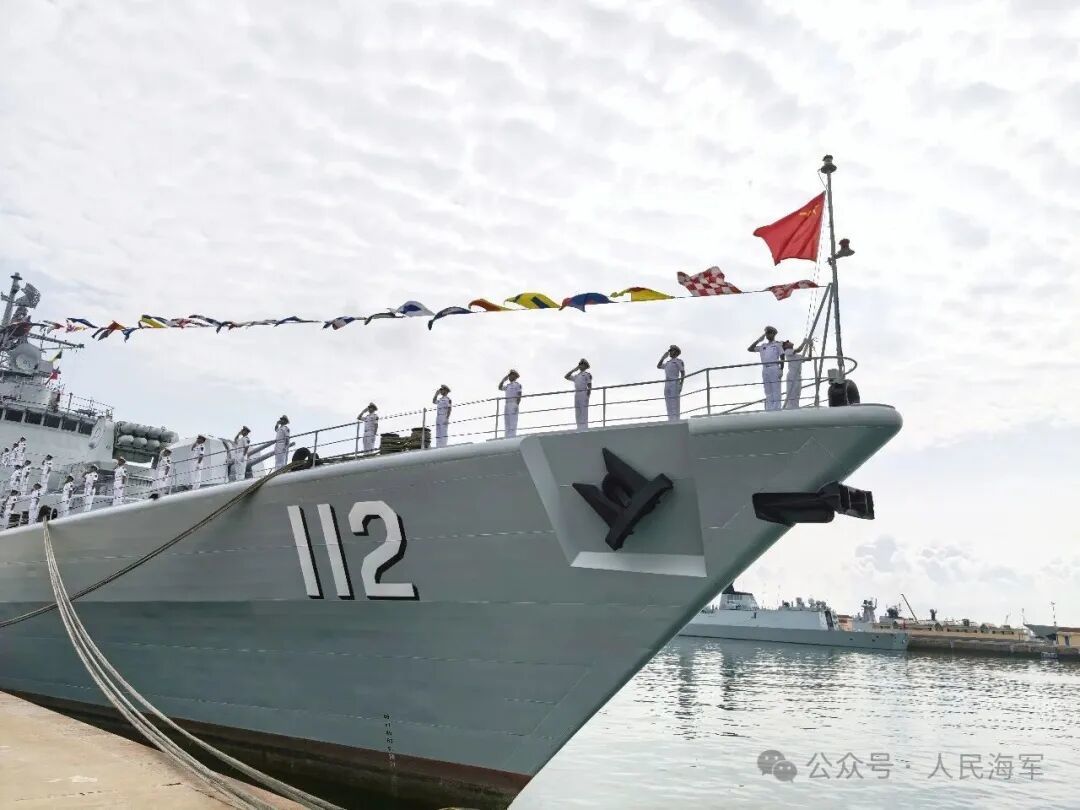
[Global Times reporters Guo Yuandan, Global Times special correspondents Wang Guanfeng, Liu Gang, Liu Peiran] The first ship of China's second-generation domestically produced missile destroyer, the 112 ship (ship name: Harbin), known as the "first ship of China," officially retired from active service at a military port in Qingdao on the morning of August 28. With the issuance of the "112 ship retirement" order, the August 1 military flag at the bow of the 112 ship was lowered for the last time, marking the official withdrawal of this warship, which has served for 32 years, from the combat sequence of the People's Navy. The 112 ship is the first ship of the 052-class missile destroyer, a second-generation main battle vessel independently developed and built by China, and is a landmark equipment signifying a significant leap in the combat capabilities of the Chinese Navy's surface vessels. During its more than 30 years of military service, the 112 ship has achieved multiple "firsts." In 2003, the Central Military Commission awarded the 112 ship the honorary title of "Maritime Pioneer Ship." The retirement ceremony is a form of respect, and according to tradition, its ship name will be inherited by a new generation of combat vessels.
Removing all military markings
At 7:05 PM on the 27th, at a military port in Qingdao, the 112 ship quietly docked at the pier, and the announcement for "beginning the big cleanup" echoed in the cabin. Crew member Wei Yun knew this was the last evening cleanup he and his comrades would conduct as crew members of the 112 ship, and everyone carried out the tasks according to standard procedures as usual.
At 7:20 AM on the 28th, the announcement for cleaning the deck in various areas sounded in the cabin. In the broadcast room, the ship's amplifier was still operating normally, but the screws had already loosened; this would be the last military equipment to be dismantled on the ship.
At 9:00 AM sharp, the retirement ceremony for the 112 ship began. The crew lined up from the bow to the stern of the ship to hold the last standing ceremony on board, giving their final salute to this warship that has carried countless tracks and memories, paying their last respects. With a command, the whistle sounded, and the military flag at the bow and the naval flag at the stern were slowly lowered, officially marking the end of the 112 ship's maritime combat career and concluding the warship's military journey.
At around 5 PM, the 112 ship removed all military markings, shedding its "military uniform," and departed from the countless docks it had visited. In the future, the 112 ship will serve as a national defense education base, docked in Changsha, Hunan Province, the hometown of the People's Navy's first commander, Xiao Jinguang, for citizens and tourists to visit and learn.
On May 8, 1994, the 112 ship was officially commissioned. As a pioneer of China's second-generation destroyers, its commissioning marked a generational leap for the Chinese Navy's vessels from coastal defense to deep-sea operations. "The 112 ship was the first truly ocean-capable domestically produced destroyer of the Chinese Navy at that time," military expert Zhang Junsha told Global Times reporters on the 28th. "Before the 112 ship, China's first-generation missile destroyers focused solely on anti-ship or air defense capabilities and could not handle multiple tasks. The second-generation missile destroyers represented by the 112 ship integrated air defense, anti-ship, and anti-submarine weapons, truly possessing comprehensive combat capabilities."
Former crew member Meng Lei told Global Times reporters that in addition to improvements in weaponry performance, the 112 ship's power system also saw significant upgrades, "transitioning from the steam boiler used on the 101 ship to gas turbines." Furthermore, the logistics support capabilities of the 112 ship have also greatly improved.
As a result, the 112 ship achieved multiple "firsts" in the history of the People's Navy: the first voyage beyond the island chain, the first crossing of the Pacific to visit the American continent, and so on. Over the past 32 years, the 112 ship has completed over a hundred major combat readiness training tasks and safely navigated more than 400,000 nautical miles.
Laying the foundation for the new generation of vessels
Declassification and demilitarization are core steps in the disposal of decommissioned vessels. The ship needs to dismantle missile, radar, sonar, and other classified electronic equipment, clear classified data on board, and eliminate military combat functions before it can be transferred for other uses such as national defense education and exhibitions.
"Being able to witness the retirement of a warship in its entirety and personally participate in the subsequent disposal process is a rare experience. It is precisely because I participated in this disposal process that I truly understood it," crew member Li Hang told Global Times reporters. "This opportunity to see the maritime professional equipment completely dismantled from inside to outside is not available in school, nor is it possible on other active vessels; only at the moment of disassembly can one truly see the 'true face of Lushan'."
Regarding the 112 ship, which was launched in 1991, Li Hang stated, "On a larger scale, whether in terms of hull structure or deck areas, the craftsmanship level from 35 years ago has withstood the test of time, being both solid and refined. Throughout its more than 30 years of service, the equipment on board has continuously iterated, with many technologies validated in real sea conditions feeding back into subsequent models, laying the foundation for the new generation of vessels, with excellent performance in actual combat."
Global Times reporters noted that compared to the new vessels docked nearby, the era characteristics of the 112 ship are very obvious, such as various radars, antennas, and onboard equipment being exposed, lacking the stealth design treatment of modern vessels.
"The pioneer ship of that time was equipped with the most advanced naval guns." Standing under the naval gun on the deck of the 112 ship, former crew member Fu Suoyan reminisced, "With the rapid development of the navy, my old buddy has gradually become somewhat outdated, even though we did undergo a modification once."
In recent years, the People's Navy has seen a concentrated commissioning of new vessels, with new combat capabilities rapidly taking shape. On January 12, 2020, the first ship of the 055-class destroyer, Nanchang, was commissioned in Qingdao, marking the transition of the Chinese Navy's destroyers from the third generation to the fourth generation. Subsequently, several 10,000-ton 055-class destroyers, such as Lhasa and Anshan (hull number 103), were commissioned in succession. On November 5, 2025, the commissioning of the Fujian marked the official arrival of the People's Navy's "three aircraft carrier era."
From Harbin to Luohe
Docked at the same pier, adjacent to the 112 ship, is the first ship of the 054B frigate, Luohe (hull number 545). On January 22, 2025, Luohe was officially handed over and commissioned. Luohe has made breakthroughs in stealth technology, combat command systems, and firepower integration control, possessing strong comprehensive combat and diverse military task capabilities, which is of great significance for enhancing the overall combat effectiveness of naval vessel formations.
"The operating interface is more intuitive and clear, the processes are simpler and more convenient, and the system response speed has significantly improved," said Luohe crew member Wang Jinxie. In April 2025, Wang Jinxie transferred from the 112 ship to Luohe, and he could clearly feel the comprehensive technological updates of the new secondary gun.
Wang Jinxie said, "Luohe has higher requirements for comprehensive capabilities; for example, there is a lot of new knowledge to learn in firepower integration control, but with the understanding and experience accumulated from operating the secondary gun on the 112 ship, I adapted quickly."
This is precisely the positive cycle of talent cultivation between new vessels and traditional vessels: the solid qualities honed on old ships enable talents to quickly adapt and operate efficiently on new platforms; while the challenges posed by new equipment, in turn, drive them towards more comprehensive growth.
After participating in the retirement ceremony of the 112 ship, Fu Suoyan said, "Just like people, warships also go through a process from youth to old age; they have had their youth and glory, but ultimately new forces will come to continue their journey. We now have three aircraft carriers, so many large destroyers, and other new vessels; these new combat capabilities, once they 'grow up and mature,' will definitely perform better than the 112 ship, and our navy's tracks will surely extend further."
The People's Liberation Army Navy decommissioned the 112 destroyer, known as 'Harbin', during a ceremony in Qingdao on August 28, 2023. This vessel served for 32 years and was the first of the second generation of Chinese destroyers, symbolizing a major advancement in naval capabilities. Following its decommissioning, the ship will be repurposed as a national defense education base.
- The 112 destroyer, known as 'Harbin', was decommissioned after 32 years of service.
- It was the first of the second generation of Chinese destroyers and marked a significant advancement in naval capabilities.
- The decommissioning ceremony took place in Qingdao on August 28, 2023.