
One E-3 AWACS Attacked, Multiple Aerial Refueling Aircraft Damaged: How Will Iran's Heavy Counterattack Affect the War?
[Global Times Comprehensive Report] The U.S. Air Force and Space Force Magazine website revealed on the 28th that the U.S. Air Force stationed at the Prince Sultan Air Base in Saudi Arabia suffered significant losses during Iran's missile and drone joint attack on the base on the 27th. Satellite imagery and photos from social media show that at least one E-3 AWACS and multiple KC-135 refueling aircraft were severely damaged in the airstrike. The report cites analysis from U.S. experts stating that these losses are likely to have a lasting impact on U.S. military operations.
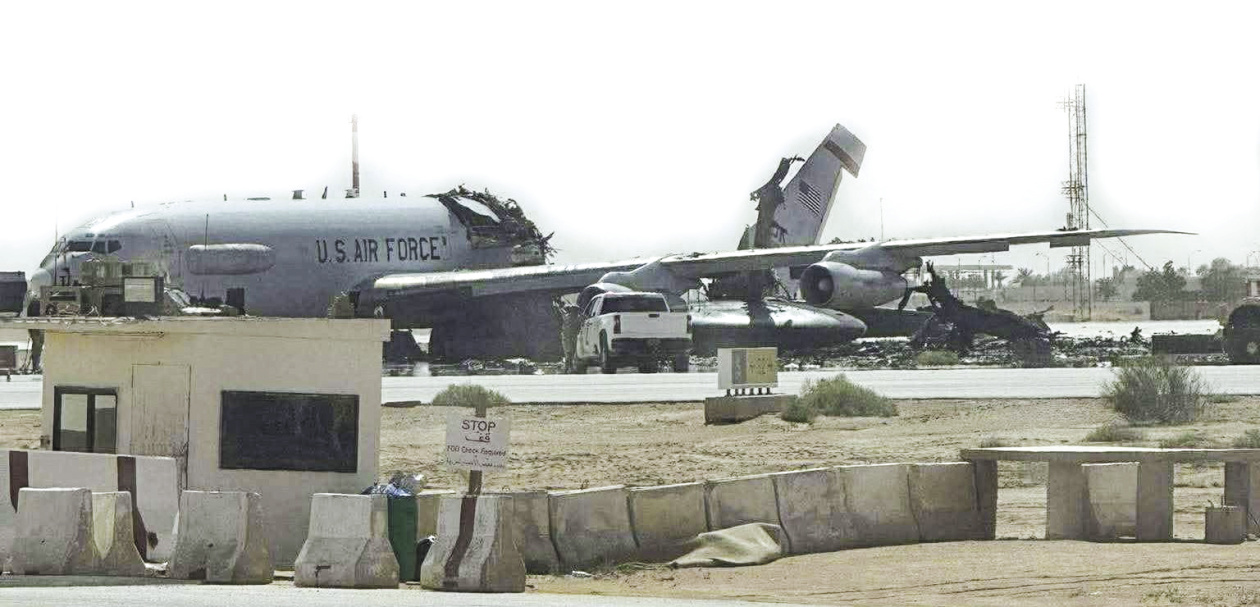
The report states that the airstrike resulted in injuries to more than ten U.S. servicemen at the base, with two sustaining serious injuries. In terms of equipment losses, related photos and other evidence indicate that the damage to one E-3 AWACS is likely irreparable, signifying a permanent loss.
According to publicly available flight tracking data, there were six E-3 AWACS stationed at the Prince Sultan Air Base prior to Iran's airstrike. U.S. experts told the Air Force and Space Force Magazine that losing this E-3 will create a gap in the U.S. Air Force's battlefield awareness and management, potentially causing the U.S. military to miss opportunities to strike Iranian forces. Penny, the research director at the Mitchell Institute for Aerospace Studies, stated that the E-3 AWACS is a core battlefield manager for the U.S. Air Force, essential for airspace coordination and target identification; its damage will directly hinder the U.S. military's battlefield control capabilities, and fighter pilots will lose critical battlefield situational support. "They are the chessboard controllers, while fighter pilots are merely the pieces."
What further concerns the U.S. Air Force is that the E-3 AWACS, which has been in service since the 1970s, is aging, its capabilities lagging behind those of "major adversaries," and its numbers are dwindling. Currently, the U.S. Air Force has only 16 E-3 AWACS, and with an operational capability rate of about 56% for the E-3 in fiscal year 2024, this means that only 8 E-3s are available for immediate deployment on missions. They are almost all deployed in the Middle East, responsible for coordinating military operations against Iran. With almost no replacements available, Penny stated that losing this E-3 will place a greater workload on the other E-3 AWACS.
Moreover, the permanent loss of this E-3 will have long-term implications. The report indicates that after the conclusion of the U.S.-Israel-Iran conflict, the U.S. Air Force's AWACS losses will be difficult to quickly replenish, further exacerbating their predicament.
The U.S. website "Power" reported on the 29th that, in addition to the AWACS, several aerial refueling aircraft were also damaged in this airstrike. Previous statistics from U.S. media indicated that the U.S. Air Force has already lost at least 5 refueling aircraft in this conflict. As U.S. Air Force fighter jets need to take off from air bases in Israel and Jordan to evade Iranian missile attacks and strike targets within Iran, they require two or even three aerial refuelings throughout the mission. Therefore, the U.S. Air Force's refueling fleet stationed in the Middle East is under immense operational pressure. However, the primary model performing refueling tasks is the KC-135, developed in the 1950s and 1960s, which is severely aging and faces reliability issues when executing high-intensity aerial refueling missions for extended periods.
Although U.S. Central Command Commander Brad Cooper stated on March 25 that since the outbreak of conflict on February 28, the number of Iranian missile and drone launches has decreased by over 90%, this attack indicates that Iran still retains long-range strike capabilities and continues to target key U.S. bases and core objectives in the region. U.S. defense policy expert and senior fellow at the Stimson Center Kelly Grieco believes that Iran is implementing "asymmetric counter-air operations" by precisely targeting key U.S. military radar, communication facilities, and aircraft, thereby weakening the U.S. military's air power projection capabilities. (Chen Shan)
Iran launched a missile and drone attack on the Prince Sultan Air Base on the 27th, damaging at least 1 E-3 AWACS and multiple KC-135 tankers. The attack resulted in injuries to over 10 U.S. military personnel, with two sustaining serious injuries. The loss of the E-3 AWACS is expected to significantly impact U.S. military operations in the region.
- At least 1 E-3 AWACS and multiple KC-135 tankers were severely damaged in the attack.
- Over 10 U.S. military personnel were injured, with two in serious condition.
- The loss of the E-3 AWACS is expected to have a lasting impact on U.S. military operations.
- Iran retains long-range strike capabilities despite a reported decrease in missile launches.
- The aging E-3 AWACS fleet poses reliability concerns for U.S. operations.