
One F-15EX at Kadena Will Not Fix America’s Okinawa Airpower Gap
 Marcus Chen
One F-15EX at Kadena Will Not Fix America’s Okinawa Airpower Gap
One F-15EX Eagle II landed at Kadena Air Base on June 29 with two F-15E Strike Eagles. That is the useful number to start with. The aircraft is not a squadron, not a permanent combat package, and not yet a replacement for the F-15C/D force that made Okinawa the U.S. Air Force’s most important fighter outpost in the western Pacific. It is a test and integration visit. The problem is that China is not presenting Washington with an integration problem. It is presenting a sortie-generation problem.
U.S. Pacific Command said the jet, assigned to the 85th Test and Evaluation Squadron at Eglin, returned to Kadena after an inaugural visit last year. The stated purpose is sensible: pilots, maintainers, mission support crews and the 18th Wing need time with the aircraft before the Eagle II becomes part of daily operations. Anyone who has served around a flight line knows that a new aircraft does not become combat power when the press release drops. It becomes combat power when fuel, weapons, spares, software, ground support equipment and maintainers all start moving at the same rhythm.
Kadena Is Getting Familiarity Before Mass
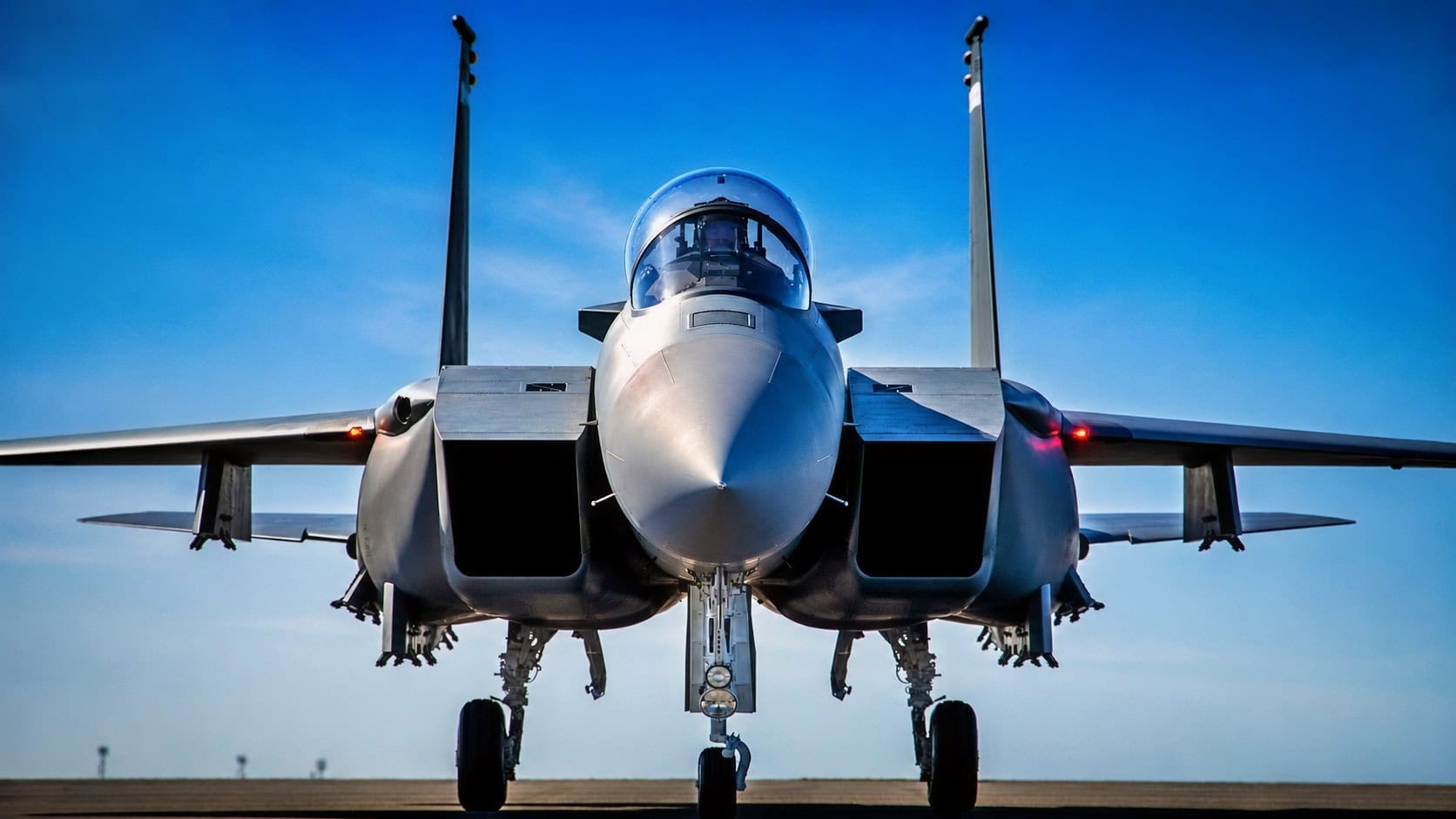
The 67th Fighter Squadron is slated to become Kadena’s first operational F-15EX unit, according to the command release. Air & Space Forces Magazine lists the planned Kadena force at 36 F-15EX aircraft, part of a U.S. Air Force program now expected to buy 104 Eagle IIs rather than the earlier 144-aircraft ambition. Boeing advertises the jet as a heavy weapons truck: Mach 2.5 maximum speed, 29,500 pounds of payload, 20,000-plus hours of service life, and carriage for up to 12 AMRAAM-class air-to-air missiles.
That payload matters. A four-ship of F-15EXs configured for counter-air can put dozens of missiles into the air, and the aircraft has the power and cooling margin to keep taking software and sensor upgrades. It is also compatible with much of the F-15 ecosystem, which makes the Kadena transition less painful than moving an entirely new fifth-generation airframe onto the island.
But the aircraft is not stealthy. That does not make it obsolete. It does mean the Eagle II needs a concept of employment that keeps it alive against Chinese long-range sensors, ballistic missiles, cruise missiles and aircraft. The F-15EX is best understood as a magazine and command node that can launch from defended bases, carry a large weapons load, work with F-35s and future collaborative combat aircraft, and push effects forward without pretending to be an F-22.
The Map Still Favors China
Kadena sits roughly 400 miles from Taiwan and roughly 450 miles from the Chinese coast. That is close enough to matter and close enough to be hit. China does not need to defeat every F-15EX in the air if it can slow fuel delivery, crater runways, saturate missile defense, or force the wing into dispersal before the first day of a Taiwan contingency is over.
This is where official modernization language becomes too neat. Replacing old F-15C/Ds with new F-15EXs improves cockpit, radar, electronic warfare and weapons capacity. It does not by itself solve runway vulnerability, tanker exposure, magazine depth, or hardened shelter capacity. The fighter is only one variable in the equation. Kadena’s real combat value is sorties per day after the first missile salvo.
Assume 36 F-15EXs eventually arrive. If readiness holds at 70 percent, that gives about 25 mission-capable jets. If each can fly one serious combat sortie per day under missile pressure, the wing generates 25 heavy counter-air sorties. Under clean peacetime conditions, the number is higher. Under attack, with damaged pavement and crews moving between dispersed locations, it can fall fast. That is the gap.
China can mass aircraft from multiple mainland bases, back them with surface-to-air missile coverage, and force U.S. aircraft to operate from a smaller set of exposed islands. The F-15EX gives Kadena more weapons per jet, but it does not change the geography.
The Eagle II Is a Necessary Bet, Not a Complete Answer
The alternative is not attractive. Keeping tired F-15C/Ds in Japan was a structural risk and an operational dead end. Buying enough F-35s to do every mission is not realistic under current production, maintenance and cost constraints. The F-15EX is therefore a practical choice: fast to field compared with a clean-sheet aircraft, easier for F-15 units to absorb, and able to carry large weapons that stealth fighters cannot carry internally.
The danger is political overclaim. A single returning F-15EX makes a good visual signal. A 36-aircraft force would be a serious upgrade. Neither should be confused with an answer to China’s theater missile and sortie-generation advantage. The U.S. Air Force still needs more runway repair capacity, more pre-positioned munitions, more distributed fuel, more hardened shelters, and a credible plan to operate from austere locations after Kadena is under fire.
The F-15EX improves the numerator in the airpower equation. China is attacking the denominator: bases, fuel, runways, tankers and time.
What to Watch Next
The next useful indicators are not ceremonial arrivals. Watch whether Kadena receives permanent airframes on schedule, whether the 67th Fighter Squadron builds enough trained pilots and maintainers, and whether Pacific Air Forces pairs the Eagle II transition with visible base-hardening and dispersal work. Also watch munitions. A heavy fighter without enough AIM-120s, longer-range air-to-air missiles and standoff weapons is just a high-performance aircraft waiting for inventory to catch up.
The F-15EX belongs at Kadena. It is one of the few near-term ways to put more missile capacity inside the first island chain. But the June 29 visit is a reminder of how much of the fight sits outside the aircraft. America is adding a better fighter to Okinawa. China is building a system to make that fighter hard to launch, hard to refuel, and hard to sustain. Until Washington treats the base as seriously as the jet, the math still does not work.
An F-15EX Eagle II landed at Kadena Air Base on June 29, accompanied by two F-15E Strike Eagles, for integration and testing purposes. The U.S. Air Force plans to establish a force of 36 F-15EX aircraft at Kadena, but faces challenges from China's military capabilities. The introduction of the F-15EX is seen as a necessary upgrade, though it does not fully address vulnerabilities in U.S. airpower in the region.
- One F-15EX landed at Kadena Air Base on June 29, accompanied by two F-15E Strike Eagles.
- The F-15EX is part of a planned force of 36 aircraft at Kadena.
- The aircraft is intended for integration and testing, not immediate combat deployment.
- China poses a sortie-generation problem for U.S. airpower in the region.
- The U.S. Air Force needs to improve runway repair capacity and munitions pre-positioning.