
Paparo Yang Meeting Cannot Stabilize the Taiwan Strait in 2026
 S.W
S.WPaparo Yang Meeting Cannot Stabilize the Taiwan Strait in 2026
One sentence in a U.S. Pacific Command readout mattered more than the usual conference choreography: Adm. Samuel J. Paparo met Gen. Yang Zhibin in Victoria, Canada, from Aug. 31 to Sept. 2, and it was their first in-person meeting.
That is not a breakthrough. It is a necessary repair job on a military relationship that should never have been allowed to go dark. Yang commands the People's Liberation Army's Eastern Theater Command, the Chinese command responsible for the Taiwan Strait and the East China Sea. Paparo commands the U.S. force most likely to be pulled into a Taiwan or South China Sea crisis. If these two officers cannot speak directly during an incident, every radar return, radio warning, and unsafe intercept becomes more dangerous than it needs to be.
The meeting is useful. It is also too thin to carry the weight being placed on it.
The Channel Reopened Because the Operating Tempo Stayed High
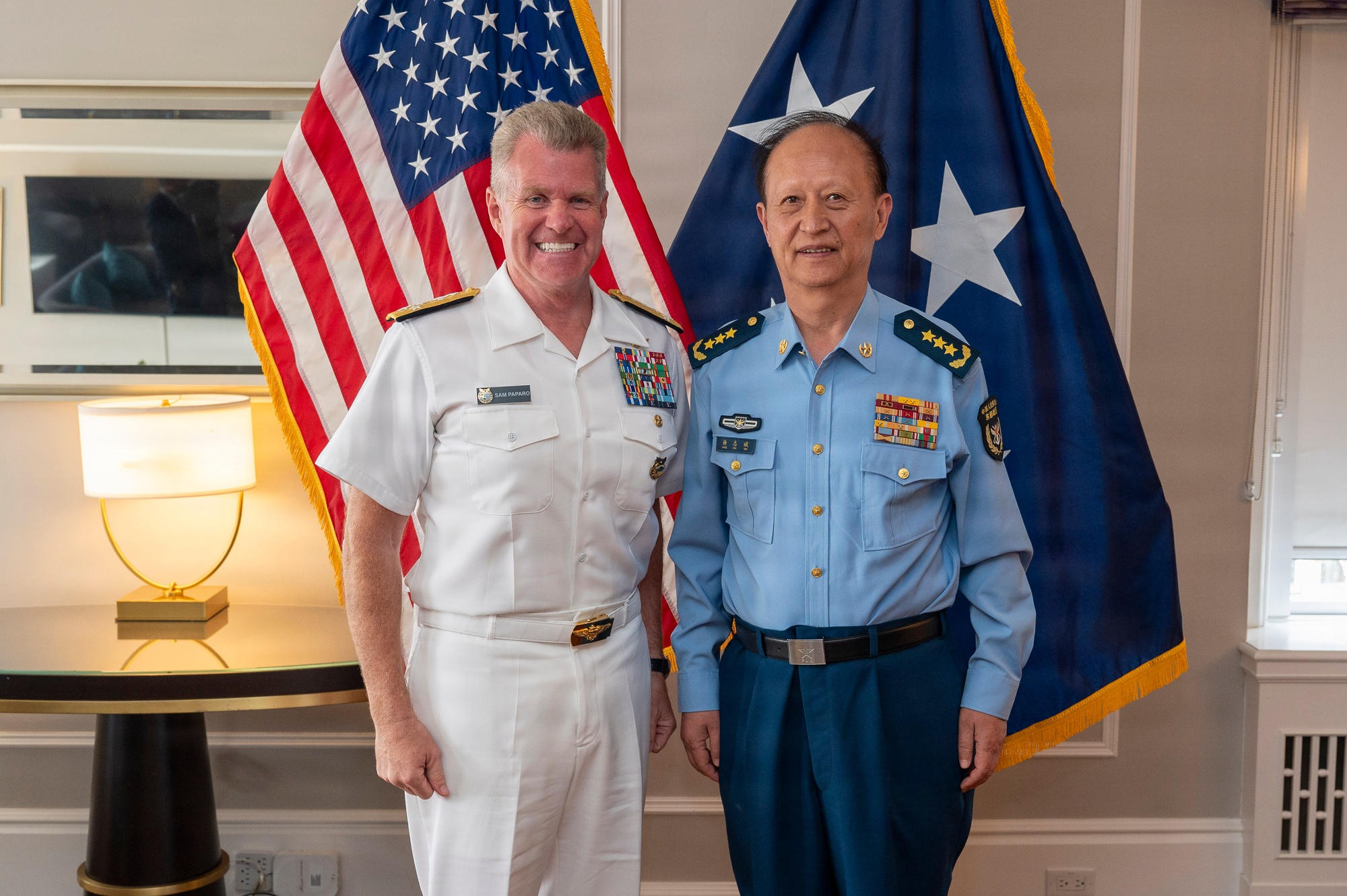
The official U.S. readout says Paparo met senior leaders on the sidelines of the 28th Indo-Pacific Chiefs of Defense Conference and held bilateral talks with military representatives from more than a dozen countries. The Yang meeting was listed near the end, but it was the most consequential item. According to the readout, the two discussed keeping open lines of communication to reduce miscalculation and promote safe, professional conduct between forces.
Militarnyi, citing U.S. Indo-Pacific Command and South China Morning Post reporting, noted the larger context: Beijing sharply reduced military contacts with Washington in August 2022 after the Taiwan crisis, and direct military dialogue has been rebuilt only in stages since the 2023 San Francisco leaders' meeting. That timeline matters because the operational environment did not pause while the phones were quiet.
PLA air and naval activity around Taiwan became more routine, not less. Chinese coast guard and maritime militia pressure around disputed South China Sea features continued. U.S., Japanese, Australian, Philippine, and other allied forces increased exercises, patrols, and access arrangements across the first island chain. The result is a crowded battlespace with too many ships and aircraft operating close enough for a tactical mistake to become a political crisis.
Yang Is Not Just Another Chinese General
Yang's title is the reason this meeting deserves attention. The Eastern Theater Command is the PLA command Beijing would rely on first in a Taiwan contingency. It is not a diplomatic shop. It is the formation that would coordinate air, naval, rocket, cyber, and ground components for coercion around Taiwan, from quarantine-style pressure to missile strikes and amphibious operations.
That does not mean Yang arrived in Canada to negotiate Taiwan policy. Chinese theater commanders do not freelance on sovereignty claims. But his presence gave Paparo something Washington has often lacked: a direct line to the officer whose headquarters would be issuing orders in the opening hours of a crisis.
Anyone who has served at sea knows the difference between a public statement and an operational channel. A statement says both sides want professionalism. A channel lets a commander ask, in real time, whether a fighter pass was authorized, whether a destroyer intends to alter course, or whether a missile exercise box has been properly broadcast. That kind of contact will not solve the dispute. It can prevent a bad watch floor from becoming the first chapter of a war.
The Math Still Points Toward Risk
The Taiwan Strait is roughly 180 kilometers wide at its narrowest point. A PLA aircraft crossing a notional median line can be minutes from Taiwan's air defense response cycle. A destroyer or frigate operating east of Taiwan can force Japanese and U.S. maritime patrol aircraft to build a track, classify the contact, and decide whether it is exercising, shadowing, or preparing to support a larger package.
That is the problem with treating crisis communication as a stabilizer by itself. It works best after an incident begins. It does not reduce the number of incidents generated by presence, patrols, and exercises.
The force structure also points in the wrong direction. China now fields the world's largest navy by hull count, backed by shore-based missiles, long-range air defense, and a growing inventory of aircraft, unmanned systems, and sensors covering the near seas. The United States still has better nuclear submarines, carrier aviation, long-range strike, and combat experience, but its Pacific posture depends on distance, access, maintenance capacity, and allied political decisions. A hotline does not change transit time from Guam. It does not reload a vertical launch cell. It does not make a Japanese or Philippine base automatically available in every scenario.
That is the gap.
Beijing Benefits From Talking While Pressing
There is a second uncomfortable point. Reopening military contacts serves both sides, but it does not require both sides to moderate behavior equally. Beijing can talk to Paparo on the sidelines of a conference while continuing to normalize pressure around Taiwan. Washington can welcome the meeting while continuing reconnaissance flights, freedom of navigation operations, and allied drills. The channel lowers accidental risk while leaving competitive operations intact.
For China, that can be useful. The PLA can present itself as a responsible great power while keeping the Eastern Theater Command active enough to wear down Taiwan's readiness and test allied responses. For the United States, the channel is useful for a different reason: it makes it harder for Beijing to claim Washington has no serious military mechanism for crisis control.
Neither side is being sentimental. They are building insurance while continuing to drive fast.
What Washington Should Take From the Meeting
The correct U.S. response is not to dismiss the Paparo-Yang meeting. It is to institutionalize it and then stop pretending communication is a substitute for readiness.
- First, the Paparo-Yang channel should be tested regularly, not saved for ceremonial conferences.
- Second, U.S. and Chinese commanders need incident-specific procedures for air and maritime encounters, especially around Taiwan and the South China Sea.
- Third, Washington should pair dialogue with the dull work that actually deters coercion: munitions stockpiles, airbase hardening, repair capacity, submarine availability, and allied access agreements.
The third point is where the United States usually underperforms. It is easier to announce a meeting than to fix ship maintenance delays or build enough long-range anti-ship missiles. It is easier to talk about deterrence than to calculate how many days of air defense interceptors Taiwan would burn through under sustained missile and drone pressure.
The meeting lowers the chance of stumbling into a crisis. It does not lower the chance that both militaries will keep creating conditions where a crisis can start.
A Useful Meeting Is Not a Stable Strait
Paparo and Yang needed to meet. The fact that they had not done so before September 2026 says more about the fragility of U.S.-China military management than about any new thaw.
The Taiwan Strait is not safer because two commanders shook hands in Canada. It is only marginally less blind. That is worth having, but it is not enough. The operational problem remains: dense forces, short distances, political red lines, and no shared definition of what routine military activity should look like near Taiwan.
If Washington wants stability, it should keep the phones open and count missiles, ships, runways, repair days, and allied permissions with the same seriousness. The conversation matters. The balance of force matters more.
Adm. Samuel J. Paparo met Gen. Yang Zhibin in Victoria, Canada, from August 31 to September 2, 2026, to discuss military communication and relations. The meeting aimed to reduce miscalculations and promote safe conduct between U.S. and Chinese forces. Despite the meeting, tensions remain high in the Taiwan Strait, with both sides continuing military activities. The dialogue is seen as a necessary step but insufficient to stabilize the situation.
- Adm. Samuel J. Paparo met Gen. Yang Zhibin in Victoria, Canada, from Aug. 31 to Sept. 2, 2026.
- The meeting aimed to reopen military communication channels between the U.S. and China.
- Yang commands the PLA's Eastern Theater Command, responsible for the Taiwan Strait.
- The operational environment remains tense with increased military activities from both sides.
- The meeting does not resolve underlying tensions but is a step towards better communication.