
Britain Sends a Carrier Because NATO Still Needs Floating Command
 S.W
S.WBritain Sends a Carrier Because NATO Still Needs Floating Command
HMS Queen Elizabeth is leaving Portsmouth on 5 September with a job that sounds more bureaucratic than dramatic. That is precisely why it matters. Britain is not just sending a 65,000-tonne aircraft carrier out for autumn training. It is putting one of its two capital ships into NATO service as the afloat command platform for the Allied Reaction Force Maritime, the alliance’s high-readiness naval crisis-response formation.
According to UK Defence Journal, citing Royal Navy statements, the carrier is due to sail with more than 800 sailors for a three-month deployment around British and northern European waters. The ship assumed the NATO command role in July, after the Royal Navy took leadership of the maritime component from Spain on 1 July. Rear Admiral Mark Anderson and a Portsmouth-based battle staff now carry the job for a 12-month rotation.
The easy version of the story is that Britain is showing the flag against Russia. That is true, but incomplete. The harder truth is that NATO still needs large, survivable, well-connected command nodes at sea because its deterrence problem is no longer abstract. Since Russia’s full-scale invasion of Ukraine in 2022, the alliance has had to relearn something it spent three decades trying to forget: speed, command resilience and maritime access are not peacetime luxuries.
The Carrier Is the Signal
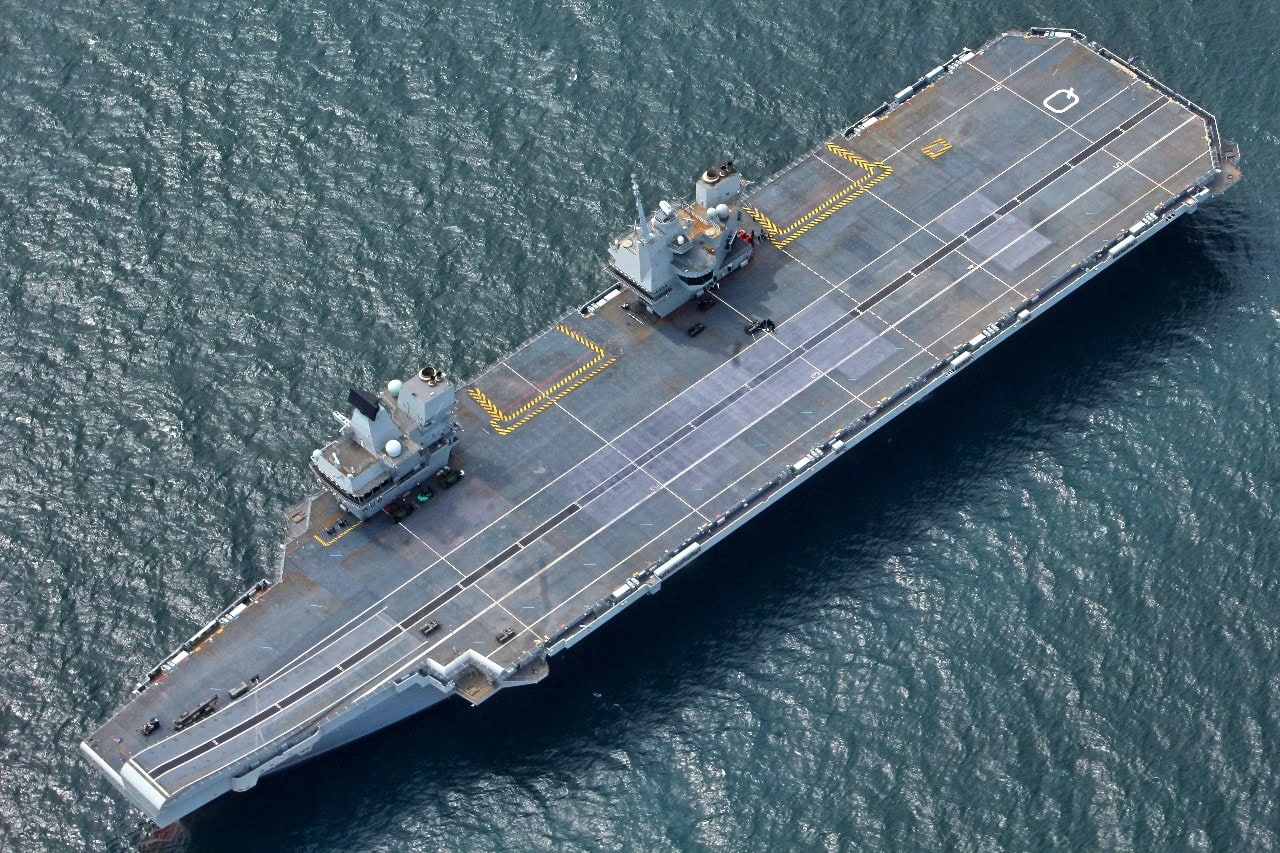
Queen Elizabeth is a useful symbol because it is also a useful headquarters. The ship is roughly 280 metres long, displaces about 65,000 tonnes, and was designed to operate F-35B short-takeoff and vertical-landing fighters, helicopters, surveillance assets and a substantial command staff. In a crisis, that combination lets NATO put aviation, communications and maritime command functions in one mobile platform rather than tying them to a fixed headquarters ashore.
That matters in northern Europe. Russia does not have to invade a NATO state to create pressure. It can probe undersea cables, move submarines through the GIUK gap, push naval groups into the North Atlantic, jam aircraft over the Baltic, or generate enough ambiguity around a grey-zone incident that allies spend the first critical days arguing about what happened. A carrier cannot solve those problems by itself. It can, however, give NATO a visible command node around which escorts, aircraft and allied staffs can form quickly.
The Royal Navy says the deployment will combine advanced warfighting training with NATO command duties. Captain Claire Thompson, Queen Elizabeth’s commanding officer, described the autumn sailing as a milestone for both the NATO commitment and the ship’s path back to being the Royal Navy’s “very high readiness” aircraft carrier, a duty it is scheduled to resume from HMS Prince of Wales in 2027. That detail is not administrative trivia. It tells us Britain is trying to make one deployment serve two purposes: alliance reassurance now, and carrier readiness later.
NATO Changed the Wrapper, Not the Problem
NATO’s own history of rapid reaction forces is a lesson in how often Europe builds structures before it funds the forces underneath them. The old NATO Response Force was created after the Prague Summit in 2002, reshaped after Russia seized Crimea in 2014, and used in a deterrence and defence role for the first time after the 2022 invasion of Ukraine. NATO’s public history notes that the enhanced NRF eventually included around 40,000 troops, including the Very High Readiness Joint Task Force with lead elements expected to move within days.
After the Vilnius summit cycle and the shift toward a new force model, the Allied Reaction Force became part of NATO’s answer to a harsher European security environment. The maritime component is supposed to assemble warships, naval aircraft and support vessels rapidly if a crisis breaks. UK Defence Journal reports that the force is designed to pull together within ten days when activated.
Ten days is fast by NATO’s traditional habits. It is not fast by Russian disruption timelines.
That is the uncomfortable part. NATO’s new structure looks better on paper than the old one because it is built for deterrence on alliance territory, not expeditionary crisis management somewhere else. But command readiness is only one piece of the problem. Ships need escorts. Carriers need aircraft. Air groups need munitions. Maritime patrol aircraft need maintenance hours. The alliance can assign a British carrier to a command role, but it still has to prove that the rest of the force package can arrive with enough mass to matter.
Britain Is Carrying More Than It Admits
The United Kingdom remains one of the few European allies that can credibly offer a nuclear deterrent, carrier aviation, maritime patrol aircraft, high-end intelligence aircraft and forward land forces at the same time. The current deployment sits alongside an 800-strong UK battlegroup in Estonia, RAF Typhoon air policing over Romania, P-8 Poseidon maritime patrol missions, and RC-135W Rivet Joint surveillance flights around the Baltic region, according to the same Royal Navy-linked reporting.
That is a serious contribution. It is also a reminder of how narrow Europe’s bench still is. France can bring a carrier, but not continuously. Italy has useful naval aviation, but at smaller scale. Spain, the Netherlands, Norway, Denmark and Germany all bring important maritime capabilities, yet none can substitute for a British carrier command platform in the North Atlantic. The United States still sits behind the whole architecture, whether Europeans like admitting it or not.
Everyone in Brussels likes to say NATO is stronger after Finland and Sweden joined. Geographically, that is true. Militarily, it is more complicated. The Baltic Sea is now more NATO-friendly, but the defence burden also grew. More coastline, more infrastructure, more undersea assets and more airspace must be watched. The northern flank did not become easy because the map turned bluer.
The Russian Navy Still Forces NATO to Work
Russia’s surface fleet is weaker than Moscow wants outsiders to believe, especially after Black Sea losses to Ukrainian missiles and drones. But that has encouraged a lazy assumption that Russian naval power is no longer a serious problem. It is. Submarines, maritime aviation, electronic warfare, long-range missiles and sabotage-adjacent activity all remain central to how Russia can stress NATO without starting the war it probably does not want.
NATO’s maritime commands have spent the past year publicising surveillance of Russian vessels from the Baltic to the Mediterranean. That messaging is partly deterrent theatre, but theatre has a military function. It tells Moscow that movements are being watched. It tells smaller allies that the alliance is present. It tells European publics that “defence spending” is not just an argument about spreadsheets in parliament.
Queen Elizabeth’s deployment belongs in that category. It will not frighten the Kremlin by itself. A carrier sailing near home waters is not a magic answer to Russian submarines or missile saturation. But it is a practical rehearsal for the kind of crisis NATO actually worries about: a fast-moving northern European incident in which command cohesion matters before the first communique is drafted.
What To Watch Next
The next useful indicator is not whether Queen Elizabeth leaves port on time. It is what sails, flies and plugs into the carrier once the exercise cycle begins. A command platform without enough escorts is a target. A carrier without enough aircraft is a headquarters with a runway. A NATO maritime force without rehearsed multinational communications is a press release with hull numbers attached.
Three questions matter over the next three months. How many allied ships integrate with the British battle staff? How much live aviation does the carrier conduct as it rebuilds readiness? And does NATO use the deployment to practise real northern-flank contingencies, or merely to produce reassuring photographs?
The key finding is simple: Britain’s carrier deployment is not just a signal to Russia, it is a test of whether NATO’s new reaction-force model has real maritime muscle behind it. The prediction is less comfortable. The command piece will probably work before the force-generation piece does. That has been NATO’s habit for years. Queen Elizabeth can carry the flag; the question is whether Europe can fill the formation around it quickly enough when the flag stops being symbolic.
HMS Queen Elizabeth deployed from Portsmouth on 5 September, serving as NATO's command platform for the Allied Reaction Force Maritime. The carrier, with over 800 sailors, will conduct a three-month mission in British and northern European waters, enhancing NATO's maritime command capabilities amid rising tensions with Russia.
- HMS Queen Elizabeth is deployed as a NATO command platform.
- The carrier is manned by over 800 sailors.
- The deployment is part of NATO's high-readiness naval crisis-response formation.
- The carrier is scheduled for a three-month deployment around British and northern European waters.
- The Royal Navy took leadership of the maritime component from Spain on 1 July.