
Patriot and Skyranger 30 in Europe 2026 — why more money won't close the drone gap
 S.W
S.WPatriot and Skyranger 30 in Europe 2026 — why more money won't close the drone gap
Berlin, September 20, 2026. Europe's defense ministers are discussing higher budgets, while the President of Latvia publicly states that Europe is not keeping pace with developments in drone and air warfare in Ukraine. This is not a contradiction, but the core of the problem. Patriot batteries, Eurofighters, and new NATO command structures do not yet create the capability to detect, classify, and cost-effectively engage an adversary in large numbers.
Ukraine is the operational laboratory, Europe remains a spectator

The recent warnings from Riga hit a sensitive point. Since 2022, Ukraine has developed a dense learning loop: reconnaissance, electronic warfare, drone production, defense, and tactical adaptation are realigned within weeks. In contrast, European armed forces often purchase individual systems through multi-year programs. Years can pass between ordering a sensor and integrating it into a connected battlefield. In drone warfare, that is a strategic eternity.
Reuters points out in its current analysis of NATO readiness a second gap. While many alliance armies have high-quality platforms, they lack sufficient stocks, trained crews, and realistic procedures for a prolonged, intensified conflict. This applies not only to ammunition. It concerns data connections, spare parts, maintenance, mobile power supply, and the ability to engage a large number of small targets simultaneously.
Patriot is indispensable, but for the wrong cost category
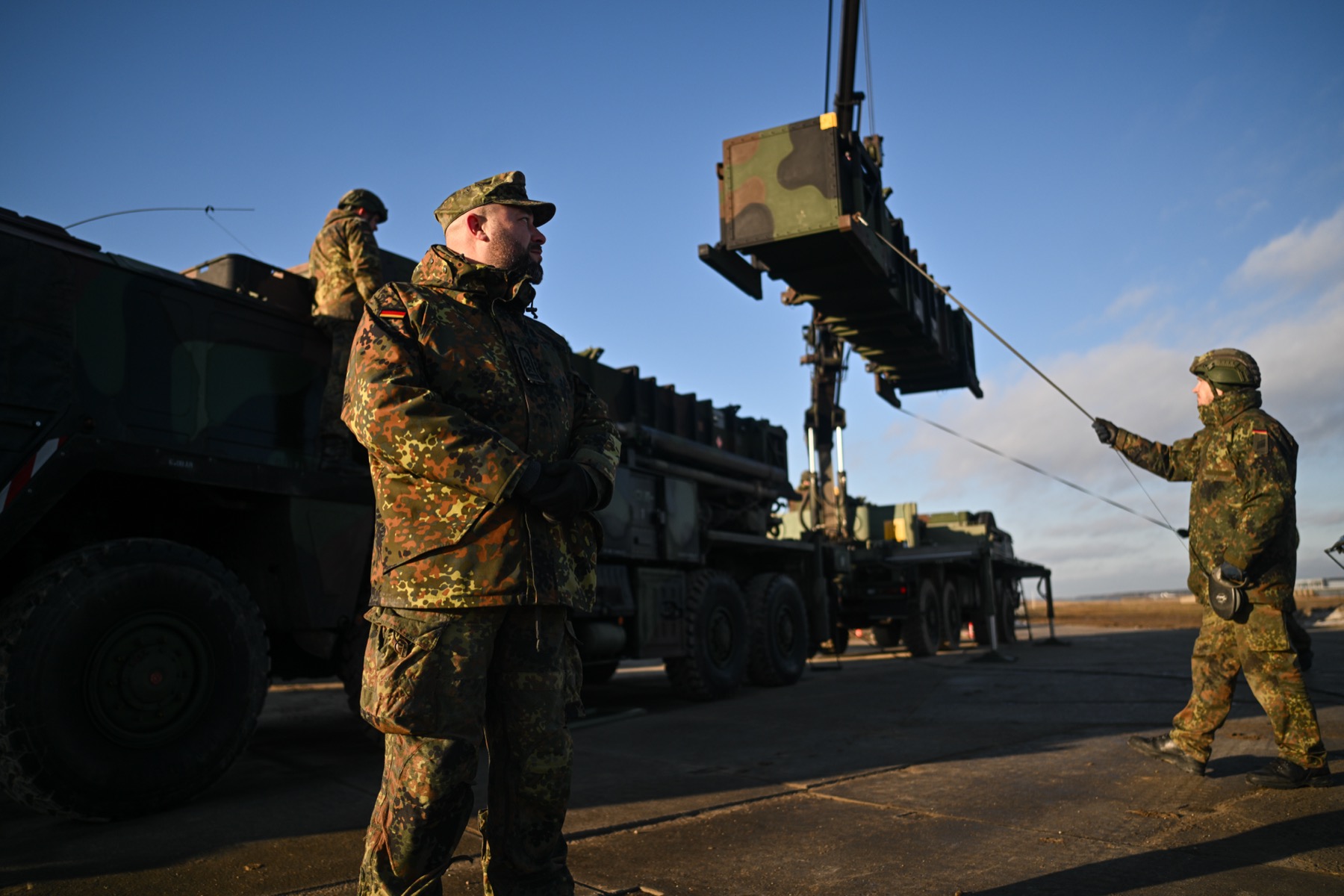
The Patriot system with the AN/MPQ-65 radar and PAC-3 MSE interceptors remains Europe's most important capability against complex missiles and ballistic threats. Its sensors, range, and networking are designed for high-value targets. However, this is precisely where the economic trap lies. Engaging a cheap disposable drone with an expensive interceptor may be militarily necessary, but it is not a sustainable foundational architecture in the long run.
Therefore, the answer cannot be to replace Patriot with less capable systems. It must be a layered air defense. Systems like the Skyranger 30 combine a 30-millimeter cannon with programmable ammunition, radar, and electro-optical sensors. They are intended for close-range defense and for targets where a Patriot-class missile would be wasteful. Additionally, electronic jamming, passive sensors, intercept drones, and a robust command infrastructure are needed. The technical toolkit exists. What is missing is joint procurement and operational doctrine.
More defense spending does not solve the integration problem
The current IISS analysis of European defense production describes a real capacity expansion but simultaneously warns of fragmentation and lack of scaling. New factories are politically visible; common standards, long-term procurement contracts, and interoperable software are not. The temptation is great to promote national champions with national contracts. This creates jobs and headlines, but not automatically a European air defense.
Therefore, the crucial metric is not the share of defense spending in gross domestic product. What matters is how many operational sensor-effector chains Europe can operate per night, how quickly they can update their software, and how long the ammunition stocks will last. A NATO state can meet the two or five percent target and still remain vulnerable in small drones, electronic warfare, and spare parts reserves. This is the difference between financial burden-sharing and military capability.
The transatlantic price of European dependence
For Washington, the European drone gap is also a strategic relief problem. If European states concentrate their scarce resources on American high-end systems while the cheap and mass threat remains underfunded, dependence will not decrease. Europe then buys top capability but lacks sufficient depth. In a crisis, US air defense would have to fill the very gaps that European budgets were supposed to eliminate.
This is particularly uncomfortable for Germany. Berlin has industrial competence in radar, air defense, and armored platforms but has tried for too long to organize individual solutions within national timelines. The turning point will only be credible when procurement no longer ends with the handover of a device. It must begin with a permanently funded learning system that translates Ukrainian experiences into European training, software, and production.
The institutional decision
The EU can support this task through common standards and procurement instruments. NATO, on the other hand, must define military requirements, data architectures, and operational procedures. The well-known competition between the EU and NATO would be particularly harmful here. A European program without NATO integration would be industrial policy; a NATO plan without European production capacity would remain an American stopgap solution.
Europe does not simply need more systems. Europe needs more learning-capable, interconnected, and affordable systems.
The political irony is clear. Higher spending is necessary, but it does not buy time. Patriot, Skyranger 30, and Eurofighter can strengthen Europe's defense, but only as parts of a common architecture. Ukraine shows how quickly air warfare is changing. Europe's problem is not that it lacks technology. Europe's problem is that its institutions learn more slowly than the adversary.
Sources
- Reuters, Is NATO ready to fight? The Ukraine war is raising doubts among military analysts, September 19, 2026
- The Guardian and other reports on the warning from the Latvian president, September 18–19, 2026
- International Institute for Strategic Studies, Analyses on European defense production, September 2026
European defense ministers discussed increased military budgets in Berlin on September 20, 2026, addressing the gap in drone and air warfare capabilities compared to Ukraine. The Latvian president emphasized the urgency of improving European military readiness, particularly in drone warfare. The report highlights the importance of the Patriot system and the need for a layered air defense strategy to counter complex threats.
- European defense ministers are discussing increased budgets for military capabilities.
- The Latvian president warns that Europe is lagging behind Ukraine in drone warfare.
- The Patriot system remains crucial for Europe against complex threats.
- There is a need for a layered air defense strategy in Europe.
- The report highlights the fragmentation in European defense production and procurement.