
Penghu Strengthens the Defense Line with Drones and the Stronghold of Xiongfeng III: The PLA Must First Address the Maritime Barrier 50 Kilometers Offshore Before Attacking Taiwan
 Li Minghui
Penghu Strengthens the Hsiung Feng III and Drone Defense Line: The PLA Must First Address the 50-Kilometer Maritime Barrier Before Attacking Taiwan
On August 30, Taiwan's defense department reported that the PLA dispatched three military aircraft, eight warships, and five civilian vessels around the Taiwan Strait that day, with all three aircraft crossing the so-called median line of the strait and entering the airspace north and east of Taiwan. Looking at the numbers alone, this is not an exceptionally high peak, but compared to the previous two days when there were almost no military aircraft and only a presence of ships and coast guard, this sudden resumption of aerial crossings seems more like a continuous pressure test on Taiwan's military front-line nodes. The most noteworthy point is not Taipei or Kaohsiung, but Penghu, which is about 50 kilometers from the main island of Taiwan.
Penghu is Transforming from a Defensive Island Chain to a Forward Denial Platform
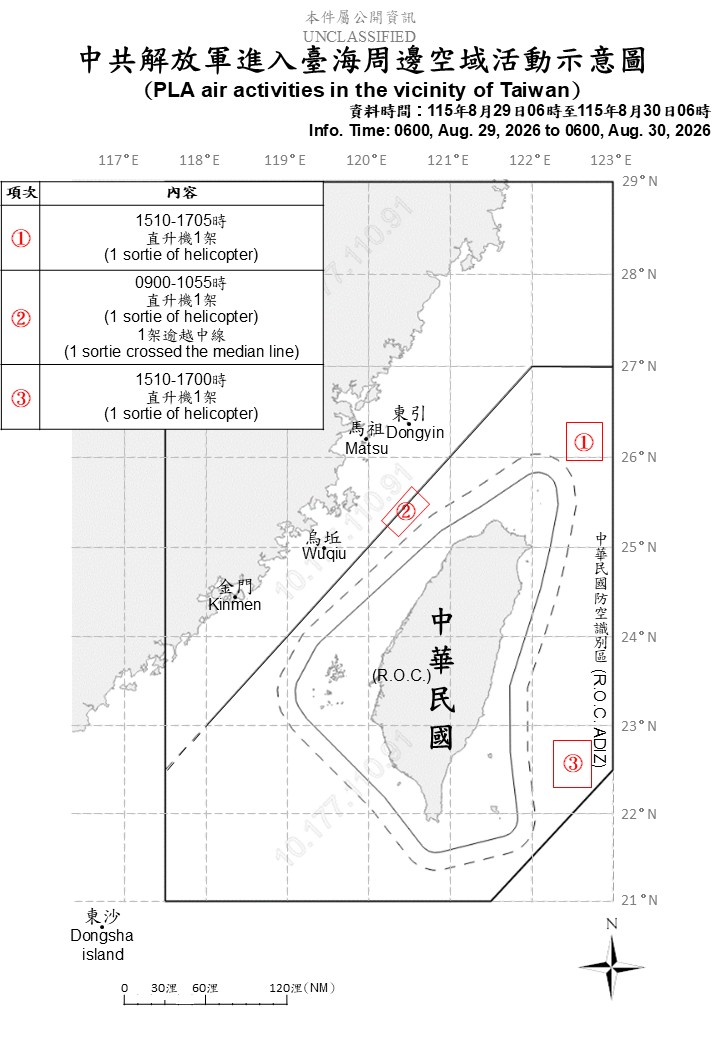
According to a Reuters report on August 30, the Taiwanese military is reshaping Penghu into a true forward battlefield. It is no longer just an offshore island group for early warning and buffering for the main island, but a firepower point that can directly threaten PLA amphibious assault formations, assembly areas, and subsequent supply lines during wartime. The Taiwanese military has clearly pushed its naval shore-based combat capabilities towards Penghu for the first time and has deployed longer-range, more powerful Hsiung Feng III missiles, while also establishing drone units to enhance reconnaissance and target designation capabilities in the central strait.
From the PLA's operational perspective, the issue with Penghu is not its size, but its strategically critical location. Any large-scale landing or firepower blockade targeting Taiwan's west coast, if it does not first suppress Penghu, is equivalent to allowing the opponent to retain a continuously extended dagger in the middle of the strait. Especially when the Taiwanese military combines anti-ship missiles, mobile radars, drone reconnaissance, and decentralized supply, the significance of Penghu has approached that of a maritime denial hub, rather than a traditional isolated stronghold as described in textbooks.
For the Eastern Theater Command, This Means Attacking Taiwan is No Longer Just a Matter of Crossing the Sea
In the past, discussions about attacking Taiwan often focused on transport capacity, beachhead assaults, and air superiority, but the strengthening of Penghu highlights a more realistic issue: the PLA must first address the obstacle clearance in the central strait. If the Taiwanese military can maintain effective resistance from Penghu for several days, it could force the PLA to invest more long-range firepower, electronic suppression, and special operations forces in the initial stages of the campaign, even diverting resources that would have been used for the main island. This would raise the cost of the initial strike and prolong the campaign's tempo.
- First, Penghu can push forward the Taiwanese military's reconnaissance chain, exposing the PLA fleet earlier.
- Second, supersonic anti-ship missiles like the Hsiung Feng III will increase the risk for amphibious formations approaching.
- Third, after combining drones with civil defense supplies, the garrison's sustained combat capability may be stronger than external estimates.
My personal judgment is that the PLA's recent resumption of military aircraft crossing the line and activities towards the northeast is not just routine deterrence, but more like a continuous calibration of the Taiwanese military's response tempo towards the central strait and offshore islands. If similar combinations of aircraft and ships continue to operate around Penghu, the waters off Taichung, and northern Taiwan in the coming weeks, it would indicate that the Eastern Theater Command is prioritizing island suppression and strait passage control.
What to Watch Next is Not the Slogans, but Whether the Suppression Chain Takes Shape
The next key observations are threefold: first, whether PLA aircraft continue to expand their frequency of entering Taiwan's northern and eastern airspace; second, whether coast guard and naval vessels form a more stable dual presence off the coast of Penghu; and third, whether the Taiwanese military's deployment of drones, anti-ship missiles, and mobile logistics in Penghu can continue to be made public. If these signals strengthen simultaneously, the Taiwan Strait game will shift from simple political pressure to a more strategic pre-positioning around the island nodes. By then, Penghu will not just be Taiwan's outpost, but a latch that the PLA must first remove.
On August 30, the Chinese People's Liberation Army conducted military operations in the Taiwan Strait, deploying 3 aircraft, 8 warships, and 5 civilian vessels. This activity included crossing the median line, indicating increased pressure on Taiwan's defenses. Taiwan is enhancing its military presence in Penghu, deploying advanced missile systems and drones to counter potential threats from the Chinese military.
- Chinese military deployed 3 aircraft, 8 warships, and 5 civilian vessels on August 30.
- The operations included crossing the median line of the Taiwan Strait.
- Taiwan is enhancing its military capabilities in Penghu with advanced missile systems and drone units.
- The strategic importance of Penghu is emphasized as a potential military stronghold against Chinese forces.
- The report suggests a shift in military focus towards controlling the Taiwan Strait and surrounding islands.