
PLA Drone Airdrops New Taiwan Dollars and Gold in Occupation Rehearsal
 Marcus Chen
PLA Drone Airdrops New Taiwan Dollars and Gold in Occupation Rehearsal
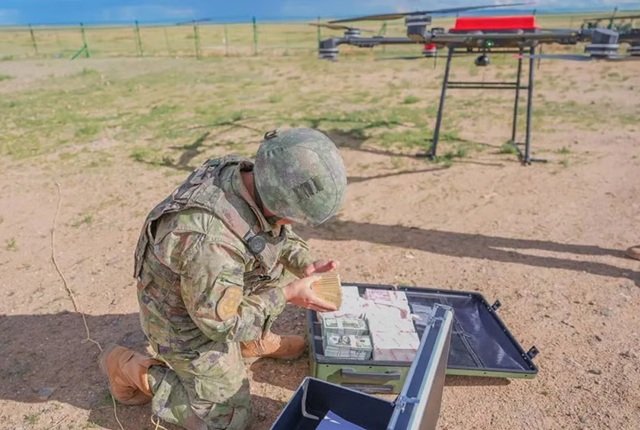
The case carried the PLA emblem and was marked "Settlement Office No 4, Nanjing Centralised Funds Receipt and Payment Management Centre." A multi-rotor drone set it down in a field where soldiers in tactical gear counted NT$1,000 notes, US$100 bills, and gold bars. The People's Liberation Army Eastern Theatre Command ran the drill as a "wartime financial support" exercise, the state-owned Defence Times reported last week — then deleted the report after it sparked heated discussion online.
What the Drill Actually Showed
The deleted report, first covered by the South China Morning Post on August 18, described drone-delivered camouflage cases containing physical currency and gold at designated locations during an Eastern Theatre Command exercise. Photographs released with the original article showed troops in the field counting stacks of New Taiwan dollars and US dollars alongside gold bars. The report did not specify where or when the exercise took place, and it was unclear whether the cash and gold were genuine.
What is clear is the intent. Physical payment exists for one reason in a modern military: the scenario where banking and electronic payment systems no longer work. Wartime cash covers purchases of supplies and services, compensation for collateral damage, intelligence-related payments, and transactions that cannot be routed through normal financial channels. That part is standard doctrine in any army that has thought about fighting far from home.
Why the New Taiwan Dollars Matter More Than the Gold
Gold and US dollars are universal. Any force operating overseas packs them. But NT$1,000 notes are only useful in one place: on the island of Taiwan. Their presence in a Nanjing-marked settlement case means the PLA is not just rehearsing logistics — it is rehearsing transactions with the local population during an operation on the island.
That is a different kind of preparation than practicing beach landings or missile salvos. Paying people in local currency is what occupying forces do. It is the mechanism for hiring labor, buying food from farmers, paying civil servants to keep utilities running, and compensating the families whose houses got hit. The currency choice converts a logistics exercise into an occupation rehearsal, whether or not the report's authors intended that reading.
The Drone Is the Detail Everyone Will Miss
Put the drone in the operational context. If the PLA is fighting across the strait, the financial system it relies on at home — mobile payments, bank transfers, state treasury networks — cannot be assumed to work on the far shore. Roads and bridges will be contested. Airfields will be under fire. The last mile of any occupation starts as a supply problem, and the drone is the answer to that problem: a cheap, low-altitude delivery platform that does not need a runway or a working road network.
Anyone who has worked the logistics side of a naval operation recognizes the pattern. You do not design a drone financial-delivery scheme for a permissive environment. You design it for the degraded one — the same reason a carrier strike group trains replenishment at sea rather than in port. The drill is not about the novelty of the delivery method. It is about planning for a collapsed banking environment on the far side of the strait.
What the Deleted Report Tells Us
The deletion is the second signal. Defence Times published, the discussion went online, and the article came down. That sequence happens when a story reveals more than the PLA wants publicly visible. The photographs were real enough to circulate; the framing was sensitive enough to retract.
This is consistent with how the PLA has handled Taiwan-preparation indicators all year: show capability, then control the narrative. The deletion does not make the drill less real. It makes it more deliberate.
The Occupier's Math
Do the numbers. A post-conflict Taiwan means paying for something like 23 million people's basic services while the island's banking system is either frozen, evacuated, or actively hostile to the new authority. Cash on hand is the only instrument that works without counterparty trust. Gold holds value when the currency does not. New Taiwan dollars are the one denomination that actually spends at the point of need. The PLA is solving a real accounting problem — the cost of the day after — and it is doing it before the shooting starts.
That should unsettle anyone who has assumed Beijing's planning stops at the beachhead. Military preparations get attention. Payroll preparation is quieter, and it tells you the PLA's leadership is thinking in phases: win the fight, then run the place. The deleted drill suggests the second phase is already on the table.
You can argue about whether the PLA can cross the strait. The harder question is why it is already rehearsing what happens on the other side. Cash, gold, and New Taiwan dollars by drone is not a battle plan. It is an occupation plan with a settlement office attached.
The People's Liberation Army conducted a drill involving drone airdrops of cash and gold, indicating preparations for potential operations in Taiwan. The exercise, described as a 'wartime financial support' drill, included New Taiwan dollars, suggesting a focus on local transactions during an occupation. The original report was deleted after it generated significant online discussion, highlighting the sensitivity of the information.
- PLA conducted a drill involving drone airdrops of cash and gold.
- The exercise was labeled as a 'wartime financial support' drill.
- New Taiwan dollars were included in the airdrop, indicating preparation for operations in Taiwan.
- The original report was deleted after sparking online discussion.
- The drill suggests planning for a potential occupation scenario.