
PLA Submarine-Launched Missiles Fly Over 7,300 Kilometers, New Combined Deterrence Formed by Coast Guard Patrols on the Eastern Side of the Taiwan Strait
 Li Minghui
PLA Submarine-Launched Missiles Fly Over 7,300 Kilometers, New Combination Deterrence Formed by Coast Guard Patrols on the Eastern Side of Taiwan Strait
In early July, I noticed two seemingly unrelated actions: one is that Chinese Coast Guard white vessels have been continuously appearing in waters east of Taiwan, and the other is that the PLA Navy conducted a submarine-launched ballistic missile test from the South China Sea, with the trajectory entering the Pacific Ocean. Looking at the former alone, it seems like law enforcement in a gray area; looking at the latter alone, it appears to be a display of nuclear deterrence. However, when time, direction, and targets are placed on the same map, the issue becomes interesting: Beijing is using a low-intensity, long-term Coast Guard presence alongside high-intensity, hard-to-ignore strategic missile signals on the same Western Pacific chessboard.
White Vessels Are Not Low-End Navy
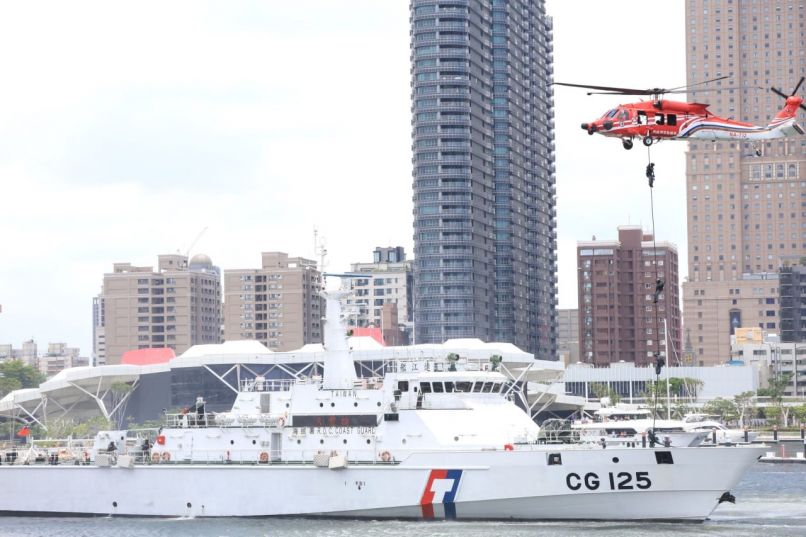
Defense News reported on July 15 that Chinese Coast Guard vessels have been operating in waters east of Taiwan since May, with one location about 54 nautical miles from Taiwan, or approximately 100 kilometers. Around July 4, a fleet rotation occurred, and Taiwan's Mainland Affairs Council stated that it undermines regional stability; the mainland, on the other hand, describes such actions as normalized law enforcement patrols.
I believe the key here is not how close a single voyage is to Taiwan, but the term "rotatable." Large Coast Guard vessels are more suitable for long-term low-intensity presence than naval combat ships, and the political signals are easier to package as law enforcement. In simple terms, it means using the Coast Guard as a buffer shell to rewrite military pressure into administrative presence. For Taiwan, Japan, and the United States, the challenge is not identifying whether this is a warship, but how to respond to a presence that is ongoing every day yet has no threshold for opening fire.
Submarine-Launched Missile Test is About Second Strike Credibility
The harder edge is the submarine-launched ballistic missile test on July 6. Defense News cited public analysis stating that the missile, carrying a simulated training warhead, flew approximately 7,300 kilometers, while other reports based on Taiwan's announced trajectory indicated about 7,000 kilometers, with the impact area near Nauru and Tuvalu. Beijing stated this was part of an annual training schedule and had notified relevant countries in advance; Australia, Japan, New Zealand, the United States, and some South Pacific island nations expressed protests or concerns.
The most heated discussion outside is whether it touches the spiritual boundary of the South Pacific Nuclear-Free Zone established by the Rarotonga Treaty. However, from an equipment perspective, what should be focused on is the launch platform. If it is a JL-2 or JL-3 class submarine-launched ballistic missile, this test is not about how far a single missile can fly, but about demonstrating that sea-based nuclear capabilities can transition from "having this thing" to "being able to train as planned, display externally, and form stable expectations." This is different from the public appearance of land-based DF series missiles; the essence of submarine launches is survivability, meaning the ability to retaliate after being struck.
Combination Signals Are More Important Than Individual Performance
Looking at Coast Guard patrols and submarine missile tests together, one can see a deterrence chain from low-end to high-end. The low end is the normalized appearance of the Coast Guard east of Taiwan, consuming the opponent's maritime patrol, navy, and intelligence surveillance resources; the mid-end is the re-display of hypersonic glide weapons like the DF-17 in English content on CCTV, emphasizing their ability to penetrate aircraft carriers and large surface targets; the high end is the submarine-launched ballistic missiles sending signals to the South Pacific.
There is an easily overlooked detail: the public visibility of the three types of tools is completely different. Coast Guard actions are almost visible every day, the DF-17 is selectively displayed, while submarine-launched missiles are rare but have a significant impact. They do not replace each other but resonate at different frequencies. For the U.S. ally system, this is more difficult to handle than simply increasing a few warships, as each level of response may be used by Beijing to prove "the other side is escalating."
Still Need to Look at Production Capacity and Training Density
I do not agree with interpreting a single missile test as the PLA having completed the sea-based nuclear deterrence loop. There is too little public information, and the outside world still cannot confirm the type of launch platform, missile model, maritime area security, command communication, and readiness patrol cycle. The most challenging aspect of engineering is not launching the missile but ensuring that submarines can complete the launch command chain in sufficiently concealed positions, through repeatable processes, under complex communication constraints. Once this system needs to be normalized, it will be a long-term test for submarine noise control, base support, ammunition maintenance, and maritime training windows.
However, this action at least indicates that Beijing is using both "gray zone pressure around Taiwan" and "distant sea strategic nuclear signals" in parallel. The real question worth asking is not how far the next missile will fly, but whether the Chinese Coast Guard will form a fixed rotation schedule east of Taiwan, and whether PLA submarine-launched ballistic missile tests will transition from sporadic news to rare but predictable annual actions.
Main references: Defense News July 15 report on Chinese Coast Guard patrols east of Taiwan and submarine-launched missile tests; Defense News July 7 report on South Pacific nuclear-free zone controversy; Chinese official statements on annual training and prior notification to relevant countries.
Chinese coast guard vessels have been regularly operating east of Taiwan since May 2023, while the People's Liberation Army Navy conducted a submarine-launched ballistic missile test on July 6, 2023, reaching approximately 7300 kilometers. These actions represent a strategic combination of low-intensity maritime presence and high-intensity missile signaling in the Pacific region, raising concerns among neighboring countries about regional stability.
- Chinese coast guard vessels have been operating east of Taiwan since May 2023.
- A submarine-launched ballistic missile test was conducted on July 6, 2023, flying approximately 7300 kilometers.
- The missile test was part of an annual training schedule and was communicated to relevant countries in advance.
- The activities are seen as a combination of low-intensity coast guard presence and high-intensity missile signaling.
- There are concerns regarding the implications of these actions on regional stability.