
PLA Type 076 Sichuan Ship Launches GJ-21 for the First Time, Accelerating the Carrierization of Maritime Drones by 2026
 Li Minghui
PLA 076 Type Sichuan Ship Conducts First Electromagnetic Catapult Launch of GJ-21, Accelerating Carrierization of Maritime Drones by 2026
On October 30, Chinese state media disclosed that the PLA Navy's 076 Type amphibious assault ship Sichuan has completed the first electromagnetic catapult launch and recovery of the GJ-21 naval stealth drone. The significance of this action lies not in "adding another aircraft carrier," but in the PLA beginning to integrate large drones into the routine aviation system of its far-sea formations. Publicly available footage remains limited, and it cannot be concluded from a single test whether the Sichuan has reached a state capable of executing combat missions.
What a Single Electromagnetic Catapult Changes
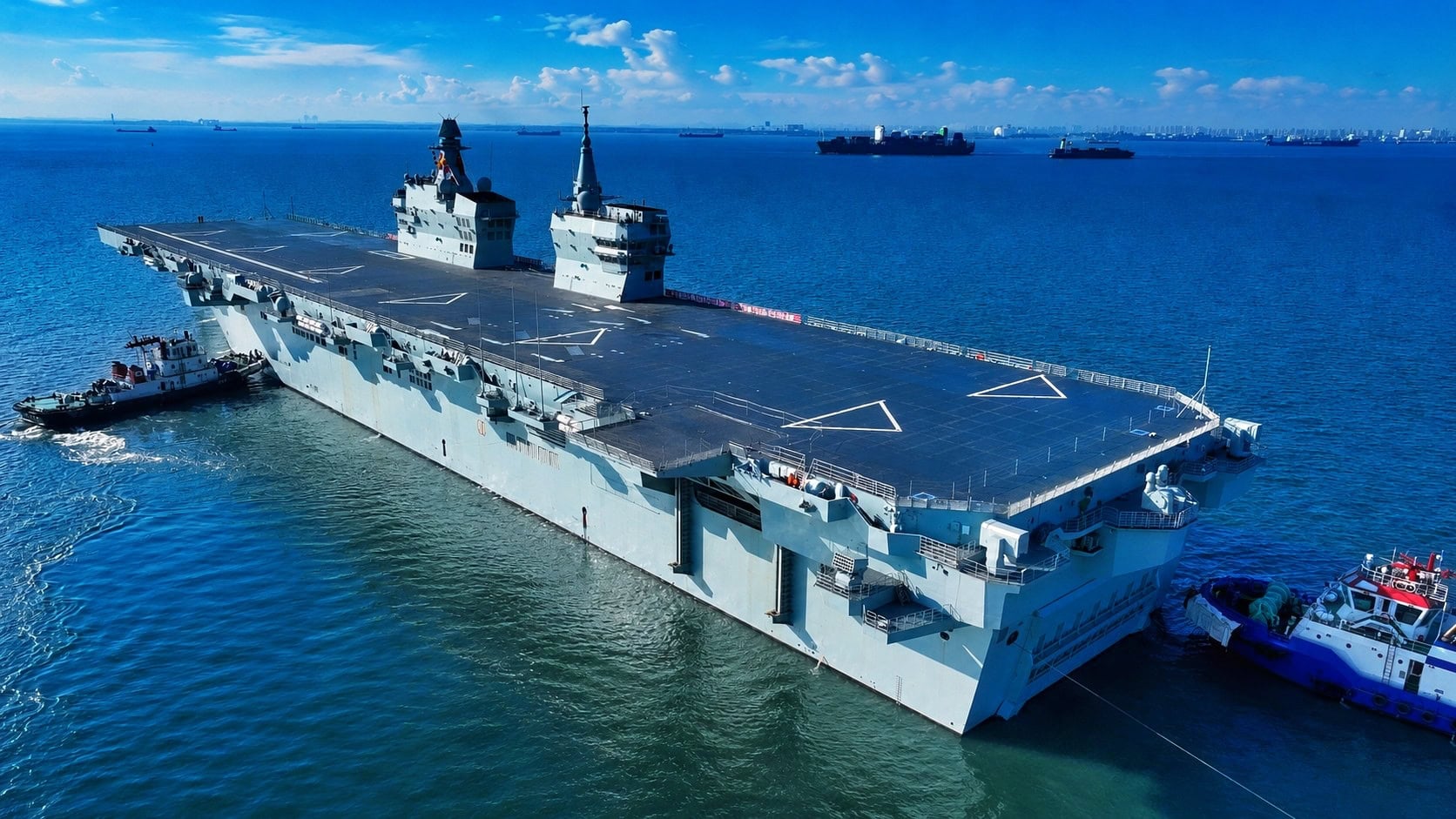
The American Enterprise Institute and the Institute for War Studies released a report on November 3 titled "China and Taiwan Update," stating that the Sichuan is currently the only known vessel equipped with an electromagnetic catapult on an amphibious assault ship. The report cites public data estimating that the GJ-21 has a range of approximately 1,500 kilometers and can undertake reconnaissance and ground strike missions. This figure should be viewed cautiously, as the effective range, payload, and data link status of the drone have not been fully disclosed, but it is sufficient to indicate that the design goal of the Sichuan is not a traditional helicopter carrier.
The 071 Type dock landing ship and the 075 Type amphibious assault ship primarily address issues of transport, vertical landing, and near-shore support; the 076 Type attempts to push the aviation reconnaissance nodes further forward. The advantage of electromagnetic catapults is their wider adaptability to takeoff weight and aircraft speed, theoretically allowing large fixed-wing drones to take off from vessels that do not have traditional carrier ski-jump decks. In simple terms, this is an amphibious ship beginning to take on the role of the "eyes of the formation."
How It Addresses the Shortcomings of PLA Carrier Groups
The Liaoning and Shandong rely on ski-jump takeoffs, allowing carrier-based aircraft to perform air superiority and anti-surface strike missions, but large fixed-wing early warning aircraft cannot take off from their decks, thus limiting the aerial early warning, target designation, and communication relay capabilities of far-sea formations to land-based aviation or helicopters. The electromagnetic catapult on the Fujian will alleviate this issue, but it still requires a long training and support cycle. If the Sichuan can carry the GJ-21, it could provide additional reconnaissance radius for the Liaoning, Shandong, or other surface formations at a lower deck and personnel cost.
A more realistic application is not to have drones "attack aircraft carriers" alone, but to have them patrol the periphery of the formation for extended periods, relaying coordinates to carrier-based fighter jets, long-range anti-ship missiles, or land-based firepower upon detecting targets. For the Taiwan Strait and the Philippine Sea, this means the PLA can push sensors and data links further beyond the first island chain. The loss of drones does not incur pilot casualties and is more suitable for executing high-risk continuous surveillance missions.
Three Thresholds from Testing to Combat Capability
- Ship-Aircraft Coordination: A single launch and recovery proves the mechanical process is feasible, but does not demonstrate stable operation under high sea conditions, at night, or in electromagnetic interference environments.
- Data Link: The true value of the GJ-21 depends on its ability to deliver reconnaissance data to the formation command system in a timely manner, rather than simply flying further.
- Support and Production Capacity: Drones require backup units, maintenance personnel, catapult maintenance, and deck scheduling. The ability to form mass sorties is key to assessing the combat capability of the Sichuan.
This is also the reason why I remain cautious about the assertion that "the 076 Type is a drone carrier." An advanced ship platform does not equate to a mature aviation group; the functionality of the electromagnetic catapult does not mean that a stable aerial command loop has been established within the formation. The experience of the U.S. Navy indicates that the most challenging aspect of carrier aviation operations is often not getting aircraft into the air, but maintaining high-intensity sorties, maintenance, and resupply over consecutive days.
The Next Signal Worth Observing
If the Sichuan demonstrates more continuous takeoffs and landings of the GJ-21, formation coordination, or cross-sea deployments in subsequent sea trials, it would indicate that the PLA is transitioning the 076 Type from a technical verification platform to a far-sea support node. It may also form a division of labor with the Fujian: the Fujian responsible for manned carrier-based aviation, while the Sichuan handles unmanned reconnaissance, communication relay, and decoy missions. Such a combination may not immediately alter the balance of aerial power in the Taiwan Strait, but it would increase the difficulty for Taiwan and intervening parties to identify, track, and suppress PLA formations.
Main reference sources include the American Enterprise Institute and Institute for War Studies' "China and Taiwan Update" on November 3, reports from Chinese state media on the Sichuan's trials on October 30, and Taiwan News' report on the deployment of Chinese naval aircraft carriers on November 4. Public information is still insufficient to confirm the Sichuan's service time; the real question is whether the PLA can convert a successful launch into a sustained operational capability for dozens of drone sorties daily.
On October 30, 2023, the Chinese Navy's 076 amphibious assault ship Sichuan successfully conducted its first electromagnetic catapult launch and recovery of the GJ-21 stealth drone. This marks a significant advancement in integrating large drones into naval operations, enhancing reconnaissance capabilities for the fleet. The GJ-21 is estimated to have a range of 1500 kilometers and is designed for reconnaissance and ground strike missions.
- The Sichuan ship completed its first electromagnetic launch and recovery of the GJ-21 drone.
- The GJ-21 drone has an estimated range of about 1500 kilometers.
- The Sichuan ship is the only known amphibious assault ship equipped with an electromagnetic catapult.
- The GJ-21 is intended for reconnaissance and ground strike missions.
- The Sichuan ship aims to enhance the reconnaissance capabilities of the Chinese Navy's fleet.