
PLA's 205-Meter Unmanned Submarine Mother Ship Emerges, Underwater Unmanned Combat System Enters Deep Sea
 Li Minghui
PLA's 205-Meter Unmanned Submarine Mothership Emerges, Underwater Unmanned Warfare System Enters the Open Sea
A new ship approximately 205 meters long from Shanghai Hudong-Zhonghua Shipbuilding has recently come into the public eye. Satellite images from the American geospatial intelligence company Vantor show that this ship has a hull similar to that of an amphibious vessel, a dock that can open underwater, and 12 arms capable of raising and lowering unmanned submersibles. U.S. Navy analysts have concluded that it may be the world's first "mothership" specifically designed to carry large unmanned submersibles. The key term here is not "first," but rather the transition of unmanned submersibles from test sites and research vessel decks into fleet formations.
What Can a Ship Carry
According to estimates by U.S. Navy submarine expert H.I. Sutton, this vessel could carry up to four super-large unmanned submersibles ranging from 35 to 45 meters in length, or a greater number of medium and small unmanned submersibles. The relevant models are said to be capable of autonomous operation for several months, with a maximum range of about 4,000 nautical miles. However, these parameters come from manufacturers and open-source analysis, and there is insufficient public information to determine whether the PLA has completed military deployment; one cannot equate "under construction" directly with "combat-ready."
Nonetheless, the size of the platform itself indicates a significant capability. Traditional unmanned submersibles are limited by their port of departure, and deploying them in the open sea requires manned submarines, transport vessels, or temporary support nodes. The mothership provides centralized maintenance, mission assembly, and recovery capabilities before departure, theoretically allowing underwater sensors, mine-laying platforms, or attack-type unmanned submersibles to be positioned closer to mission areas. In simple terms, it acts as a mobile forward base for underwater unmanned systems.
From 076 to Underwater Mothership
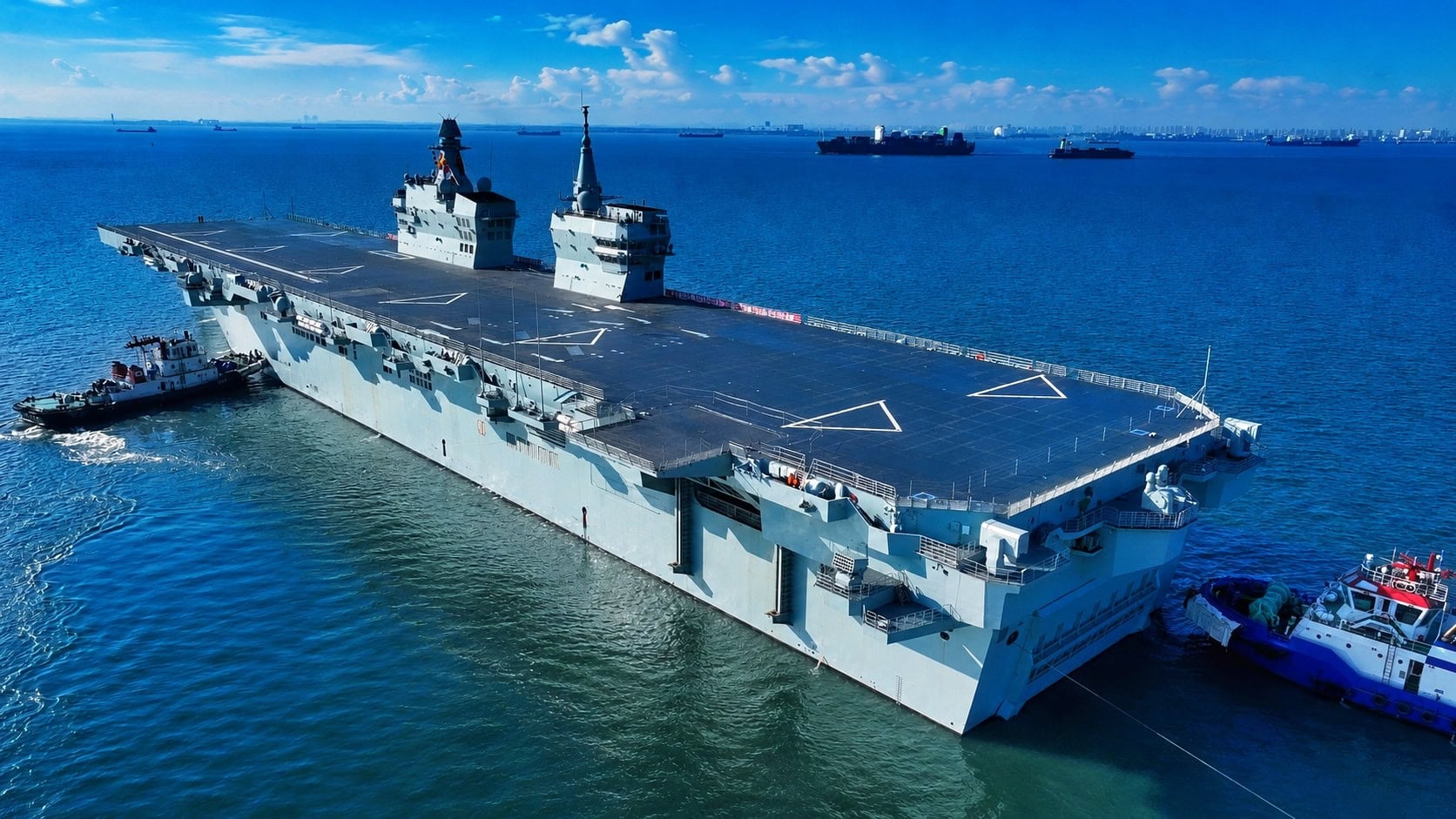
This is not an isolated shipbuilding project. The PLA has previously promoted the 076-type amphibious assault ship to undertake unmanned aerial vehicle operations, and aerial unmanned platforms and underwater unmanned platforms are forming a unified "mothership—cluster—remote sensor" concept. The difference is that drones on the deck are easier to detect and intercept, while underwater unmanned submersibles are more suitable for continuous reconnaissance, seabed mapping, mine-laying, and anti-submarine surveillance. The ISW's "China & Taiwan Update" released on September 18 believes that such platforms could be used to scout underwater passages, monitor surface vessels and submarines during a Taiwan Strait conflict, and may be pre-deployed in critical maritime areas.
For the Taiwan direction, the value lies not just in increasing the number of unmanned assets but in transforming the maritime intelligence chain. Large underwater unmanned submersibles can continuously collect ocean conditions and acoustic data before a conflict, expand anti-submarine search ranges during a crisis, and even provide low-cost nodes for blockades and mine warfare. For the U.S. and its allies, the challenge also changes: they must look for a surface mothership that may operate in the open sea while tracking multiple underwater targets it releases. This shifts anti-submarine warfare from "finding a submarine" to "assessing an entire distributed system."
The Real Bottleneck is Above the Surface
The author believes that external observers may overestimate the immediate combat value of this ship. The larger the mothership, the easier it is to be detected by satellites, long-range reconnaissance aircraft, and fleet sensors; once it loses escort or communication relay, the maintenance, recovery, and command of underwater unmanned submersibles may be interrupted. A more realistic shortcoming is production capacity and support. The quiet propulsion, energy management, seabed communication, and reliable recovery of super-large submersibles are much more challenging than simply constructing a hull. Whether the PLA can stably integrate four large submersibles into mission cycles depends on batteries, sensors, software, and maritime support systems, not just the welding speed of the shipyard.
Therefore, this 205-meter platform is more like a capability amplifier rather than a standalone "underwater aircraft carrier." It connects the shipbuilding capabilities, satellite reconnaissance, and unmanned system research and development that Chinese military industry has already accumulated, while also exposing the higher demands of systematic operations on communication, data fusion, and maintenance networks. The South China Morning Post's report on the mysterious Shanghai vessel on September 18, along with Naval News' analysis of its large unmanned submarine mothership attributes on September 15, should be understood as open-source identification results rather than official confirmation from China.
The real question worth pursuing is not whether this ship can be launched, but how many large unmanned submersibles the PLA is prepared to build for it, and whether these submersibles can complete missions without continuous satellite communication.
Sources and Boundaries of Judgment
- Institute for the Study of War, "China & Taiwan Update," September 18, 2026
- South China Morning Post, September 18, 2026, report on the mysterious Shanghai vessel
- Naval News, September 15, 2026, analysis of China's large unmanned submarine mothership
- Vantor satellite images and H.I. Sutton's open-source vessel identification opinions
A new 205-meter unmanned submarine mother ship has surfaced in Shanghai, enhancing the People's Liberation Army Navy's capabilities for deploying unmanned underwater vehicles. This ship can carry multiple large and small UUVs, indicating a significant advancement in underwater warfare and intelligence operations. The development reflects a strategic shift in the PLA's naval operations, moving towards integrated unmanned systems for extended missions.
- A new 205-meter unmanned submarine mother ship has been identified in Shanghai.
- The ship can carry up to four large unmanned underwater vehicles and numerous smaller ones.
- It is designed to enhance underwater warfare capabilities and intelligence gathering.
- The vessel represents a shift in the PLA's approach to unmanned systems in naval operations.