
PLA's Aircraft Carrier Group Normalizes Operations Beyond the Island Chain in November 2026, Fujian and Liaoning Push Pressure Towards Japan's Southwestern Islands
 Li Minghui
The PLA's Carrier Group Normalizes Operations Beyond the Island Chain in November 2026, Pushing Pressure Towards Japan's Southwestern Islands with Fujian and Liaoning Carriers
On November 20, the latest report released by Taiwan's defense department indicated that within the 24 hours from 6 AM on the 19th to 6 AM on the 20th, 8 PLA military aircraft, 7 PLA Navy vessels, and 2 civilian ships were detected operating, with 6 aircraft crossing the Taiwan Strait median line and entering Taiwan's northern and southwestern airspace. While these numbers are not large, they combine with reports from early November of over 100 military-related vessels operating around Taiwan and in the Western Pacific, presenting a trend that is more worthy of analysis than just the "daily disturbance to Taiwan": the PLA's naval and air forces are normalizing their presence beyond the first island chain.
From One-Time Exercises to Continuous Presence
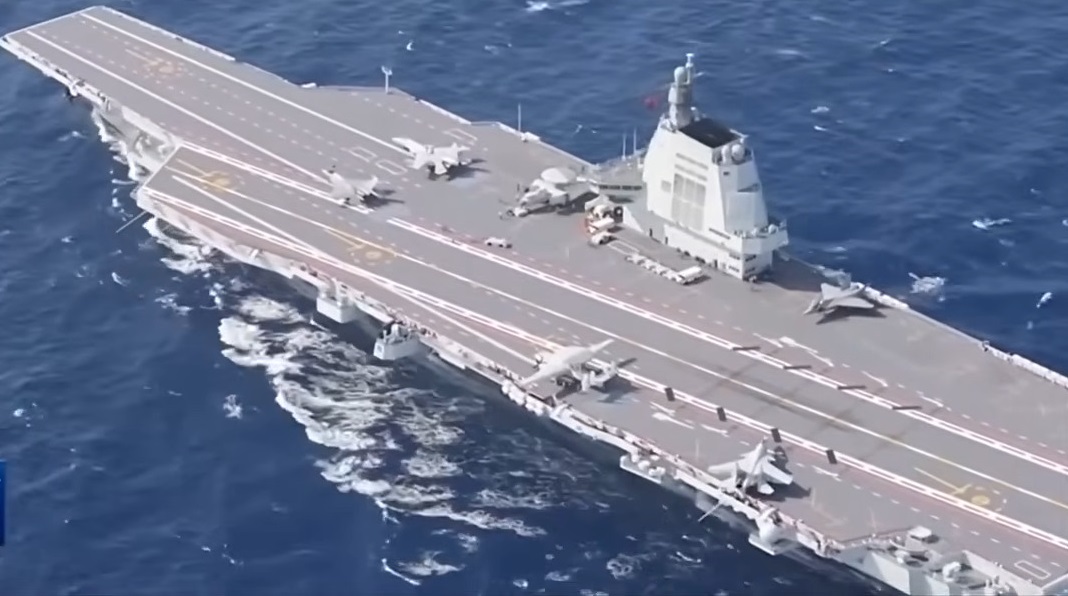
Defense News reported on November 16, citing regional experts and public activity records, that following statements by Japan's Prime Minister in 2025 regarding the potential threat of a Taiwan Strait conflict to Japan's survival, the Chinese Navy has significantly increased its long-range deployments in the waters surrounding Japan's southwestern islands, including live-fire training, drone missions, and complete carrier group operations. The mixed formation of the Liaoning and Fujian carriers along with Coast Guard forces observed in early November indicates that such actions are no longer just carrier training but are testing the joint capabilities of the Navy, Coast Guard, and air forces to exert maritime pressure.
The significance of the Fujian carrier is not simply "one more aircraft carrier." As China's first carrier equipped with electromagnetic catapults, it theoretically enhances the operational flexibility of fixed-wing early warning aircraft and carrier-based fighters, allowing the carrier group to maintain a more complete air defense when far from domestic airfields. Public information is still insufficient to prove that the Fujian has developed a mature long-range operational standby capability, especially since the scale of its carrier air wing, the reliability of its catapults, and long-term support data have not been disclosed. However, including it in long-range operations alongside the Liaoning at least indicates that the PLA is accumulating experience in dual-carrier coordination and cross-domain deployment.
The Real Change Lies in Maritime Rhythm
The daily announcements of military aircraft numbers by Taiwan easily become a focal point of public opinion, but the sustained presence of naval vessels is harder to "reset." Aircraft need to return for maintenance and ammunition replenishment after completing a mission, while vessels can maintain a presence at sea for several days or even longer, extending their operational chain through supply ships, Coast Guard vessels, and land-based air forces. In simple terms, the PLA is breaking down the peak of a single exercise into many low-intensity, repeatable daily actions.
This pressure is particularly evident for Japan. The islands to the southwest of Japan, the Miyako Strait, and the northern air and maritime areas around Taiwan are interconnected; any carrier group entering the Western Pacific from the East China Sea will compel the Japan Air Self-Defense Force and Maritime Self-Defense Force to continuously allocate reconnaissance, fighter jets, and surface vessels. If Japan wants to maintain the same frequency of tracking, it must increase its rotating forces, long-range sensors, and logistics budget. The recent discussions in Japanese media about a 70 trillion to 80 trillion yen five-year defense plan starting in 2027 have gained political space against this backdrop of long-term attrition.
Don't Rush to Equate It with Blockade Exercises
I believe the most critical judgment to avoid right now is interpreting all carrier movements as a direct rehearsal for "the next Taiwan Strait war." Existing public data can only confirm the scale of activities, routes, and some formations; it cannot prove that the PLA has completed the sustained resupply, maritime traffic control, and joint firepower closure necessary for a blockade of Taiwan. The Fujian also still needs to demonstrate the actual maturity of its carrier aviation through more public deployments.
Conversely, underestimating this normalization is equally dangerous. It allows the PLA to gather command coordination data under real maritime conditions, keeps Japan and Taiwan's early warning systems in a state of readiness, and gradually shapes a new baseline where "PLA vessels appearing beyond the first island chain is a normal phenomenon." What is truly worth tracking is not how many military aircraft will appear next time, but when the Fujian will begin to carry a stable fixed-wing early warning and fighter jet group, continuously traversing the Miyako Strait area without large-scale publicity.
Sources and Basis for Judgment
Taiwan's defense department "PLA activities in the waters and airspace around Taiwan Nov. 20 2026": https://air.mnd.gov.tw/en/News/News_Detail.aspx?CID=214&ID=59406
Defense News "China has normalized naval presence near Japan since political spat of 2025": https://www.defensenews.com/global/asia-pacific/2026/11/16/china-has-normalized-naval-presence-near-japan-since-political-spat-of-2025/
This article is an independent analysis based on publicly available information; regarding the Fujian's long-range standby maturity and specific tasks of the formation, further confirmation from official or satellite data is awaited.
Chinese military aircraft and naval vessels operated near Taiwan from November 19 to 20, 2026, with six aircraft crossing the Taiwan Strait median line. The PLA's ongoing presence, including the Fujian and Liaoning aircraft carriers, signifies a shift towards normalized military operations in the East China Sea and Southwest Islands of Japan. This trend is prompting Japan to enhance its defense capabilities and budget in response to perceived threats.
- PLA aircraft and naval vessels were active near Taiwan from November 19 to 20, 2026.
- Six aircraft crossed the Taiwan Strait median line during this period.
- The presence of the Fujian and Liaoning aircraft carriers indicates a shift towards normalized operations in the region.
- Japan is increasing its defense budget in response to these activities.
- The PLA is testing its ability to coordinate naval and air forces in the region.