
"Poisonous Foam Erupts from Manhole Covers Around U.S. Military Bases in Japan"
Xinhua News Agency, Beijing, February 6 - After recent pollution issues were reported in the water bodies and soil surrounding U.S. military bases in Japan, a large amount of foam was found emerging from manholes around the Futenma base in Okinawa Prefecture last week, raising concerns about the possible presence of toxic substances. Experts involved in the investigation confirmed on the 5th that the foam contained high concentrations of per- and polyfluoroalkyl substances (PFAS), which likely originated from the U.S. military base and could threaten the health of nearby residents. The people of Okinawa are once again demanding access to the U.S. military base to investigate the source of the pollution.
Indeed "toxic"
On January 29 of this year, a large amount of white foam was discovered emerging from manholes around the Futenma base located in Ginowan City, Okinawa Prefecture. The Ginowan City government and a civic group collected samples of the foam for expert analysis. The analysis results released on the 5th by Koji Harada, a professor of environmental health at Kyoto Prefectural University, showed that the concentration of per- and polyfluoroalkyl substances in the foam was 268 nanograms per liter, which is five times the provisional national standard in Japan.
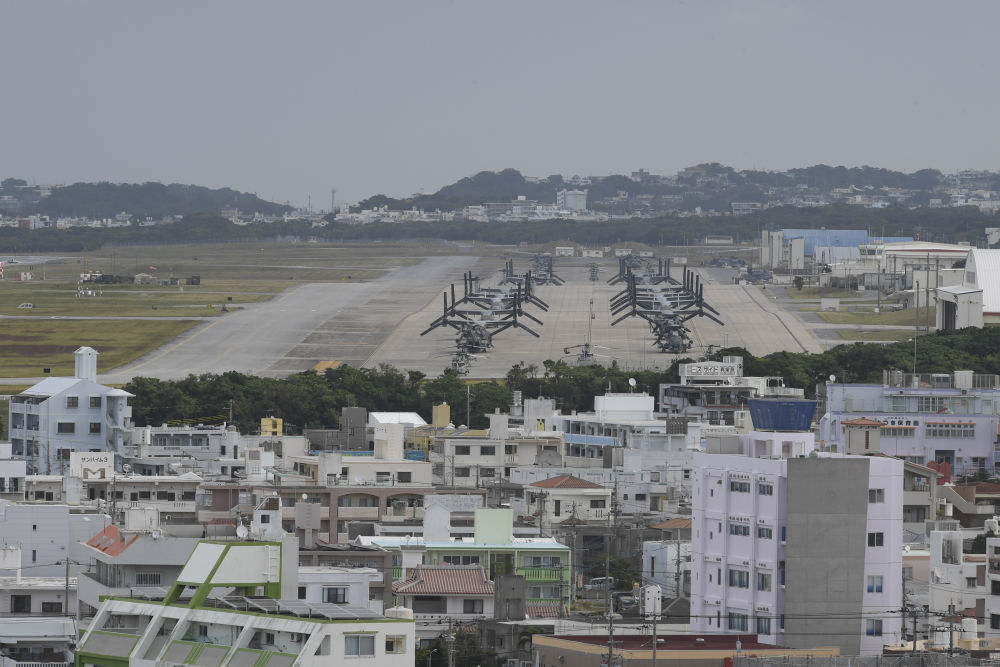
This is a V-22 Osprey transport aircraft stationed at the U.S. military Futenma base in Okinawa, Japan, on November 25, 2023. Photo by Xinhua reporter Feng Wuyong
Per- and polyfluoroalkyl substances are difficult to degrade and can accumulate in the environment and the human body, earning them the label of "forever chemicals." Experts point out that long-term consumption of water contaminated with these substances may affect reproductive health and child development, and could even lead to diseases such as breast cancer and prostate cancer.
The Ginowan City government stated that the sewer system beneath the manholes from which the foam is emerging is connected to the U.S. military Futenma base. The Ginowan City government has sampled the water in the sewer system through which the "toxic foam" flows to test for the presence of per- and polyfluoroalkyl substances. The analysis results are expected to be available in about a month.
In response to the "toxic foam" incident, the U.S. military base stated on January 30 that it was "unrelated to the incident." According to the U.S. military, no foam fire extinguishing agents were used or related training conducted "the day before the incident." The U.S. military in Japan claimed in 2024 that it would no longer use fire extinguishing agents containing per- and polyfluoroalkyl substances, opting instead for agents that do not contain these substances.
Koji Harada believes that the latest investigation results indicate that the U.S. military base "may have been continuously discharging per- and polyfluoroalkyl substances."
Accused of "hiding the truth"
Japanese media reported on the 5th that a civic group from Okinawa Prefecture visited the prefectural assembly two days ago, requesting access to the U.S. military base regarding the "toxic foam" incident, and to jointly conduct an investigation with the Okinawa Prefectural government and relevant departments to determine the source of the pollution.
Previously, Japanese media disclosed that the U.S. military had admitted in 2023 that its training activities were likely the cause of the excessive levels of per- and polyfluoroalkyl substances in the surrounding area, but the Japanese Ministry of Defense did not disclose this information to the public. The civic group suspects that the Japanese government is "deliberately hiding the truth" and is demanding that the government and the U.S. military publicly release all original and translated responses to base investigation requests, and is considering making relevant appeals to the Japanese Ministry of Defense.
Since 2016, Okinawa Prefecture has submitted four requests to the U.S. side through the Japanese Ministry of Defense to enter the U.S. military base to investigate the source of the pollution, but has not received a response. The Japanese Ministry of Defense stated that the U.S. military finally formally responded "disagree" to the relevant investigation request in December 2025. The reason given by the U.S. side is that there is currently no scientific basis to prove that the U.S. military base and related facilities are the source of the pollution, and that there is no unified standard for determining the contamination of water and soil samples between Japan and the U.S.
A research institution in Okinawa Prefecture stated that the latest research shows that per- and polyfluoroalkyl substances can transfer through the placenta to the fetus, with global reports of related cases such as low birth weight, pregnancy-induced hypertension, and gestational diabetes. The institution and the civic group have decided to provide blood testing for pregnant women residing in Okinawa Prefecture starting this month to prevent the impact of these "forever chemicals" on the health of pregnant women and fetuses. (Zhang Jing)
High concentrations of per- and polyfluoroalkyl substances (PFAS) were detected in foam emerging from manholes near the U.S. military base in Okinawa, Japan, raising health concerns among local residents. The U.S. military denied any connection to the contamination, while Okinawa officials have requested access to the base for further investigation. Local experts confirmed the foam's toxicity, prompting demands for accountability and transparency regarding the pollution source.
- High levels of PFAS detected in foam from manholes near the U.S. military base in Okinawa.
- Local residents express health concerns due to potential toxicity of the foam.
- The U.S. military denies involvement in the contamination.
- Okinawa officials have requested access to the base for further investigation.
- Previous admissions by the U.S. military suggest training activities may have contributed to the contamination.