
Poland's 60 Billion Zloty SAFE Contracts Highlight Europe's Procurement Problem 2026
 Dr. Klaus Weber
Poland's 60 Billion Zloty SAFE Contracts Highlight Europe's Procurement Problem 2026
60 billion zloty for heavy weapons in a single contract block: Poland has done exactly what Brussels has been promising for months and what many capitals have only discussed abstractly, using the European credit instrument SAFE. On May 30, contracts were signed for Borsuk infantry fighting vehicles, Krab howitzers, Rak mortars, Homar-K support vehicles, and 155mm artillery ammunition. According to Defense News, the value amounts to around 60 billion zloty, or about 16.5 billion dollars. This is not a normal procurement package. It is the first major test of whether European defense financing can generate industrial capacity faster than national budget processes.
The preliminary answer is: partially. Poland can now place orders because Brussels disbursed the first SAFE pre-financing of 6.6 billion euros on May 29. The European Commission estimates Poland's total allocation at 43.7 billion euros, naming Warsaw the largest recipient of the instrument. However, there is a gap between the credit line and combat value, which is particularly visible in Warsaw. SAFE lowers financing costs; however, it does not automatically produce production lines, skilled workers, explosives, steel bodies, fire control systems, and supply discipline.
The Polish Approach is Radically National, Not Abstractly European
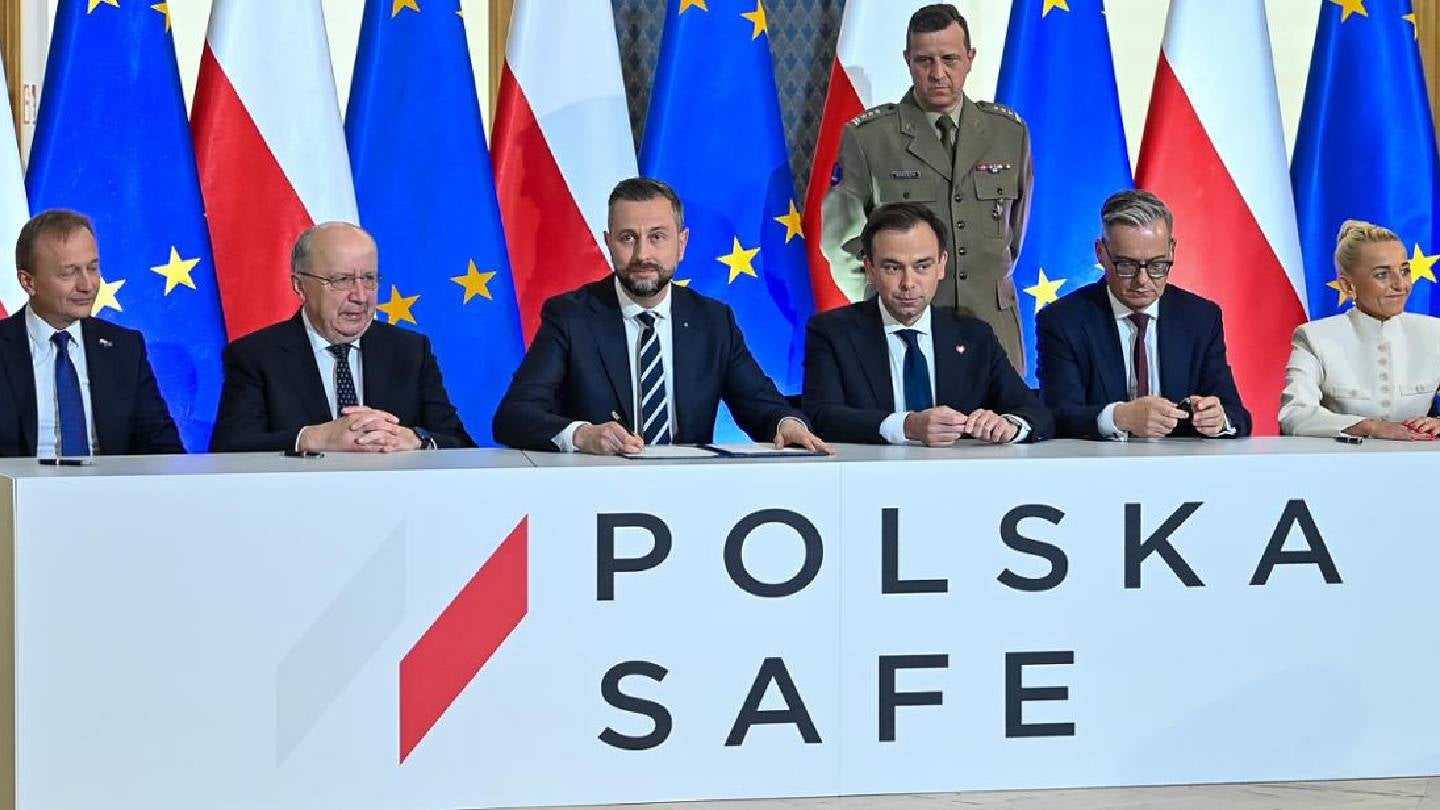
What is remarkable is not only the sum but also the structure. The main recipients are Polish companies, especially the state-owned PGZ group and Huta Stalowa Wola. Orders were placed for 146 Borsuk infantry fighting vehicles, 96 AHS Krab 155mm self-propelled howitzers, 64 Rak 120mm mortars, and about 1,000 vehicles for ammunition, command, and communication in the Homar-K rocket artillery system. Additionally, there is a separate contract for more than 13.5 billion zloty for several hundred thousand 155mm shells.
This sounds like exactly the kind of European arms shift that is often described in grand terms in Brussels. But Poland interprets it in a very sober sense: European money, national factories, national armed forces, later export capability. According to Notes from Poland, the government had already stated at the end of May that it intended to spend around 90 percent of the SAFE funds domestically. More than 10,000 Polish companies are expected to benefit indirectly. This is industrial policy with security policy urgency.
Here lies the first institutional contradiction. SAFE was designed as a European instrument, intended to promote interoperability and incentivize joint procurement. However, its first major practical application looks like the accelerated financing of a national reindustrialization. Is that a mistake? Not necessarily. Poland has an immediate perception of threat, a long border with Belarus, and Kaliningrad in strategic proximity. Warsaw needs mass faster than Brussels can produce consensus. But if every member state primarily uses SAFE as a credit line for its own national champion, more capacity will be created in the end, but not necessarily more integration.
SAFE Addresses the Interest Rate Issue, But Not the Capacity Issue
The European Commission describes SAFE as an instrument that enables long-term and favorably structured loans through EU borrowing. Breaking Defense reported in May that the loans have a term of 45 years and a ten-year grace period. For Poland, this is financially attractive. It allows for contract signings today, with the budget burden politically deferred into the future.
But defense capability does not arise with the date of the signature. A Krab howitzer is not just a vehicle with a barrel; it is part of a supply chain consisting of chassis, turret, fire control, optics, ammunition, maintenance, and trained personnel. A Borsuk infantry fighting vehicle is not just a new platform, but a question of series production. And 155mm ammunition is, after three years of the Ukraine war, the most honest unit of measurement in European arms policy: those who can forge shells, fill TNT, produce propellants, and scale quality control possess industrial power. Those who only grant loans possess payment capability.
Poland's ammunition contract is therefore more important than the flashy vehicle list. PGZ emphasizes that shell bodies will be forged in Poland and filled with Polish TNT. This is the right lesson from Ukraine. Europe believed in 2022 and 2023 that stockpiles were a bridge to production. In reality, they were often just a thin carpet over industrial erosion. Poland is now trying to rip up the carpet and renew the factory floor. But here too, the announcement of a national supply chain is not yet a proven monthly output rate.
The Dispute with Washington is Built-In
The domestic political controversy in Warsaw is not a Polish fringe phenomenon but the core of the European problem. President Karol Nawrocki and the PiS opposition criticize SAFE as a potential Brussels intervention in national security decisions. Former Defense Minister Mariusz Błaszczak additionally warns that Poland could be pushed out by EU-funded procurement from American suppliers. For a country that simultaneously hosts about 10,000 US soldiers on its territory and understands large contracts with Washington as a strategic bond, this is not just a campaign slogan.
Defense Minister Władysław Kosiniak-Kamysz is trying to neutralize this tension. Poland still has contracts with the United States worth more than 200 billion zloty, he said according to Defense News. This is politically wise but analytically unsatisfactory. SAFE demands more European industrial value creation; Poland's deterrence model remains strongly American at the same time. This very dual structure defines Europe's security situation in 2026: more European production, but still American reassurance.
This can be defended as a transitional model. Poland is not buying Abrams, HIMARS, F-35, and Patriot out of sentimental Atlantic loyalty, but because these systems are available, combat-proven, and politically tied to the American presence. At the same time, Warsaw cannot ignore that the US is dividing its attention between Europe, the Indo-Pacific, and the Middle East. The logical answer is therefore not either-or, but an expensive parallel strategy: American high-value capabilities where Europe has no alternative; national and European mass production where it can realistically be built.
European Autonomy Begins with Uncomfortable Dual Structures
For Brussels, Poland is both a success and a warning. Success because SAFE finances concrete contracts for the first time in large sums. Warning because the first major contracts show how politically fragmented European arms integration remains. Poland is using EU debt to build Polish capacities; France is using SAFE differently; smaller states will have to attach themselves to larger supply chains. This is not a common European arms market but a network of national procurement logics under a common financial roof.
Perhaps more is not possible at this stage. Ukraine has forced Europe to give up the luxury of slow harmonization. Those who need 155mm shells, infantry fighting vehicles, and mortars cannot wait until all member states have negotiated a perfect division of labor. But Europe's problem has never been just too little money. It has been the confusion of financing, procurement, and capability. Poland is now making the most honest attempt to close this chain. Whether it succeeds will not be decided in Brussels press releases but at the gates of Huta Stalowa Wola.
The real paradox remains: SAFE is supposed to create strategic autonomy by indebting national states, strengthening national industries, and only gradually reducing American dependencies. This is less elegant than European speeches about sovereignty. But it is closer to reality. Europe will not become autonomous because it decides on an instrument worth over 150 billion euros. It will become autonomous when reliable series production emerges from these loans. Poland has now begun the first major proof attempt for this.
Source Note: Defense News, European Commission, Breaking Defense, and Notes from Poland on Poland's SAFE allocation, the contract signings of May 29/30, 2026, and the procurement positions for Borsuk, Krab, Rak, Homar-K, and 155mm ammunition.
Poland signed contracts for heavy weapons procurement worth 60 billion Zloty under the SAFE program on May 30, 2026, aiming to enhance its defense capabilities. The contracts include 146 Borsuk infantry fighting vehicles, 96 AHS Krab howitzers, and several hundred thousand 155mm shells. Poland plans to utilize 90% of the SAFE funds domestically, benefiting over 10,000 Polish companies, while navigating the complexities of European defense integration and national security concerns.
- Poland signed contracts worth 60 billion Zloty for heavy weapons on May 30, 2026.
- The contracts include 146 Borsuk infantry fighting vehicles and 96 AHS Krab howitzers.
- Poland aims to utilize 90% of SAFE funds domestically, benefiting over 10,000 Polish companies.
- The SAFE program is intended to enhance European defense capabilities but is being used primarily for national interests.
- Poland's defense strategy includes significant reliance on American military systems alongside European procurement efforts.