
Port Arthur Witness: New and Old Warships "In the Frame" Celebrating Navy Day
[Global Times reporter Guo Yuandan, Global Times special correspondent Yu Chao, Zhou Yang, Guo Zhengyang] Entering the classroom of the Zheng He ship, 23-year-old Ye Ruiting ran directly to the chart table in the last row, "This was my seat back then." In July 2023, Ye Ruiting had her first "intimate contact" with the ship on the Zheng He, where she completed a comprehensive understanding of the vessel and became familiar with the basic operational processes. At that time, she was still a sophomore; now she has become an officer on the Ordos ship.
April 23 of this year marks the 77th anniversary of the founding of the People's Navy. The Navy held open house events in more than ten cities across the country, with over 40 active-duty ships meeting the public. At the military dock in Dalian's Lüshun Port, the Zheng He ship, Ordos ship, and other types of warships were open to the public.
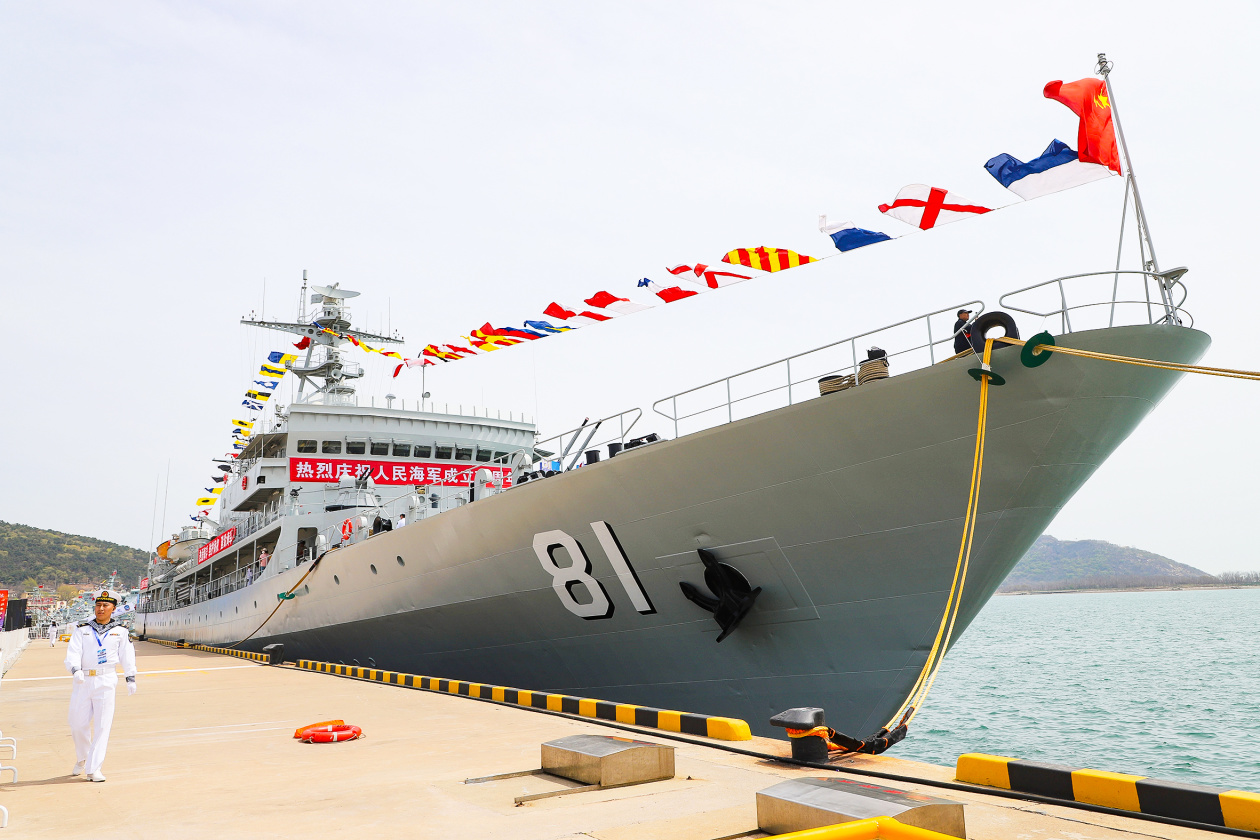
Among them, the "joint appearance" of the Zheng He ship and the Ordos ship left a deep impression on reporters. The Zheng He ship is the first ocean-going training vessel designed and built by China. It is equipped with comprehensive training facilities, including a maritime classroom, a ship maneuvering simulation training system, an integrated teaching system, and practical conditions supporting navigation, communication, and electromechanical subjects. The Ordos ship is a 054A-class missile frigate designed and built by China, equipped with weapon systems such as naval guns, anti-ship missiles, air defense, anti-submarine, and short-range missile defense, as well as electronic warfare and helicopter deck systems.
The Zheng He ship was commissioned in 1987 and has been in service for nearly 39 years. The Ordos ship will be commissioned in 2025 and is currently the main surface vessel for the People's Navy's long-range operations and routine patrols, representing the highest combat capability level of frigates. The two ships have nearly a 40-year "age difference," and their joint appearance not only reflects the legacy of naval officers passing down through generations and striving to strengthen maritime capabilities but also visually demonstrates the iterative upgrades and leaps in combat power of the People's Navy's equipment.
A chart table witnessing the growth of naval navigation talents
The Navy is a technology-intensive military branch, and cultivating students' practical hands-on abilities is crucial. The mission of the Zheng He ship is to connect the classroom with the battlefield, bridging the "last mile" of talent delivery to the troops, so every aspect of the ship's design serves educational purposes.
The chart table that Ye Ruiting feels familiar with is a widened and lengthened desk. Although it is equipped with stools, sitting down to read or write is not comfortable, as chart work requires standing to mark and annotate on the paper.
Meng Feida, a class leader on the Zheng He ship, brought over a chart to lay out; the chart can be embedded in the slots on the edge of the table, preventing the paper from curling and making it easy to take out and put away.
Charts are essential navigation roadbooks for ships sailing on the sea, and independently completing chart work is a required course for a qualified ship commander. "Each time we sail far, students need at least dozens of charts. Different sea areas and ports correspond to different charts," Meng Feida explained, noting that he has served on the Zheng He ship for 12 years and has trained multiple batches of students, with the shiny surface of the table being the "result" polished by generations of students.
Ye Ruiting clearly remembers that to mark the ship's position on the chart, she held a sextant (an optical instrument) on the deck to find identifiable landmarks.
For different specialties, the assessment of chart subjects varies, and the difficulty requirements also differ. Wang Songyuan, now an officer on the Ordos ship, reached the standard for supporting daily navigation duties with the charts he completed during his sophomore year on the Zheng He ship. With just the basic sextant and azimuth instrument, he could plot the real-time track of the Zheng He ship as required. "Keen eyes, quick hands, meticulous heart, and clear mind" are the basic qualities needed to complete chart work.
After nearly two years of work, Wang Songyuan can "almost memorize" some commonly used charts. This also means he has internalized certain sea areas, allowing him to reconstruct them directly in his mind. In ensuring combat navigation, this can significantly shorten the decision-making response time for commanders, enhancing the ship's survivability and combat effectiveness. Of course, this is also inseparable from the precise coordinate benchmarks provided by the advanced satellite navigation system on the Ordos ship.
"During my internship on the Zheng He ship, the chart work done 'without radar or satellite navigation' was our core skill and the most fundamental means of navigation. When both radar and satellite navigation fail, we can revert to celestial navigation, using the sextant for landmark positioning, or by observing the sun and stars to obtain latitude and longitude for direction," Wang Songyuan believes. "My internship on the Zheng He ship was the first button of my career and an irreplaceable valuable experience in becoming an excellent ship commander."
Multiple types of radar weave the history of naval equipment development, from "seeing" to "seeing clearly"
It was precisely because of the experience of training on the Zheng He ship that Ye Ruiting ultimately became a crew member on a surface vessel.
Ye Ruiting vividly remembers her internship on the Zheng He ship. The reporter followed her back to the Zheng He ship, and at every place they visited, Ye Ruiting could recall her learning experiences from back then. In front of an old-looking radar, she said she "had used it before."
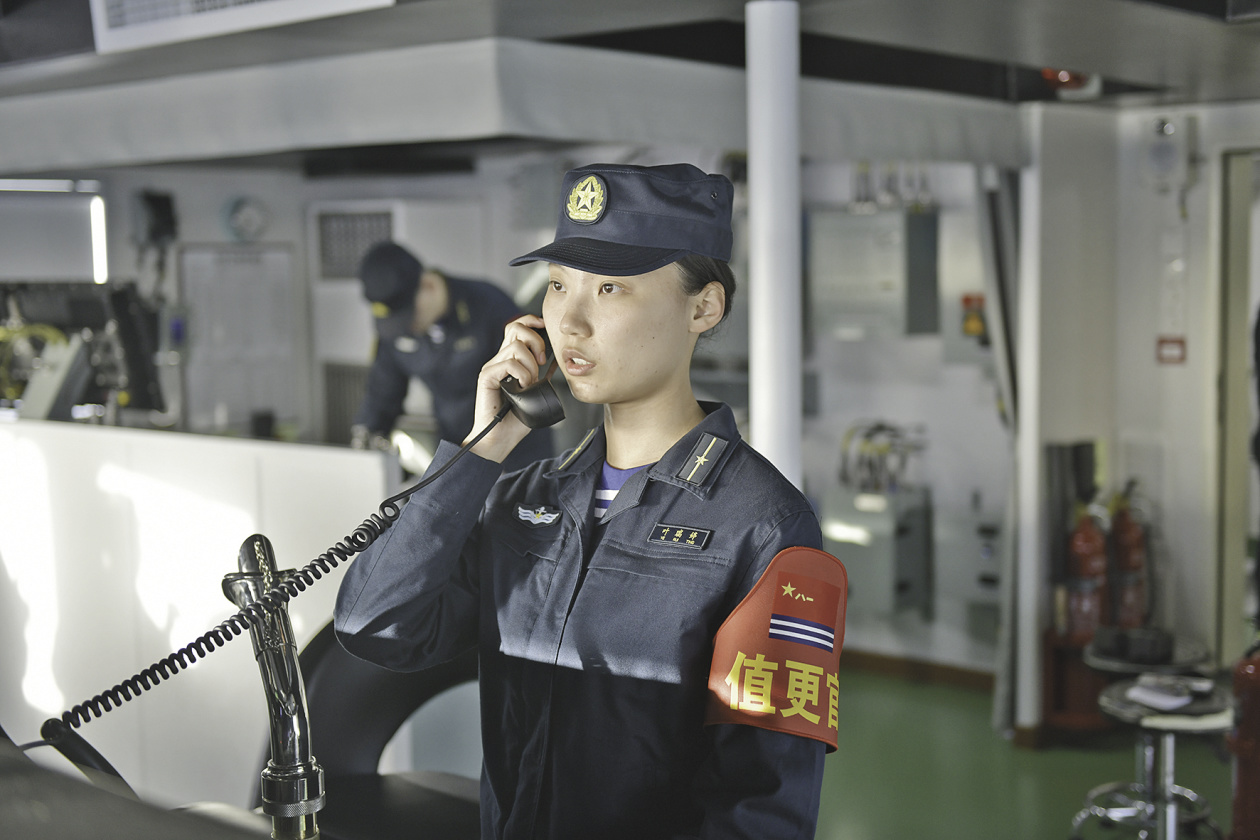
"This is the most primitive generation of radar, which can only measure the distance and direction of targets, making it easier for students to learn quickly," said Liu Chengwei, a class leader on the Zheng He ship, noting that there are currently seven types of navigation radars from different eras on the Zheng He ship, almost forming a miniature history of naval radar equipment development.
"Old radars are the most primitive and basic training carriers; new radars can automatically lock onto targets. Through such comparative teaching, students can solidly master the basics while also becoming familiar with modern equipment, thus growing more comprehensively," Liu Chengwei explained.
On the Ordos ship, the integration and informatization of various radars, including navigation radars, are at a higher level. "Our ship has achieved more precise perception of maritime and aerial targets," Ye Ruiting introduced. From the Zheng He ship to the Ordos ship, the development of multiple types of radar clearly outlines the Chinese Navy's journey from "seeing" to "seeing clearly and distinguishing accurately" in equipment evolution.
The department Ye Ruiting is in is equivalent to the "intelligent brain" of the ship. The newly commissioned Ordos ship is the latest modernized upgrade version of this type of ship, with significantly enhanced levels of informatization and intelligence. "All our software and hardware have been domestically produced, providing a better user experience. By optimizing the operational command system architecture, we have enhanced comprehensive combat and coordination capabilities in complex battlefield environments," introduced Yang Wenzhi, an officer on the Ordos ship.
The "14th Five-Year Plan" outline mentions in the section on "accelerating the construction of advanced combat capabilities": strengthening strategic deterrent forces, maintaining global strategic balance and stability, promoting the large-scale, practical, and systematic development of new domain and new quality combat forces, accelerating the construction of unmanned intelligent combat forces and countermeasures, and enhancing the upgrade and transformation of traditional combat forces.
"For us, it is both an opportunity and a challenge," Yang Wenzhi said. "We are also learning to use various advanced models and intelligent technologies, integrating them into the combat power generation chain. Regardless of how technology evolves, the last link in the command chain will always be the commanders with solid professional qualities, rich practical experience, and decision-making abilities. Ultimately, talent is the decisive factor in winning future wars."
A new generation of warships supports a new generation of naval power
Stepping onto the Zheng He ship, traditional navigation instruments such as the compass and sextant are quietly placed here, affectionately referred to as the "star-gazing and sea-measuring" deck. Standing on the deck, the scene of using the sextant to determine direction once again comes to the minds of Wang Songyuan and Ye Ruiting.
The deck of the Zheng He ship carries a profound training heritage and historical foundation, while the deck of the Ordos ship nearby points directly to the deep blue battlefield. Looking from the dock, the hull of the Ordos ship is long and entirely sea gray. The newly added radar panels around the bridge showcase the ship's upgrades in informatization and intelligence. The most eye-catching feature on the deck is the stealth main gun at the bow, with its smooth turret contrasting sharply with the angular structures of the upper deck.
"Our current naval guns have a faster firing rate, longer range, and higher accuracy," said Guo Pengyu, an officer on the Ordos ship, noting that "the optimization of equipment performance has significantly shortened combat response times in practical applications, and the strike capability has also been enhanced accordingly."
During the public open day, Ye Ruiting served as a guide on the Ordos ship. At the helicopter takeoff and landing platform, she explained, "This ship usually carries a shipborne helicopter when performing maritime missions, which can be parked here and is mainly used for a series of tasks such as maritime reconnaissance, search, anti-submarine, escort, rescue, and transportation. The tracks beneath our feet are rapid recovery devices that assist the helicopter's takeoff and landing, pulling the helicopter in and out quickly."
Compared to previous 054A vessels, the reporter can feel that the helicopter deck of the Ordos ship is longer. This is not just a simple change in size but is designed to accommodate helicopters with longer ranges and stronger anti-submarine capabilities. Ye Ruiting expressed that what she is most proud of is the helicopter takeoff and landing platform, "Our ship can take off and land new shipborne helicopters, representing the combat strength of a major power's navy."
During the interviews conducted by the Global Times reporter, most of the officers encountered were "post-2000s," who have become the main force of the Navy's new ship commissioning units.
"Active thinking and broad vision" are the labels of the "post-2000s" young officers. In 2023, Wang Songyuan, still a senior in college, participated in a far-sea internship visit with the ship, visiting countries such as Vietnam, Brunei, and Thailand. During the visit, Chinese vessels not only conducted joint training with the navies of these countries but also had multiple opportunities to visit and inspect foreign military vessels, barracks, schools, and training institutions, engaging in military exchanges.
As the People's Navy's far-sea training becomes routine, the tracks continue to extend, and the frequency of young officers like Wang Songyuan executing far-sea missions is increasing. For these young officers, it is a rapid growth process. "On one hand, through practical navigation in far seas, I can enhance my professional skills and accumulate experience; on the other hand, I can also personally realize the importance of building a strong People's Navy—strength is the foundation of peace." During the exchanges while visiting, Wang Songyuan also sensed the recognition of the Chinese Navy from foreign counterparts, which filled him with pride and confidence.
With the iteration and update of weaponry, these young officers face highly integrated command systems and informatized equipment as they transition from graduation to active duty. Compared to their predecessors, they stand at a higher starting point for informatized combat. Based on the context of the People's Navy's transformation and development, striving to strengthen maritime capabilities, they not only welcome the era's opportunities to master new equipment and rapidly enhance combat power but also face the complex challenges brought by intelligent warfare, shouldering the mission of transforming technological advantages into practical victory on future battlefields.
On April 23, 2023, the People's Liberation Army Navy held a public open day in Dalian, showcasing over 40 active naval vessels, including the Zheng He training ship and the Ordos frigate. This event marked the 77th anniversary of the navy and highlighted advancements in naval training and equipment. Young officers participated in the event, reflecting the evolving role of the new generation in naval operations and international exercises.
- The People's Liberation Army Navy celebrated its 77th anniversary on April 23, 2023.
- Over 40 active naval vessels were showcased to the public in Dalian.
- The Zheng He ship is China's first self-designed ocean training vessel, while the Ordos is a modern 054A frigate.
- The event highlighted the evolution of naval training and equipment over nearly 40 years.
- Young officers are increasingly involved in naval operations and international training exercises.