
Privy Council No. 10: What Other Trump Cards Do the US and Iran Have Around the Strait of Hormuz?
As the conflict between the United States and Iran continues, the "struggle" between the two sides over the Strait of Hormuz is escalating. Late at night on March 2, an advisor to the commander of the Iranian Islamic Revolutionary Guard Corps stated that the Strait of Hormuz has been closed, and Iran will strike all vessels attempting to pass through the Strait. As of now, the Iranian Islamic Revolutionary Guard Corps has not issued an official statement. U.S. President Trump stated on March 1 that "the U.S. has destroyed and sunk 9 Iranian naval vessels." U.S. satellite images show significant damage to key Iranian naval bases. There is a widespread belief that the U.S. military's strikes on Iranian warships aim to eliminate Iran's military capabilities that could be used to blockade the Strait of Hormuz. The world is closely watching how the situation in the Strait of Hormuz will develop, and whether Iran truly has the capability and determination to lock down the Strait. If Iran blocks the Strait of Hormuz, what options will the U.S. military have left?
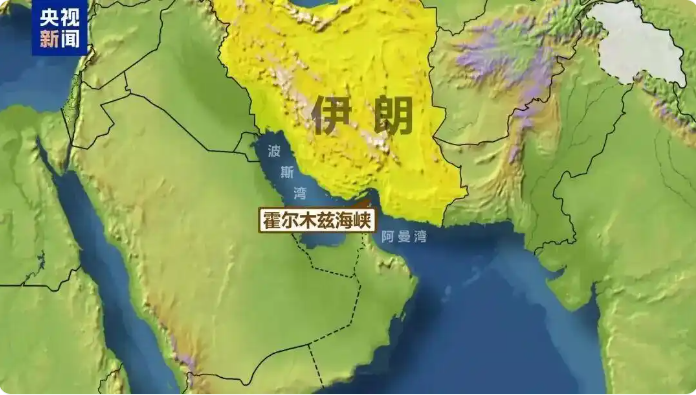
The strategic importance of the Strait of Hormuz can be seen on the map. As a strategic passage connecting the Persian Gulf and the Gulf of Oman, approximately one-fifth of the world's oil transportation passes through this Strait.
Due to the fact that the narrowest part of the Strait is about 39 kilometers wide (with only two one-way safe channels available for large oil tankers, each about 3 kilometers wide), its strategic position and geographical attributes make it susceptible to being blocked.
Now, let's take a look at what Iran's trump cards would be if it truly wanted to blockade the Strait.
After Iran announced the closure of the Strait, about 150 oil tankers have been anchored in the open waters on both sides of the Strait of Hormuz, waiting to pass. Foreign media quoted Nick Childs, a maritime security expert from the British think tank International Institute for Strategic Studies, stating that Iran has developed a "fairly extensive" capability, including mines, fast boats, submarines, drones, and anti-ship missiles, to blockade the Strait of Hormuz. He stated, "If these weapons are used in a comprehensive operation, it could cause very serious damage."
The Guardian reported that the easiest way for Iran to blockade the Strait would be to lay mines in the two 3-kilometer-wide channels; once passing vessels are detected, these mines would detonate. Iran possesses thousands of mines, including relatively traditional anchor mines and modern rocket-propelled mines, posing a significant threat to passing vessels. During the Iran-Iraq War, Iran used old mines to damage a large oil tanker that was being escorted by the U.S. Navy. During the Gulf War in 1991, the U.S. Navy's USS Tripoli and USS Princeton were also damaged by Iraqi mines, demonstrating the threat that mines pose to modern navies.
The Guardian believes that under the close surveillance of the U.S. Navy, Iran would likely need submarines and small fast boats to covertly lay mines to blockade the Strait of Hormuz. Although "Iran can utilize coastal anti-ship firepower, small fast boats, and aerial drones to support mine-laying operations, it may face attacks from the U.S."
Additionally, another option for Iran to blockade the Strait of Hormuz is to deploy a large number of armed fast boats and missile boats to conduct "wolf pack attacks," which is also a focus of training for the Iranian Islamic Revolutionary Guard Corps in recent years.
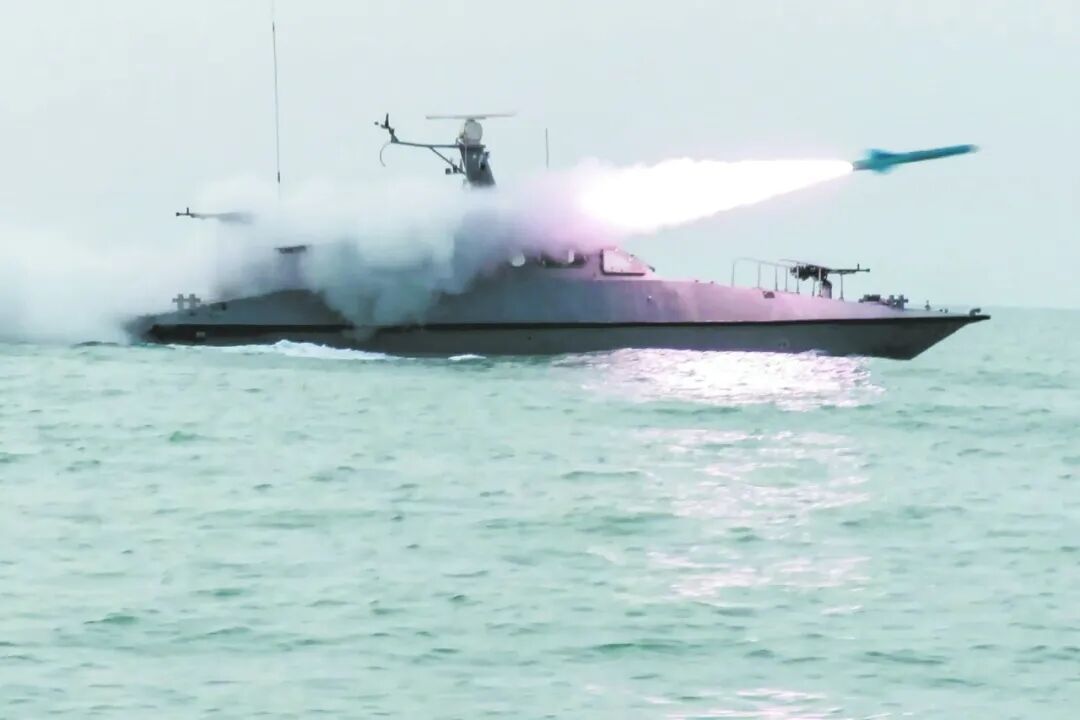
Photos released by the Iranian military on February 16 show the Iranian Navy and the Islamic Revolutionary Guard Corps conducting joint exercises in the Persian Gulf, with a fast boat launching a missile.
Currently, the U.S. Navy's USS Lincoln carrier strike group needs to guard against the threat of Iranian coastal anti-ship firepower. The carrier is located far from the Strait of Hormuz, thus limiting its ability to continuously monitor and strike in the Strait. Iran's coastline is dotted with more than a dozen large ports and over 60 small ports, along with many dispersed fishing villages and towns, providing excellent hiding places for small vessels. This creates opportunities for Iran to use fast boats to ambush passing vessels.
Old Liu reviewed a report titled "Closing Moments: Assessing Iran's Threat to the Strait of Hormuz" published years ago by the Belfer Center at Harvard University's Kennedy School.
Although the report was not published around the time of the U.S. airstrikes against Iran, its content still holds certain reference value, revealing the U.S. assessment of Iran's wartime capability to blockade the Strait and considerations regarding its own military power to break the blockade and the potential costs involved.
The report states in its abstract: If Israel or the U.S. were to launch limited strikes, how would Iran retaliate? The most economically damaging response Iran might take is to blockade the Strait of Hormuz. Based on publicly available data, military history, and geographical information, Iran indeed possesses strong near-shore combat capabilities, including mines, anti-ship missiles, and land-based air defense systems. If Iran can effectively integrate these capabilities, it could paralyze or obstruct traffic in the Strait of Hormuz for up to a month or even longer. Efforts by the U.S. to reopen the waterway would likely escalate into sustained large-scale airstrikes and naval battles, during which, even if Iran's actions do not truly blockade the Strait, they could still inflict significant economic and military losses on the U.S. The consequences of launching limited strikes against Iran would be very complex and costly, indicating that the U.S. needs to adjust its military deployments and energy policies.
This report is divided into five parts. The first part introduces the geographical overview of the Strait and how Iran might utilize it to launch a comprehensive near-shore operation, employing means such as mine-laying, anti-ship missiles, and land-based air defense systems. The next three parts analyze the various components of Iran's potential military actions and the possible countermeasures the U.S. might take. The final part discusses the implications for U.S. policy towards Iran and the overall structure of U.S. military forces.
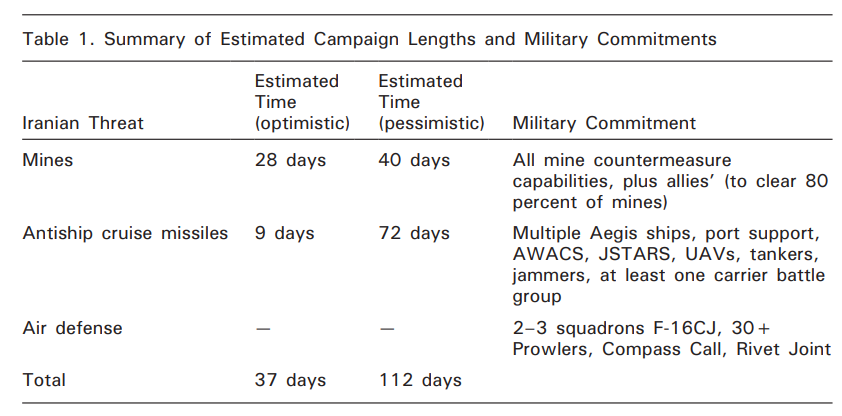
One chart in the report also lists the potential impact on this maritime strategic transportation line in terms of days if Iran were to use different military means to blockade the Strait. The report attempts to quantify the possible duration using "optimistic estimates" and "pessimistic estimates," and tries to enumerate the equipment and military forces that the U.S. might employ in countermeasures.
Having discussed the blockade methods Iran might employ, let's now look at what military actions the U.S. military has taken in recent airstrikes around the Strait of Hormuz, and what considerations lie behind this series of actions?
On March 1, Trump stated on social media that the U.S. has destroyed and sunk 9 Iranian naval vessels, some of which are "large and significant."
According to the U.S. website "Global Security," the main base of the Iranian Navy in the direction of the Persian Gulf is Abbas Port, which is the location of the Iranian Navy Command and is Iran's most important and largest naval base. Additionally, the Chabahar Port Konarak Naval Base facing the Gulf of Oman is also an important docking base for the Iranian Navy's main vessels. Currently, the Iranian Navy has 3 "Alvand" class frigates manufactured in the 1970s in the UK, as well as several "Moudge" class frigates that Iran has copied based on these ships. They are the largest surface combat vessels in the Iranian Navy but have weak air defense capabilities and are basically unable to cope with modern airstrikes.
The international maritime news media "Maritime Executive" reported on March 1 that prior to the U.S. airstrikes, the Iranian Navy did not seem to adjust its deployment, only dispersing significantly from its home port a few hours before the attacks. Reports indicate that satellite images show that as of February 27, the Iranian main frigates "Sabalan" (F73), "Sahand" (F74), "Jamaran" (F76), and "Zagros" (H313) were all docked at Abbas Port. At the same time, the port also had a Russian-made "Kilo" class conventional submarine "Tareq" (S901) in a semi-combat state and another "Kilo" class submarine "Nuh" (S902) still undergoing modifications in dry dock, while the third submarine of the same class, "Younis" (S903), had gone missing after going out to sea.
Additionally, several large vessels of the Iranian Islamic Revolutionary Guard Corps were also docked here, including a drone carrier converted from an oil tanker.
On March 1, U.S. Central Command announced that it had sunk a frigate at the Konarak Naval Base. The U.S. website "Defense" reported that satellite images show that 3 frigates were docked at the base's pier, one of which was severely damaged, with its hull obscured by thick smoke. Furthermore, the Iranian Islamic Revolutionary Guard Corps possesses a large number of missile boats and armed fast boats, which are dispersed across more small docks and ports, making them harder to locate.
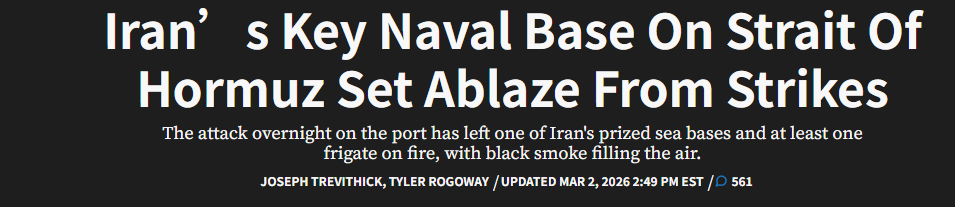
On March 2, an article on the U.S. website "Defense" published satellite images taken by a U.S. satellite company, showing that important naval bases around the Iranian Strait of Hormuz were attacked and caught fire, with at least one frigate ablaze, sending up thick smoke.
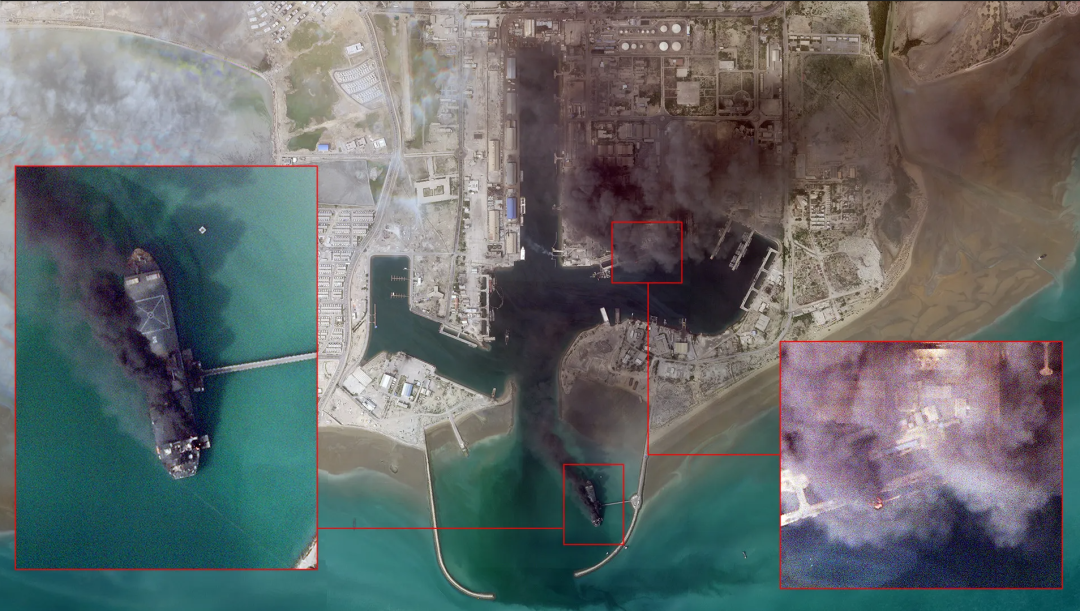
However, "Defense" also acknowledged that the smoke in the satellite images of Abbas Port, which was attacked, makes it difficult to assess the extent of damage to Iranian naval vessels in the port. Comparing images taken on March 2 and February 26, it is evident that some small boats and large vessels have been moved out of the port. This likely occurred after the attacks on Iran, and some vessels may have already sunk, but "Defense" believes there is currently not enough evidence to support these conclusions.
As U.S. media reports indicate, it is currently impossible to confirm the extent of damage to Iran's naval forces from the U.S. and Israeli airstrikes based on publicly available information.
However, even if, as Trump stated, "multiple Iranian warships have been destroyed or damaged," it still does not completely change the situation of both the U.S. and Iran around the Strait of Hormuz.
Currently, the U.S. has a considerable military presence in the Gulf region, but it has not yet been able to completely suppress Iranian maritime activities, especially since mine-laying operations can be carried out with small boats, which means that Iran's military feasibility of using mines to blockade the Strait of Hormuz is quite high.
The Guardian states that mine clearance at sea is a complex and dangerous task that ideally should be conducted in a relatively safe, conflict-free environment. Although the risks of modern mine clearance have been significantly reduced with the use of unmanned mine clearance equipment, the main steps remain fundamentally unchanged: first, using high-performance sonar to search for suspicious targets, then using mine clearance tools to approach for location, confirmation, and final detonation. This means that mine clearance vessels, which lack sufficient self-defense firepower and are slow-moving, need to approach and enter the Strait of Hormuz to operate, thereby exposing themselves to Iranian coastal anti-ship firepower such as drones and anti-ship missiles.
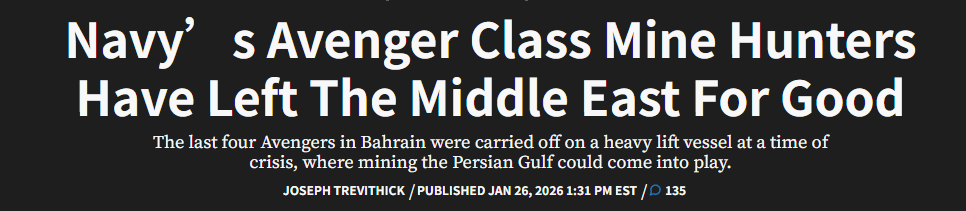
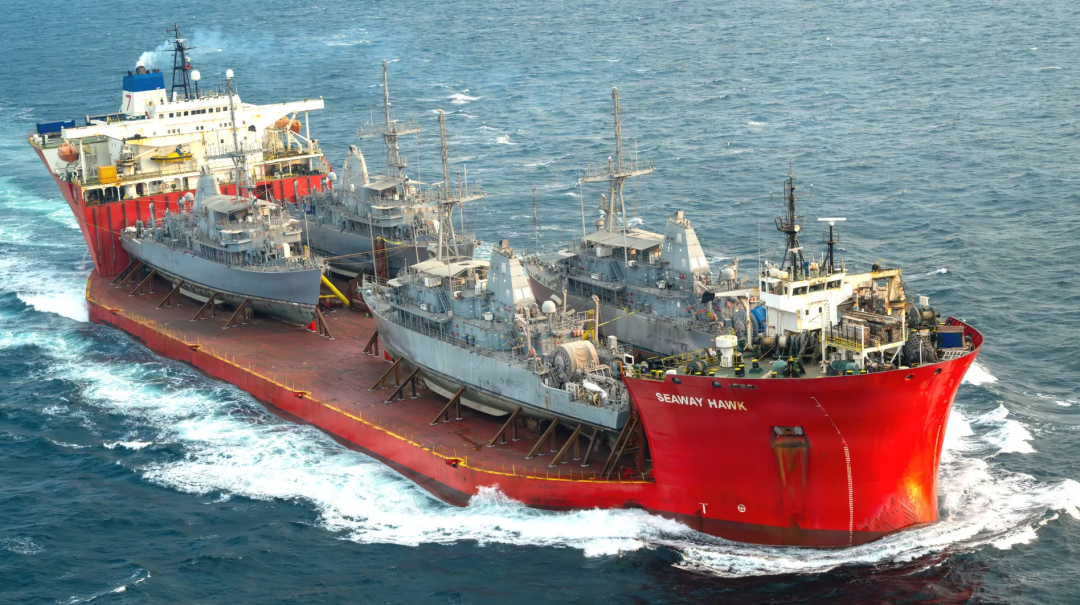
Theoretically, the U.S. military deployed in the Middle East has certain mine clearance and hunting capabilities, but this has significantly declined compared to the Gulf War period. The U.S. website "Defense" previously mentioned that while the U.S. has repeatedly threatened to take military action against Iran, the U.S. Navy has been retiring the 4 "Avenger" class mine countermeasure ships stationed in Bahrain since September 2025, and in January of this year, they were transported back to the U.S. mainland on heavy transport ships.
The U.S. Naval Institute website states that the current mine countermeasure tasks of the U.S. military stationed in the Middle East are mainly handled by 3 littoral combat ships in the region, of which only the USS Canberra is equipped with a complete mine clearance operation module. However, conducting mine clearance operations in the Strait of Hormuz requires approaching the Iranian coast, and littoral combat ships, limited by their 3000-ton hulls, do not have enough space and weight capacity to install effective air defense and missile defense weapons after installing mine clearance modules, resulting in almost zero air defense capability during mine clearance operations, lacking self-defense ability.
The aforementioned report from the Belfer Center at Harvard University's Kennedy School concludes: Most importantly, Iran does not need to completely blockade the Strait of Hormuz for the U.S. to intervene. Once intervention begins, the likelihood of military conflict escalating further is very high. Especially if airstrikes and naval battles continue, the U.S. may be forced to consider striking other targets within Iran or deploying ground forces. In either case, oil prices could see significant and sustained increases.
Iran has closed the Strait of Hormuz and threatened to attack any vessels attempting to pass through, while the U.S. has conducted airstrikes, claiming to have destroyed nine Iranian naval vessels. Approximately 150 oil tankers are currently waiting to transit the strait. The situation highlights the strategic importance of the strait, through which a significant portion of global oil transport occurs.
- Iran has closed the Strait of Hormuz and threatens to attack vessels.
- The U.S. claims to have destroyed nine Iranian naval vessels.
- Approximately 150 oil tankers are waiting to pass through the Strait.
- Iran has developed capabilities including mines and anti-ship missiles.
- The strategic importance of the Strait of Hormuz is highlighted, with 1/5 of global oil transport passing through.