
"Prolonged Dual Fatigue of Humans and Machines: Maintaining Hegemony or 'Overwhelmed'? The 'Rusty' U.S. Aircraft Carrier Sparks Debate"
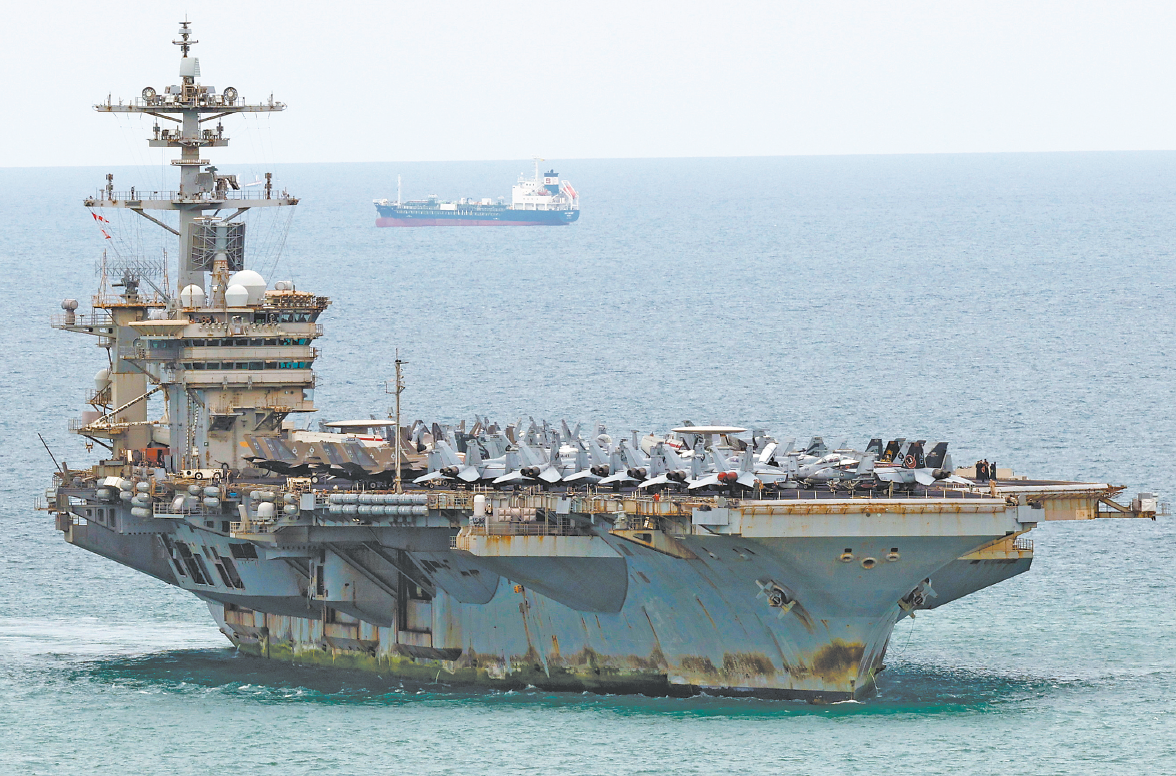
[Global Times Comprehensive Report] The U.S. Navy aircraft carrier USS Lincoln arrived at Thailand's Laem Chabang Port on September 2. U.S. media celebrated that the 5,000 personnel aboard could finally end their 286-day extended deployment and set foot on land for rest. However, what attracted the most attention was the visible rust on the hull of the aircraft carrier. Although some U.S. media claimed that rust on the hull is a common phenomenon for ships on long-term deployment, CNN still described the situation as "shocking" and stated that the problems arising from the USS Lincoln's long deployment go far beyond rust. Due to material shortages, the morale of the crew is low, and there was even an incident of a crew member falling overboard. The New York Post reported that concerns about the USS Lincoln's prolonged deployment are growing. Meanwhile, informed sources revealed to U.S. media that Secretary of Defense Lloyd Austin is quietly extending the U.S. military's deployment in the Middle East, and the conflict between the U.S. and Iran may drag into the next year. Military expert Zhang Junsha told Global Times reporters on the 3rd that the U.S. has long engaged in wars abroad and intervened in regional conflicts, which not only burdens its own economy but also continuously consumes its military machinery. "The high-intensity overseas military operations aimed at maintaining global hegemony have clearly misaligned with its actual military capabilities."
Thai police strengthen patrols and security forces
The USS Lincoln arrived at Laem Chabang Port in Chonburi Province, Thailand, on the 2nd. According to Reuters, Thai officials stated that this stopover will last for five days. The U.S. Embassy in Thailand issued a statement that since its deployment began in November 2025, the USS Lincoln has been at sea for 286 consecutive days, marking its first complete port call for rest.
The arrival of thousands of U.S. troops has generated expectations in the nearby resort city of Pattaya. The mayor of Pattaya stated that the USS Lincoln's stopover for rest is an important opportunity to stimulate local economic development. Each visitor's spending could range from 1,000 to 3,000 Thai Baht (1 Thai Baht is approximately 0.20 RMB), potentially bringing local businesses an income of 5 to 15 million Thai Baht per day.
Global Times reporters learned from hotel operators in Pattaya that the sudden influx of 5,000 people has sharply increased local accommodation demand. Journalists checked hotel booking platforms and found that during the USS Lincoln's visit, prices at some popular hotels in Pattaya have risen, and some standard room types are already sold out, forcing last-minute bookers to choose more expensive options, undoubtedly raising the accommodation costs for tourists. For example, at a local upscale hotel, the minimum room rate on regular weekdays in September is usually around 5,000 Thai Baht, but during the aircraft carrier's visit, the availability of rooms on certain dates has significantly decreased, with remaining room rates on the hotel's official website exceeding 20,000 Thai Baht on the 4th.
Behind the bustling scene lies another account. To accommodate the thousands of U.S. troops landing for activities, Thai police have noticeably strengthened patrols and security forces in key tourist areas of Pattaya. Global Times reporters learned locally that during the day, some residents have seen individual American soldiers lying drunk on the streets. Although this is just an isolated phenomenon, it also indicates that the aircraft carrier brings not only consumption but also additional pressure on security and urban management.
Compared to the activities of U.S. military personnel in Thailand, the condition of the USS Lincoln is more visually striking. "As it slowly entered the port near Pattaya, it was no longer the majestic sight of the past," the U.S. Beast Daily website reported on the 2nd. After sunrise, large crowds gathered on the shore to watch, and as the USS Lincoln slowly approached the port, the deterioration of the hull became increasingly clear: large areas of paint had peeled off, and rust seemed to cover the entire hull.
When asked about the rusted condition of the aircraft carrier's exterior, Captain Dan Kille of the USS Lincoln responded, "It is normal for such conditions to occur during long deployments, and we will not comment further." However, William Freer, a researcher at the British think tank Geostrategic Council, told Newsweek that if the rust on the hull continues to spread unchecked, it could damage critical watertight sealing structures, forcing the aircraft carrier into dry dock for repairs.
"In a high-humidity, high-salinity marine environment, if periodic rust removal, anti-corrosion, and coating repairs are lacking, the steel structure of the hull will continue to corrode, leading to thinning of the hull and cracking of welds, which directly weakens navigational safety, watertightness, and structural strength; corrosion of pipelines, machinery, and electrical joints can cause control delays and sensor distortion. If such latent damage is not addressed in a timely manner, it can easily lead to higher-level equipment failures," military expert Zhang Junsha told Global Times reporters on the 3rd. He stated that if maintenance is severely inadequate, corrosion and fatigue will accelerate, and equipment may be forced to retire early due to structural safety or combat suitability issues before reaching its designed lifespan.
"It's like the movie 'Groundhog Day,' repeating day after day"
According to multiple U.S. media reports, the deployment cycle for most U.S. aircraft carriers typically ranges from 6 to 7 months, although in specific circumstances, deployment times may be extended. During this period, aircraft carriers usually dock at ports for resupply and allow crew members to rest. However, the USS Lincoln began its planned deployment in November last year, was redirected to the Middle East in January this year to participate in U.S. military operations against Iran and maritime blockades, totaling over 9 months. During this time, apart from brief resupply stops in Guam and Oman, the USS Lincoln has spent the majority of its time on combat duty at sea, with approximately 5,000 sailors and Marines not receiving regular rest.
Previously, negative reports surrounding the USS Lincoln had persisted for quite some time, covering issues such as basic sanitation and food supply shortages, mold growth in showers, toilet malfunctions, lost mail, and a sharp decline in crew morale. Newsweek reported that family members of the USS Lincoln's crew stated that as the mental health of the crew deteriorated, several individuals attempted to jump overboard. The U.S. Navy confirmed that in early August, one person fell overboard but was rescued.
Todd Wind, a former service member on a U.S. Navy aircraft carrier, told The Wall Street Journal that aboard the ship, sailors likely have to grapple with the uncertainty of deployment duration while avoiding complacency and maintaining high levels of focus in a dangerous environment. The Wall Street Journal noted that many things can go wrong on an aircraft carrier: aircraft moving on the deck may collide with other objects, the pressure settings of the catapult system may malfunction, and lookouts may miss potential threats due to fatigue. "Life on the ship is like the movie 'Groundhog Day,' repeating day after day," Wind said regarding the mental state of the sailors. "A person's spirit can become numb and chaotic. There are five or six thousand people on board, but you may only interact with a fixed group of about 50 each day."
However, the U.S. military denies that there is a mental health crisis aboard the USS Lincoln. Secretary of Defense Lloyd Austin downplayed related reports, stating that the actual situation on the ship has been "completely distorted." Due to reports of poor working conditions and the mental breakdown of sailors aboard the USS Lincoln, Eric Slavin, the editor-in-chief of the military newspaper Stars and Stripes, and publisher Max Ledler were dismissed by the U.S. Department of Defense on the grounds of "disobeying orders."
The USS Lincoln has been deployed at sea for 286 consecutive days, "the direct consequence of which is 'double fatigue.'" Zhang Junsha told Global Times reporters, "On one hand, aircraft carriers, destroyers, submarines, and other equipment are on extended duty, with dry dock repairs continually postponed, leading to hull rust and equipment operating with issues; on the other hand, crew members are long adrift at sea with no end in sight, resulting in low morale and psychological exhaustion." Zhang Junsha stated that the combination of rust on equipment and low morale further erodes the actual operational capabilities and readiness of the troops.
"Ammunition is depleted, ships are severely worn, and funds are exhausted"
The USS Lincoln's extended deployment is closely related to the U.S. military's strikes against Iran. According to a report by The Wall Street Journal on the 2nd, Secretary Austin, who had promised to avoid getting bogged down in a long military quagmire against Iran, has quietly extended the U.S. military's deployment time. The U.S. military maintains a force of 50,000 in the Middle East, partly to preserve flexibility for the president's next actions.
Informed sources indicated that as the U.S.-Iran conflict continues, the Pentagon's deployment cycles are being extended. Crew members of warships, air defense units, and paratrooper forces have been ordered to stay in the Middle East longer than originally planned. Army air defense forces need to intercept Iranian missiles and drones under pressure, with the standard deployment cycle extended from 9 months to 12 months. Some units originally planned to be stationed in Europe and the Pacific have been redirected to the Middle East, resulting in actual deployment times exceeding one year. Navy vessels and crew are also under immense pressure, continuously executing the task of blocking Iranian ports. A Navy official stated that the U.S. currently has 19 warships deployed in Middle Eastern waters, including 2 aircraft carriers and 13 guided-missile destroyers. Tom Karako, director of the Missile Defense Project at the Center for Strategic and International Studies, believes that deployment delays will lead to physical and mental exhaustion of soldiers, delayed equipment maintenance, and hinder long-term modernization efforts.
CNN previously cited analysts commenting that global deployment demands, including the conflict with Iran, have left the U.S. Navy "overwhelmed." The Iran conflict has also exposed shortcomings in the U.S. military's critical ammunition stockpiles. The U.S. military's "Patriot" and "THAAD" air defense systems have significantly depleted interceptor missiles, and some offensive ammunition stockpiles are also "in the red."
How to fund a war with no clear end in sight is also a major challenge. The Guardian reported in August that military operations against Iran have dragged the U.S. military into a severe financial crisis, forcing the Navy to divert personnel salary accounts and other funds to cover operational expenses. A retired officer working for a U.S. Navy contractor, familiar with the funding shortfall, stated, "They are in deep trouble. Ammunition is depleted, ships are severely worn, and funds are exhausted."
Zhang Junsha analyzed that the U.S. military has been almost continuously engaged in overseas operations for decades, from Iraq and Afghanistan to Syria and the Red Sea, and now to the current operations against Iran. "The front lines are stretching longer and longer, while domestic shipbuilding and repair capacities and the workforce of skilled technicians are simultaneously shrinking." This military expert stated that the contradiction between the "permanent presence" required for the U.S. to pursue global hegemony and the "sustainable force" it can support is becoming evident through aircraft carriers carrying exhausted personnel and covered in rust.
[Global Times Special Correspondent in Thailand Zhang Jinru, Global Times Special Correspondent in the U.S. Feng Yaren, Global Times reporters Guo Yuandan, Jing Kuan]
USS Lincoln arrived at Laem Chabang port on September 2, 2023, after a 286-day deployment, allowing its 5000 personnel to rest. The ship's condition raised concerns, with visible rust and maintenance issues reported. Morale among the crew is low, exacerbated by the extended deployment without adequate rest.
- USS Lincoln has been deployed for 286 days without a proper rest period.
- The ship showed significant signs of wear, including rust and maintenance issues.
- Morale among the crew is reportedly low due to extended deployment and lack of resources.