
Putin's Decree on "Temporary Management" of Oil Refineries — Nationalization Under the Pretext of Protection from Drones
 Dmitri Volkov
Putin's Decree on "Temporary Management" of Oil Refineries — Nationalization Under the Pretext of Protection from Drones
On the morning of August 28, Ukrainian drones attacked the Yaroslavl Oil Refinery "Slavneft-YANOS" for the eighth time since the beginning of the year — one of the five largest oil refineries in Russia, processing about 15 million tons of oil per year (according to the General Staff of the Armed Forces of Ukraine and Governor Mikhail Evraev). Only four days had passed since Vladimir Putin signed a decree officially aimed at protecting such facilities from drones. The decree did not shoot down a single drone — but it has already begun to change the Russian economy more than any air defense system.
What Exactly Did Putin Sign on August 24
The decree dated August 24, 2026, allows the government to take "temporary management" of critical infrastructure facilities whose owners "have not provided adequate protection" against drone strikes or other threats, or have not restored damaged enterprises in a "timely manner" (ISW analysis, August 25, 2026). First Deputy Prime Minister Denis Manturov hastened to assure the next day that this is not about nationalization, but merely "temporary management" to eliminate security risks. Press Secretary Dmitry Peskov added that the facilities face threats from Ukrainian drones, but their owners "do not always pay due attention to security."
However, the document itself contains neither criteria nor deadlines for when the seizure mechanism is activated. There is also no procedure for its completion: "temporary management" is terminated only at the personal discretion of the president. Formally, any enterprise that has been hit at least once can fall under the decree's action — that is, almost the entire Russian rear from the Urals to Crimea. This is not a slip — it is a construct in which the criterion for seizure is retroactively adjusted to fit any convenient case.
"Temporary Management" Without Deadlines and Criteria
"The mechanism has raised questions among experts and market participants due to unclear grounds for activation and blurred lines of responsibility between enterprise owners and the Ministry of Defense" — "Kommersant," August 24, 2026.
The Russian business community, accustomed over four years of war to various forms of state intervention, reacted noticeably nervously this time. "Kommersant" and The Bell described the same problem on the same day, August 24: the mechanism does not contain definitions of who, when, and on what basis initiates the procedure, and where the boundary lies between the owner and the Ministry of Defense. The independent publication The Bell pointed to a deeper layer: a private enterprise cannot, in principle, protect itself from a drone.
Legal Trap for Owners
According to current Russian regulations, only the National Guard, the Ministry of Defense, intelligence agencies, and private military companies have the right to interfere with a drone's flight — to jam, shoot down, or intercept. A factory owner who shoots down a drone over their territory risks becoming a subject of a criminal case. Formally, their duty is to "ensure protection," but in reality, the right to defend themselves has been taken away by law. The decree of August 24 turns this trap into a seizure machine: if you did not protect (and cannot protect) — the factory comes under state management, which also will not protect, but without asking.
Why Right Now
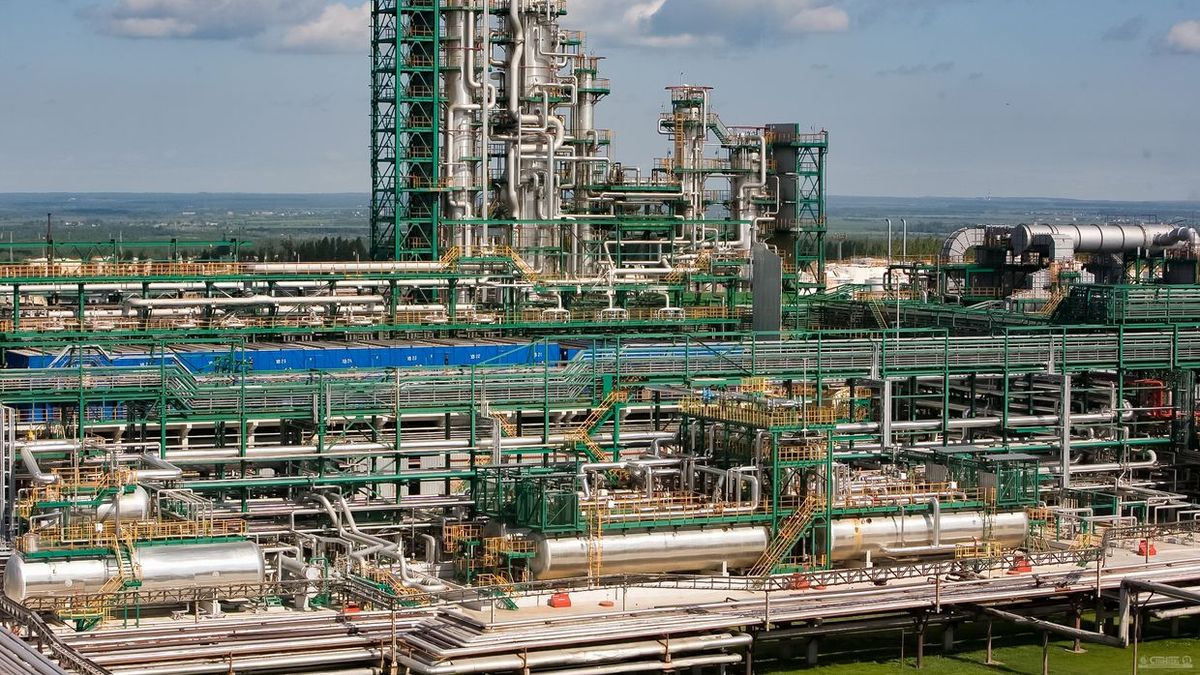
The context is simple and unpleasant for the Kremlin. Just in recent days, Ukrainian strikes have hit the Afipsky Oil Refinery in the Krasnodar region (capacity 6.25 million tons per year), a gas processing plant in Astrakhan (12 billion cubic meters of gas per year), the Novoshakhtinsk Oil Refinery, which was forced to suspend operations, and the Perm "Lukoil-Permnefteorgsintez," which stopped after a strike on August 21 (ISW report, August 25). Raw material exports through the ports of the Azov-Black Sea basin, which account for 88 percent of Russian grain exports, have been squeezed to the limit: the price of fourth-grade wheat in southern Russia fell by 19 percent in a week, and the August export forecast was reduced from 3.1 to 1.8 million tons.
YANOS was attacked on March 28, April 26, May 8 and 22, July 6 and 16, August 6 — and now, August 28. That same night, SBU "Alpha" special forces damaged a strategic bomber Tu-95 at the Engels airbase in the Saratov region — 600 kilometers from the front line. In other words, the state that intends to seize factories for "insufficient protection" was unable to protect its own strategic aviation that same night. The Ukrainian Armed Forces' strike campaign against Russian oil refining continues against the backdrop of nighttime combined raids on Ukraine — 164 "Shahed" drones overnight on August 28, half of them with jet engines, seven ballistic missiles "Iskander-M" and KN-23 were shot down over Kyiv. This is a war of attrition, in which a decree does not win.
Historical Context
The mechanism of "temporary management" in Russia is not new — it refers to Soviet practices of external management of enterprises and to post-Soviet bankruptcy procedures. But the closest precedent is the years 2022–2023, when "temporary management" was applied to the assets of departing foreign companies: Danone and Carlsberg lost their Russian subsidiaries in this way. At that time, the argument was "ensuring continuity of production." Now the argument is "protection from drones." The logic is the same: the state takes what it considers strategic under a legal pretext that cannot be challenged in court, because the court is also part of the system.
The difference from 2022 is fundamental. Back then, the assets of outsiders — foreigners who had no lobby within the country — were seized. Today, the targets are domestic owners, including systemic ones, whose interests are usually represented at the very top. That is why the reaction of the business community is so nervous: the decree strikes not at "enemies," but at the entire vertical of ownership at once.
Forecast
The mechanism will begin to operate this fall, and the first to fall under "temporary management" will not be the factories that have lost protection, but those whose inability to protect themselves will be conveniently demonstrated: oil refineries, logistics centers, energy enterprises. The National Guard and the Ministry of Defense will not receive a new air defense tool, but a new tool for controlling the economy. If the Ukrainian Armed Forces' strike campaign against oil refining continues at the same pace — and everything points to this — by winter "temporary management" will become permanent, and the word "nationalization" will disappear from the official lexicon exactly when it becomes a fact.
Will the decree protect any oil refinery? No. But it honestly answers the question that Moscow has been addressing since 2022: who pays for the war — the one who owns or the one who manages. It seems the answer has already been chosen.
Ukrainian drones attacked the Yaroslavl Oil Refinery on August 28, 2026, marking the eighth strike this year. In response, the Russian government issued a decree allowing temporary management of critical infrastructure due to insufficient protection against drone threats. This decree has raised concerns about its vague criteria and the implications for Russian businesses.
- Ukrainian drones attacked the Yaroslavl Oil Refinery on August 28, 2026.
- This was the eighth attack on the refinery this year.
- The Russian government issued a decree for temporary management of critical infrastructure.
- The decree allows the government to take control of facilities that fail to protect against drone strikes.
- The decree lacks clear criteria and timelines for its implementation.