
Qatar Test Reveals the Limits of the Mecca Charter and the Arsenal of Turkish Drones in 2026
 Ahmed Al-Rashid
Qatar's Test Reveals the Limits of the Mecca Charter and the Turkish Drone Arsenal in 2026
On October 30, 2026, defense reports raised a practical question for Gulf countries following weeks of the signing of the Mecca Charter between Saudi Arabia, Turkey, and Pakistan. The question is not who owns the aircraft or missile, but who can operate a joint defense network when the attack begins. Breaking Defense reports linked Qatar's expansion in local arms production, the Turkish drone arsenal, and the upcoming test of the charter. This connection is important because Doha is not a signatory to the trilateral agreement, yet it lies at the heart of the geography that the agreement aims to protect.
From News to Operational Testing
The charter that brought together Riyadh, Ankara, and Islamabad in Mecca on August 7 presented itself as a framework for joint defense, but it has not yet transformed into a unified command or declared rules of engagement or a command and control structure that can be tested. On October 26, Reuters reported that the charter countries pushed for peace in Tehran while the Houthis continued their attacks. This paradox encapsulates the problem: the alliance wants deterrence, but at the same time, it needs negotiation channels to prevent a war that the alliance members cannot afford to sustain for long.
If a Qatari facility or vessel is attacked, the political question will not be sufficient. The operational center will need a shared aerial and maritime picture, determining who has the right to launch interceptions, distributing drones for reconnaissance, and then securing communications, fuel, and maintenance. Here lies the difference between a solidarity agreement and a military union. The former issues a quick statement, while the latter requires written procedures that units have trained on before the crisis.
Why Qatar is the Toughest Knot
Qatar possesses significant financial resources and an airbase hosting the American presence, and it has accumulated experience in recent years in purchasing advanced systems and building a defense industrial base. However, local manufacturing does not automatically mean decision-making independence or the ability to wage a long war. Producing part of the ammunition or components for drones is beneficial, but integrated air defense requires software, data links, missile stocks, maintenance teams, and continuous training. These elements do not appear in exhibition photos or contract figures.
Practically, Qatar can be a node for sensing, supplying, and communication within a Gulf network, but it cannot alone bridge the gap between owning the platform and operating it under jamming and simultaneous attacks. Additionally, the presence of American forces at Al Udeid Air Base adds a deterrent force, but it also reminds that any Gulf defense structure is still tied to the decision of an external power. This is the contradiction that the term localization does not resolve.
Turkish Drones Provide the Alliance with a Tool, Not a Guarantee
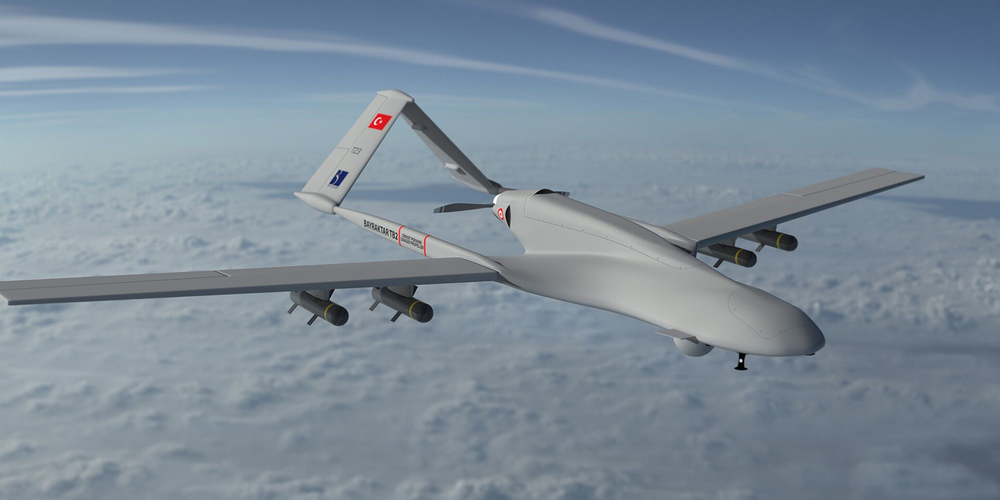
The Bayraktar TB2 and other Turkish systems have proven that drones can provide reconnaissance and precise strikes at a lower cost than manned aircraft. For an alliance comprising geographically disparate countries, these platforms offer the capability to monitor maritime corridors, borders, and vital installations, reducing pressure on advanced fighters. Moreover, Turkey does not just sell a platform; it typically offers training, operational networks, and joint manufacturing, elements that could help Saudi Arabia and Pakistan build a more realistic layer of cooperation.
However, the drone is not a magic solution. The TB2 is relatively slow and exposed to organized air defense, and its effectiveness depends on secure communications, weather availability, and target identification capability. Larger and more advanced drones require more complex maintenance, armament, and data structures. If each country operates its fleet according to different standards, the Turkish arsenal will not produce a joint force but rather three adjacent technical islands.
Who Holds the Decision When the Houthis Attack
The real test of the charter will not be in a conference or military parade, but in a limited incident below the threshold of war. A missile or drone attack on a port or tanker could present Riyadh, Ankara, and Islamabad with varying options. Saudi Arabia will consider protecting its facilities and energy export chains, Turkey will think about avoiding open involvement, and Pakistan will aim to maintain its role as a guarantor, not as a party in a Gulf war. As for Qatar, it will demand a response that protects it without turning its territory into a platform for escalation.
Therefore, integrating Qatar into information exchange and early warning arrangements may be more important than announcing new membership. What is needed is a network that acknowledges the political reality of the Gulf and allows for coordination even when the positions of countries do not align regarding Iran, the Houthis, or the United States. Attempting to impose a single command before building trust will result in a new bureaucratic apparatus without combat power.
The Triad Capability is Still Incomplete
I use a capability triangle in evaluating armies, consisting of equipment, training, and institutions. The Mecca Charter has a strong start in equipment, especially with Turkish industry, Saudi financing, and Pakistani expertise. Joint training can be built over years, but it has not yet been proven in simultaneous air and naval defense operations. As for the institution, meaning the rules of decision-making, command, and accountability, it remains the weakest link so far.
Qatar may succeed in transforming its defense industry into a real contribution if it focuses on specific components such as communications, electronic warfare, software, and maintenance, rather than chasing the image of complete self-sufficiency. Turkey may succeed in being a supplier and designer for a regional network, not just a seller of drones. However, success requires political acceptance that sovereignty does not mean that each party retains all its data and decisions.
In my estimation, the next test for the Mecca Charter will be its ability to protect a state that is not a full member of it and to coordinate a limited response without closing the door to negotiation. If it fails, Turkish drones and local capabilities will remain valuable national tools, but the charter will remain a political promise. In the Middle East, having many weapons is not enough when allies do not know who pulls the trigger and when to stop.
Sources
- Breaking Defense report on October 30, 2026, about Qatar's local weapons and the Turkish drone arsenal and the upcoming test of the Mecca Charter.
- Reuters report on October 26, 2026, about the Saudi defense charter countries moving towards peace in Tehran amid ongoing Houthi attacks.
- Carnegie Endowment analysis on October 19, 2026, about the Mecca Charter and the limits of American guarantees.
Qatar is expanding its local arms production and enhancing its military capabilities amid discussions of a defense pact with Saudi Arabia and Turkey. The Turkish Bayraktar TB2 drones are emphasized for their potential in reconnaissance and strikes. The Gulf states are preparing for an operational test of the Mecca Pact to evaluate their defense cooperation in response to regional threats. The presence of US forces in Qatar is noted as a deterrent factor.
- Qatar is expanding its local arms production.
- The Turkish Bayraktar TB2 drones are highlighted for their reconnaissance and strike capabilities.
- The Gulf states are seeking a coordinated defense strategy amid regional tensions.
- The operational test of the Mecca Pact is anticipated to assess military cooperation.
- The presence of US forces in Qatar adds a layer of deterrence.