
Quad's 2026 IPMSC Plan Cannot Police the Indian Ocean Yet
 Marcus Chen
Quad's 2026 IPMSC Plan Cannot Police the Indian Ocean Yet
The Quad announced one new maritime surveillance mechanism on May 26. That is the easy part. The hard part is turning four national surveillance systems, three regional maritime pictures, and dozens of partner-country sensitivities into a common operating picture that matters before a Chinese coast guard cutter, maritime militia vessel, or dark tanker has already done its work.
The new Indo-Pacific Maritime Surveillance Collaboration, or IPMSC, was launched at the 11th Quad Foreign Ministers' Meeting in New Delhi. The joint statement says it will begin in the Indian Ocean Region, coordinate surveillance efforts, add subject-matter exchanges and tabletop exercises, and share real-time information among Quad partners. The factsheet calls it the first-ever IPMSC initiative and links it to a wider Common Operating Picture under the existing Indo-Pacific Partnership for Maritime Domain Awareness, or IPMDA.
That is progress. It is not sea control.
The New System Starts With an Old Weakness
IPMDA has been around since the 2022 Quad summit. Its basic idea was sound: give regional partners near-real-time maritime domain awareness using commercial satellite radio-frequency data, Automatic Identification System tracks, and regional fusion centers. Australia's description of IPMDA says the initiative uses commercial satellite RF collection to provide partners across Southeast Asia, the Indian Ocean, and the Pacific with near-real-time information in their maritime zones.
The U.S. Navy's Naval Information Warfare Center Pacific filled in some of the machinery last year. It described a $125 million effort to enhance India's maritime domain awareness, with SeaVision aggregating AIS and vessel-tracking data and HawkEye 360 commercial RF detection helping spot vessels that operate without transponders. That matters because a ship that turns off AIS is not invisible. It is only invisible to systems that depend on AIS.
Anyone who has stood watch on a destroyer understands the problem. A contact report is not a decision. A track is not an intercept. A common picture does not automatically create a patrol aircraft sortie, a boarding team, a diplomatic demarche, or a coast guard hull in the right place. IPMSC improves the detection side of the kill chain. It does not solve the action side.
The Indian Ocean Is Too Big for Symbolic Coverage
The Indian Ocean Region is a logical starting point because India is the host, because the Information Fusion Centre-Indian Ocean Region in Gurugram already exists, and because Chinese naval and commercial presence west of Malacca is now a routine feature, not a periodic surprise. But geography is unforgiving. From the Strait of Malacca to the Gulf of Aden is roughly 3,500 nautical miles. From Diego Garcia to the Mozambique Channel is another vast patrol problem. A useful surveillance picture over that space requires persistent collection, not occasional screenshots.
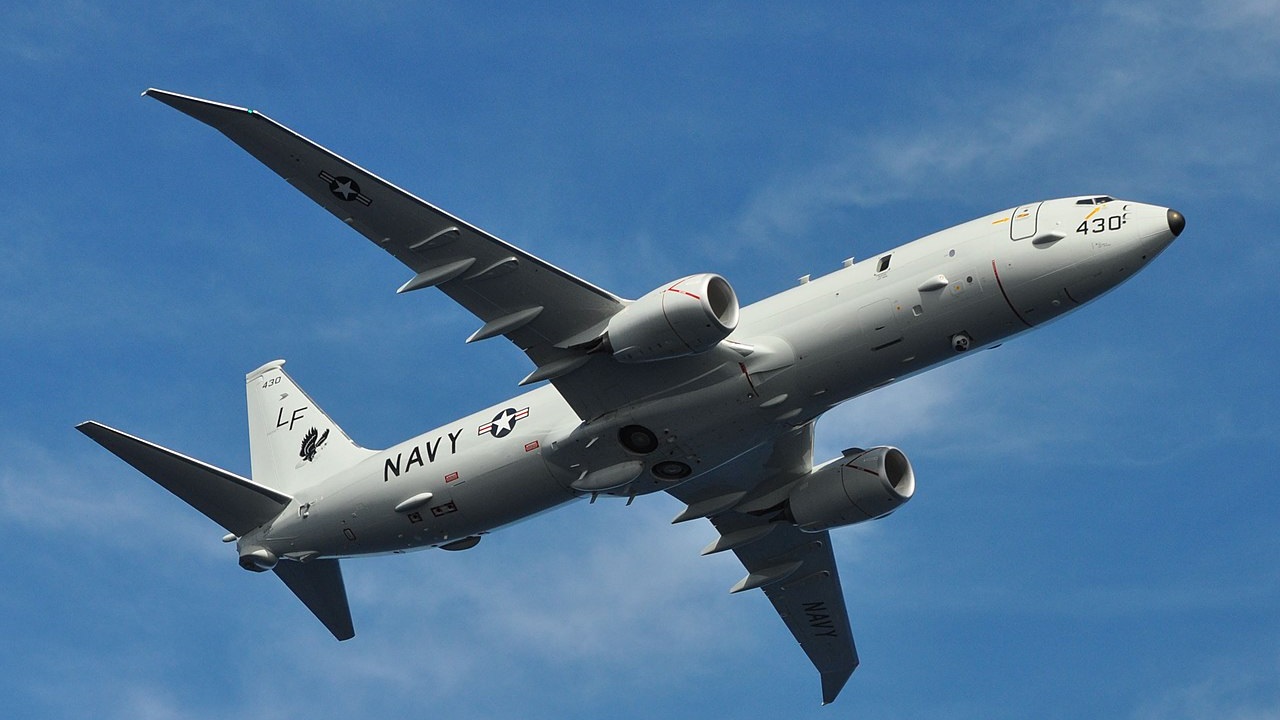
A P-8A Poseidon is an excellent maritime patrol aircraft. It has the sensors, endurance, and weapons options to make surface ships nervous and submariners cautious. But aircraft availability, basing permissions, maintenance cycles, and crew limits still decide how often a box on the map gets real coverage. Satellites can cue. Fusion centers can correlate. Somebody still has to investigate.
That is where the Quad's numbers become thin. The United States is stretched between the Western Pacific, Middle East shipping lanes, and homeland demands. Australia's P-8 fleet is capable but small. Japan has serious maritime patrol capacity, but its priority remains the East China Sea and approaches to the home islands. India has the geography and growing capacity, yet it will not accept a system that looks like an American command net with an Indian flag on the wall.
The result is a useful but limited bargain. IPMSC can make the Indian Ocean harder to hide in. It cannot make it hard enough by itself.
China Will Read This as Targeting Even If the Quad Avoids the Word
The Quad statement never names China in its South China Sea paragraph. It does not need to. It cites coercive activity, water cannons, flares, ramming, blocking actions, and the militarization of disputed features. Those are not abstract behaviors. They describe the daily mechanics of China's gray-zone campaign against the Philippines and other claimants.
Beijing's response was predictable. According to Associated Press reporting from the New Delhi meeting, China's Foreign Ministry said cooperation should not target third parties and opposed exclusive small groupings or bloc confrontation. That line is familiar. It is also a sign that maritime surveillance hits a sensitive point. China can live with statements. It has more trouble with persistent evidence.
The operational value of IPMSC is not that it threatens Chinese naval combatants. A Type 055 destroyer does not need to hide to be dangerous. The value is in documenting lower-end activity: militia swarming, transponder gaps, at-sea rendezvous, suspicious loitering around undersea cables, and coast guard pressure near offshore resources. These are the actions that sit below the threshold of war but above normal law enforcement. They work best when they are deniable or invisible.
Transparency narrows that space. It does not close it.
The Missing Piece Is Response Authority
The Quad's May 26 factsheet lists a series of maritime moves: IPMSC, a Common Operating Picture, India's hosting of the next Quad-at-Sea Ship Observer Mission, and tabletop exercises. These are the right building blocks for interoperability. But the unanswered question is who gets to act on the picture, and how fast.
If an RF satellite finds a dark vessel near a contested reef, does the track go to a Philippine coast guard command center in minutes or hours? If a suspected militia cluster appears near an undersea cable route, does Japan share the same track with Australia and India at the same classification level? If India sees a suspicious Chinese survey vessel in the eastern Indian Ocean, will the data flow into a Quad-wide system, or stay inside national channels until the moment has passed?
Those are not legal trivia. They are the difference between maritime awareness and maritime influence.
The Quad has deliberately avoided becoming an Asian NATO. That caution makes diplomatic sense, especially for India and for Southeast Asian partners that do not want to be drafted into a containment architecture. But surveillance collaboration lives in an awkward middle ground. If it is too military, partners hesitate. If it is too civilian, it may not move fast enough when the contact is operationally important.
What Would Make IPMSC Matter
The test over the next year is not whether Quad ministers mention IPMSC again. The test is whether the system produces repeatable outputs that regional operators actually use.
- First, the Quad needs a measurable reporting timeline. Near-real-time should mean minutes for priority contacts, not a polished daily digest.
- Second, it needs partner-country release rules that are agreed before a crisis. Data-sharing rules negotiated after a coercive incident are late by definition.
- Third, IPMSC should connect surveillance to exercises. Tabletop events are useful only if they rehearse who receives the track, who validates it, who calls the partner government, and who sends a platform.
- Fourth, the Quad needs more unclassified data pathways. A picture that cannot be shown to a smaller coastal state is a picture with limited deterrent value.
The strongest version of IPMSC would not look dramatic. It would look routine: a suspicious track detected, shared, verified, and acted on quickly enough that the vessel's operator knows the region is watching. That is how maritime pressure gets more expensive.
A Useful Start, Not a Fleet Substitute
The Quad's 2026 surveillance initiative is a better answer than another communique about maritime rules. It gives the group a concrete operational task and pushes IPMDA beyond pilot projects. It also fits the moment. The South China Sea, the Red Sea, and the Strait of Hormuz have all reminded governments that maritime trade routes are not self-policing.
But the math still matters. A common operating picture over the Indian Ocean does not replace patrol aircraft. It does not replace coast guard cutters. It does not replace political authority to confront a coercive vessel before it creates a new fact on the water.
IPMSC can help the Quad see faster. Unless the four governments build the response machinery behind it, they will have created a sharper map of incidents they are still too slow to shape.
The Quad launched the Indo-Pacific Maritime Surveillance Collaboration (IPMSC) on May 26, 2026, to enhance maritime surveillance in the Indian Ocean Region. This initiative aims to coordinate surveillance efforts among Quad partners, utilizing various technologies for near-real-time maritime domain awareness. However, challenges remain in operationalizing a common maritime picture and ensuring timely responses to potential threats. China's reaction highlights the geopolitical sensitivities surrounding the Quad's surveillance activities.
- The Quad announced the IPMSC on May 26, 2026.
- The initiative aims to enhance maritime surveillance in the Indian Ocean Region.
- IPMSC is linked to the Indo-Pacific Partnership for Maritime Domain Awareness (IPMDA).
- The initiative faces challenges in operationalizing a common maritime picture among Quad partners.
- China's response indicates sensitivity to the Quad's surveillance efforts.