
R-60 on "Geran-2" with 12 µSv/h Reveals the Limits of Russian Improvisation
 Dmitri Volkov
R-60 on "Geran-2" with 12 µSv/h Reveals the Limits of Russian Improvisation
Twelve micro-sieverts per hour is not the figure one typically expects to see next to the wreckage of a drone. This level of gamma radiation, reported by the Security Service of Ukraine on May 20, was recorded near fragments of the Russian R-60 missile mounted on the modified strike drone "Geran-2" after an attack in the Chernihiv region on the night of April 7. In the warhead, as claimed by the SBU, striking elements made of depleted uranium were found, identified as uranium-235 and uranium-238. This does not turn the "Geran" into some new strategic weapon. But it clearly demonstrates how the Russian military machine in 2026 combines old Soviet stockpiles, cheap strike UAVs, and the task of suppressing Ukrainian air defense.
What Exactly Did the SBU Discover
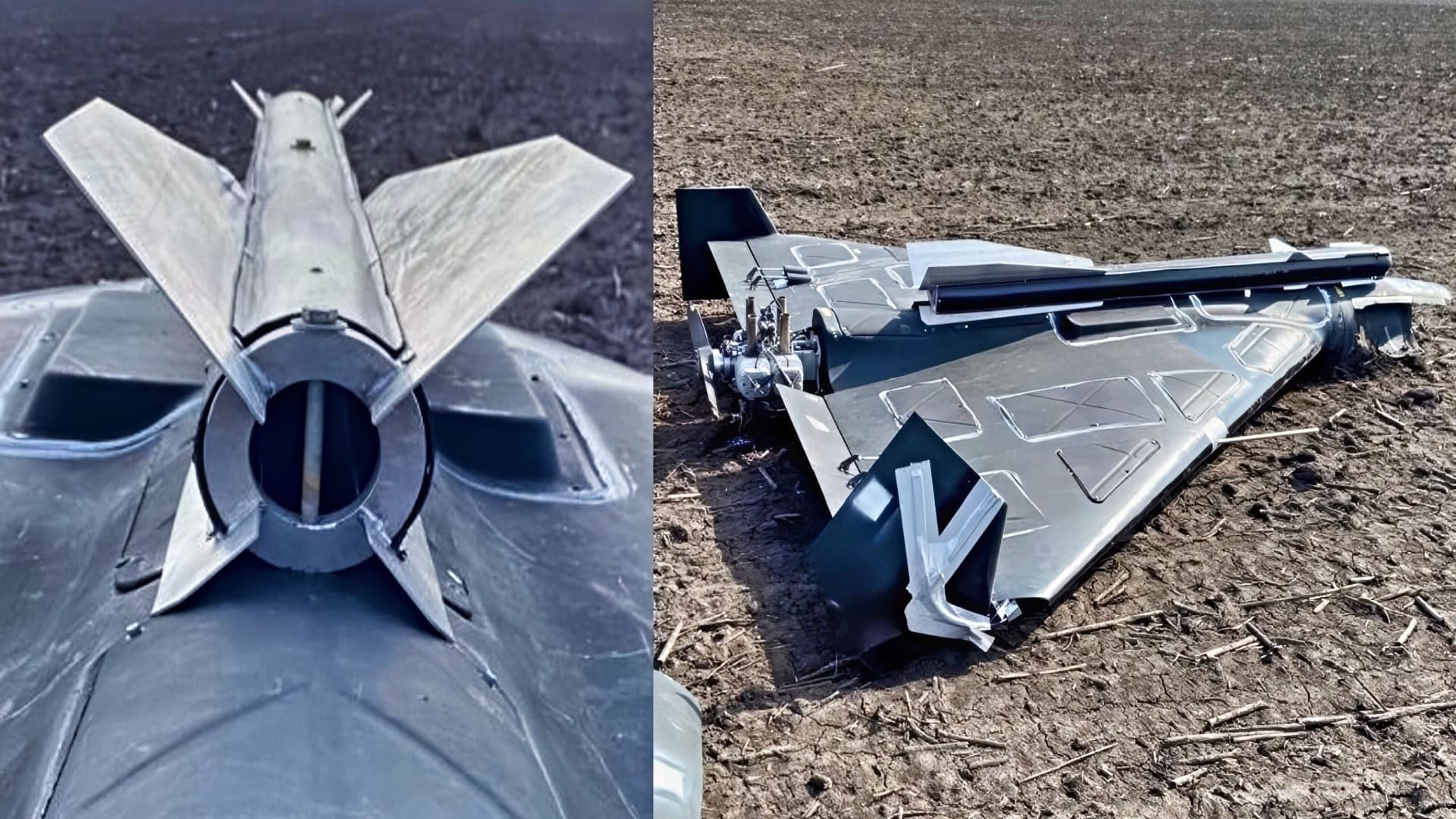
Ukrainian counterintelligence claims that these are fragments of the R-60 air-to-air missile found near the settlement of Kamka in the Chernihiv region. According to the SBU, Russian troops use such missiles during mass attacks to target Ukrainian aircraft and helicopters that intercept enemy UAVs. The warhead was rendered safe in cooperation with the State Emergency Service and the Armed Forces of Ukraine, after which it was transported to a radioactive waste storage facility. Kyiv Independent, summarizing the SBU's report, specifically noted that damaged or burned munitions with such elements can emit radioactive dust and therefore pose a risk not only to military sappers but also to civilians who are the first to find the wreckage after strikes.
It is important not to exaggerate here. Depleted uranium is used not because it is "nuclear" in the popular sense, but because it is very dense and works well as a material for striking elements or armor-piercing cores. The political noise surrounding the word "uranium" is almost always louder than the physical picture. But in this case, the configuration itself raises more interest than the radiological component: an old small-sized close-range missile is mounted on a kamikaze drone originally designed as a cheap carrier for striking ground targets.
R-60 as a Soviet Remnant, Not a Technological Breakthrough
The R-60, known in NATO classification as AA-8 Aphid, did not appear yesterday or even in the last few decades. Serial production began in 1973; GlobalSecurity describes it as a small, maneuverable infrared short-range missile suitable for mounting on most Soviet aircraft. Its strength lies in its small size and relative simplicity. Its weakness is a small warhead of about 3.5 kilograms and vulnerability to infrared countermeasures. In normal military logic, such a missile should exist in the niche of aircraft self-defense or close air combat. In the logic of a war of attrition, it becomes a consumable component for a completely different system.
The Soviet school has always been able to use old material resources longer than the original design intentions of the engineers suggested. There is nothing funny about this: sometimes it is this ability that gives an army strategic resilience. But there is a difference between meaningful modernization and forced assembly "from what is left in stock." The installation of the R-60 on the "Geran-2" looks closer to the latter option. Russia is not creating a full-fledged unmanned fighter; it is trying to turn part of its strike drones into a trap for those Ukrainian platforms that rise to intercept. This is cheaper than building a new aviation system, but much rougher in terms of accuracy, control, and reliability.
Why This is Happening Now
The main reason is the change in Ukrainian defense against massed attacks. When "Gerans" are used by the dozens or hundreds, intercepting them solely with surface-to-air missiles becomes economically unfeasible. Ukraine is increasingly using mobile fire groups, aerial intercepts, helicopters, small-caliber assets, and its own interceptor drones. The Russian side, in turn, is looking for ways to increase the cost of such interceptions. If even a small fraction of drones poses a threat not only to the ground but also to the air interceptor, the Ukrainian pilot or crew is forced to change the distance, approach profile, and risk assessment.
This does not mean that the R-60 on the "Geran" radically changes the balance in the air. The infrared missile requires target acquisition conditions, and the carrier in the form of a slow drone does not provide it with the kinematic advantages that an aircraft does. But in a massed attack, perfect efficiency is not as important as uncertainty. One suspicious object forces more time to be spent on identification. One risk to a helicopter reduces the number of convenient windows for attack. One incident with radioactive fragments complicates the work of rescuers and sappers after a strike. The Russian system has long been fighting not with the quality of individual means, but with the sum of unpleasant constraints imposed on the enemy.
In this sense, the R-60 on the "Geran-2" is not a weapon of superiority, but a weapon of friction. It does not promise victory in the air, but makes every Ukrainian interception procedure a little more expensive, slower, and nerve-wracking.
Strategic Conclusion
For the Russian army, such improvisation is both useful and symptomatic. Useful because it exploits a real problem for Ukraine: the lack of cheap and mass-scale countermeasures against strike UAVs. Symptomatic because instead of a serial specialized solution, we again see a combination of heterogeneous elements: an Iranian-origin drone, a Soviet close-range missile, old warheads, and field engineering devices. This resembles not a laboratory for future warfare, but a late Soviet repair shop, where the talent of mechanics compensates for planning deficiencies.
The geopolitical effect is also limited, but not zero. Kyiv gains an additional argument in the debate over the supply of cheap air defense systems, drone interceptors, and low-altitude radar control assets. Moscow receives a propagandistically unpleasant narrative: a country that accused the West of "uranium escalation" after supplying Ukraine with depleted uranium munitions now finds itself linked to the use of uranium striking elements in missiles on drones. Russian official rhetoric will likely deny this or shift the conversation to a legal plane. But wreckage on the ground is usually less diplomatic than press releases.
My forecast is cautious: if Ukrainian data is confirmed by new findings, such hybrid configurations will not become a mass replacement for classic "Gerans," but a niche element in the most intense strikes. Russia will use them where it expects the operation of helicopters, aircraft, or expensive mobile air defense groups. There is no military miracle here. There is a more unpleasant reality—a systematic adaptation of a poorly accurate but resource-rich army to a war where even the remnants of Soviet stockpiles can receive a second life.
Ukrainian Security Service (SBU) discovered R-60 missile fragments with depleted uranium elements near Kamka, Chernihiv Oblast, following an attack on April 7, 2026. The SBU reports that these missiles are being used by Russian forces to target Ukrainian aircraft and helicopters. This adaptation highlights the ongoing evolution of Russian military tactics in response to Ukrainian air defense capabilities.
- R-60 missile fragments were found near Kamka, Chernihiv Oblast.
- The missile was equipped with depleted uranium elements.
- The discovery was made after an attack on April 7, 2026.
- The SBU claims these missiles are used against Ukrainian aircraft and helicopters.
- The use of such missiles indicates a strategic adaptation by Russian forces.