
Rafael-linked firm gets first orders for drone laser pod
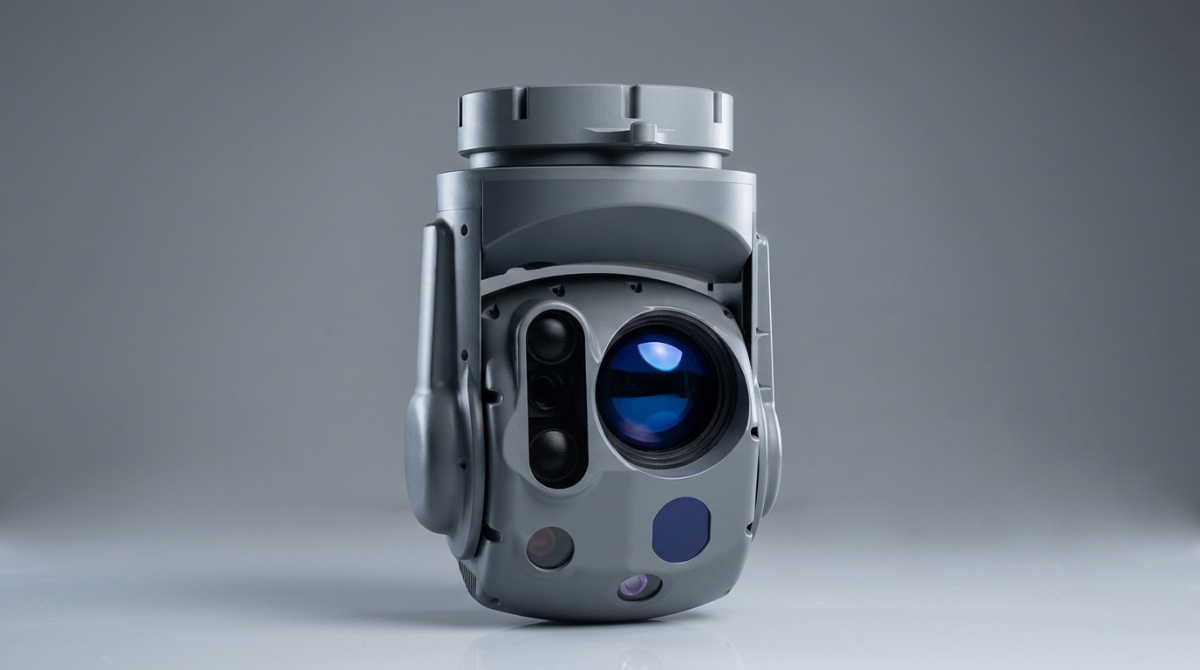
Microcon Vision, an Israeli maker of small camera systems for drones, has unveiled a 1.9 kg (4.2-pound) sensor payload that lets small unmanned aircraft mark targets with a laser for laser-guided weapons. The company said on Oct. 5 that the MICRO-D has already received initial orders, with first deliveries expected by the end of 2026.
Microcon Vision did not name the customers, the number of systems ordered, or the value of the orders. Its CEO said demand has been strongest in the United States, where the company works through its affiliate CONTROP USA.
Laser target designation has usually been done by ground troops with handheld designators or by larger aircraft, including medium-altitude drones and attack helicopters. A designator fires coded laser pulses at a target, and a laser-guided bomb or missile set to the same code homes in on the reflected energy. Putting that function on a drone small enough to carry a payload under 2 kg would let a small unit find a target and guide a strike onto it without bringing in a larger aircraft or putting a soldier within line of sight.
The MICRO-D’s designator has an output of 30 millijoules and complies with STANAG 3733, the NATO standard for laser designator coding used with laser-guided munitions. Microcon Vision has not published the designator’s effective range.
The company said the system is built for platforms flying at lower altitudes, including below cloud cover, where they can detect and track targets and designate them for compatible precision-guided weapons. Low cloud can block the view of aircraft flying higher up and has long complicated laser designation from the air.
The payload packs seven sensors and functional channels into a single two-axis gyro-stabilized gimbal, the company said. These include a daylight camera, a thermal imager, target tracking and the laser designator. The system also provides several simultaneous video outputs, line-of-sight stabilization, an airborne tracker and inertial navigation. Optional AI-based software adds video motion detection and automatic target recognition.
For integration, the MICRO-D connects over Ethernet and comes with a software development kit. It can optionally use MAVLink, a messaging protocol widely used by commercial and military drones to talk to ground control stations.
“The growing use of smaller tactical platforms is creating a need for capabilities that until now have largely been available on larger systems,” said Chen Almog, CEO and co-founder of Microcon Vision. “MICRO-D was developed to address this gap, allowing smaller platforms to take a more active role in the sensor-to-shooter chain. The initial orders we have received reflect the operational demand we are seeing for this type of capability, particularly in the U.S., where our cooperation with our affiliate CONTROP USA provides U.S. customers with local business presence, effective program execution, local technical and field support, significantly enhancing our ability to serve our customers and partners.”
The company is marketing the MICRO-D as free of International Traffic in Arms Regulations controls, which can make export approvals simpler than for U.S.-origin military hardware. It also says the system meets National Defense Authorization Act sourcing rules, which bar certain Chinese-made components from U.S. military drones, and contains no germanium. Germanium is commonly used in thermal camera lenses, and China, the dominant supplier, placed export restrictions on the metal in 2023.
Microcon Vision is part of CONTROP Precision Technologies, an Israeli electro-optics company, and the company describes itself as also part of Rafael Advanced Defense Systems. Its existing products include the MICRO300 and MICRO600 surveillance payloads and the STING seeker for small drones and loitering munitions. The MICRO-D is the company’s first laser designation payload.
Content preview only. Full article available at source. View Full Article
Microcon Vision unveiled the MICRO-D sensor payload for drones, enabling them to mark targets with a laser for laser-guided weapons. Initial orders were received on October 5, 2023, with deliveries expected by the end of 2026. The system is designed for lower altitude operations and complies with NATO standards, enhancing targeting capabilities for military applications, particularly in the United States.
- Microcon Vision unveiled the MICRO-D sensor payload for drones.
- The payload allows small drones to mark targets with a laser for laser-guided weapons.
- Initial orders were received on October 5, 2023, with deliveries expected by the end of 2026.
- The system complies with NATO standards and is designed for lower altitude operations.
- The MICRO-D is marketed as free of International Traffic in Arms Regulations controls.