
Red Sea in Crisis: Saudi Arabia's Two Requests for Help Hit a Wall, Why Does the U.S. Say "No"?

On September 11 local time, the Houthi armed forces arrived at Pilin Island in the Bab-el-Mandeb Strait and advanced towards the southwestern coastal areas of Yemen. Reuters cited sources from the Yemeni government stating that the Houthi forces had entered the island and controlled some nearby coastal strongholds. The Associated Press reported that the Houthi forces had seized this strategic island.
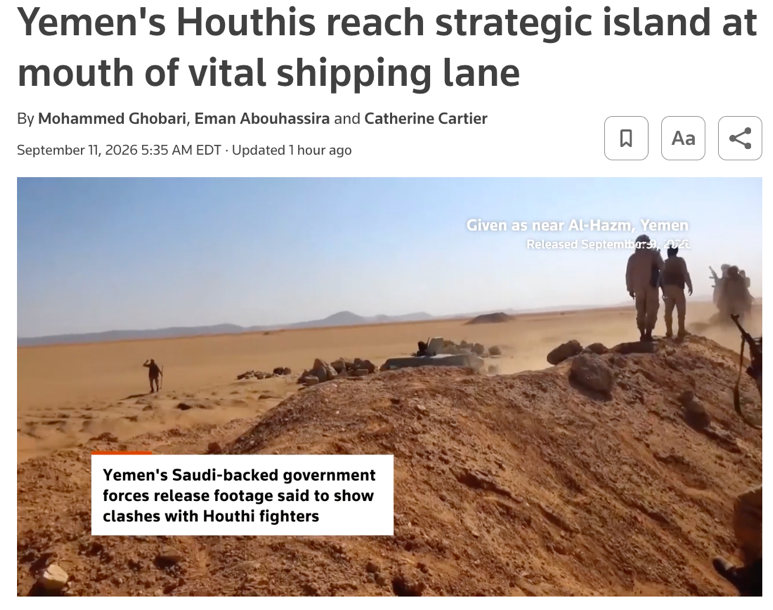
△ Reuters reported that the Houthi armed forces arrived at Pilin Island in the Bab-el-Mandeb Strait.
Meanwhile, on September 10 local time, it was reported that Saudi Crown Prince Mohammed bin Salman made two phone calls to U.S. President Trump, requesting U.S. military strikes against the Houthi armed forces in Yemen. However, the U.S. did not agree to take direct military action, only expressing a willingness to provide intelligence and target identification support to Saudi Arabia. Currently, neither the White House nor Saudi officials have publicly confirmed the related calls.
The Strait of Hormuz has not yet returned to normal navigation, and new security risks have emerged in the Bab-el-Mandeb Strait, quickly raising concerns about the further spillover of U.S.-Iran conflicts.
Another maritime chokepoint in crisis beyond Hormuz
The Houthi armed forces arrived at Pilin Island on September 11, while also controlling areas near the southwestern coastal town of Dhubab in Yemen. The Yemeni government stated that it would organize a counteroffensive and may launch airstrikes against the Houthi forces. Currently, the specific control areas on the island and the troop deployments of both sides still need further confirmation.
Pilin Island is located in the center of the Bab-el-Mandeb Strait, guarding the main shipping route from the Red Sea to the Gulf of Aden and the Indian Ocean. In recent years, the Houthi armed forces have repeatedly attacked commercial vessels in the Red Sea, forcing some international shipping companies to reroute around the Cape of Good Hope at the southern tip of Africa, leading to increased travel time, insurance costs, and transportation expenses.
This round of U.S.-Iran conflict has further amplified the importance of the Bab-el-Mandeb Strait. After navigation through the Strait of Hormuz was obstructed, Saudi Arabia has increasingly relied on east-west oil pipelines across its territory to transport crude oil to ports along the Red Sea, and then through the Bab-el-Mandeb Strait to international markets. However, the Houthi armed forces have recently intensified attacks on Saudi vessels and energy facilities, putting this alternative route at risk as well.
In the context of ongoing U.S.-Iran conflicts and regional energy transport disruptions, data released by Reuters shows that Saudi Arabia's crude oil production in August has dropped to about 6 million barrels per day, the lowest level in over 30 years. International oil prices have risen by about 8% this week, with Brent crude remaining above $100 per barrel. The escalation of the situation in the Bab-el-Mandeb Strait has added further risks to global energy transport, which is already under pressure.
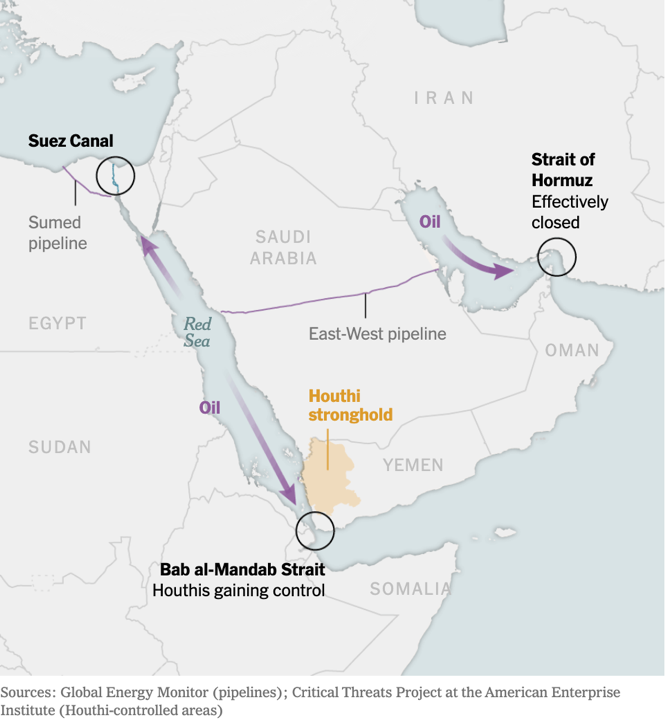
△ Geographical distribution map of the Bab-el-Mandeb Strait and the Strait of Hormuz
Saudi Arabia seeks assistance twice; U.S. refuses military strikes
According to Reuters, the Saudi Crown Prince made two phone calls to Trump on September 10, requesting the U.S. to take military action against the Houthi armed forces. The U.S. refused to launch direct airstrikes but agreed to increase support in terms of intelligence and target identification. Meanwhile, U.S. Central Command Commander Brad Cooper has traveled to Saudi Arabia to discuss the situation in the Red Sea with local officials.
Previously, Saudi Arabia had been trying to avoid becoming deeply involved in the Yemen war again. In 2015, Saudi Arabia led a coalition of countries to intervene in the Yemen conflict, conducting long-term military strikes against the Houthi armed forces, but failed to completely weaken their control capabilities. After years of war, Saudi Arabia has been gradually reducing direct military actions and seeking to maintain border stability through negotiations.
However, the latest military actions by the Houthi armed forces have expanded from within Yemen to targets in the Red Sea and Saudi Arabia, increasing the security risks faced by ports, oil pipelines, and other energy infrastructure. If both the Strait of Hormuz and the Bab-el-Mandeb Strait become tense simultaneously, Saudi Arabia's two main maritime oil export routes to the east and west will face pressure at the same time. Saudi Arabia's repeated requests for assistance from the U.S. indicate that it finds it difficult to cope with threats from Yemen on its own.
Although the U.S. did not agree to carry out airstrikes, it is also difficult to remain completely uninvolved. The U.S. has deployed a large military presence in the Gulf region, while also taking on the task of protecting its troops, allies, and international shipping lanes. As the conflict expands into the Red Sea, the regional and military objectives that the U.S. needs to consider are increasing.
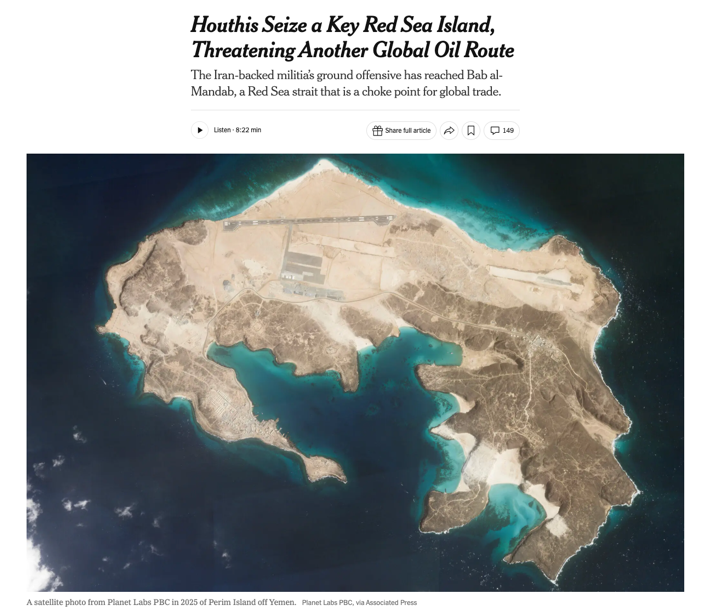
△ The New York Times reported that the Houthi armed forces occupied a key island in the Red Sea, threatening another global oil transport route outside the Strait of Hormuz.
Wanting to protect shipping lanes while avoiding involvement in conflict
Trump's refusal to directly strike the Houthi armed forces is primarily related to the military pressures currently faced by the U.S. The U.S.-Iran war has entered its seventh month, and U.S. forces are still maintaining maritime and aerial operations in the Strait of Hormuz and surrounding areas, while also protecting regional military bases and allies. If large-scale military operations are launched in Yemen, the U.S. would have to further disperse its ships, aircraft, air defense systems, and munitions.
The U.S. has previously conducted multiple strikes against the Houthi armed forces' missile, radar, and drone facilities, but has not completely eliminated their ability to attack vessels. The Houthi armed forces continue to launch attacks using dispersed missiles and drones, and if the U.S. wants to protect the vast shipping lanes in the Red Sea in the long term, it will need to invest more military resources. Even if a new round of airstrikes is implemented, it is difficult to guarantee a swift restoration of shipping lane safety.
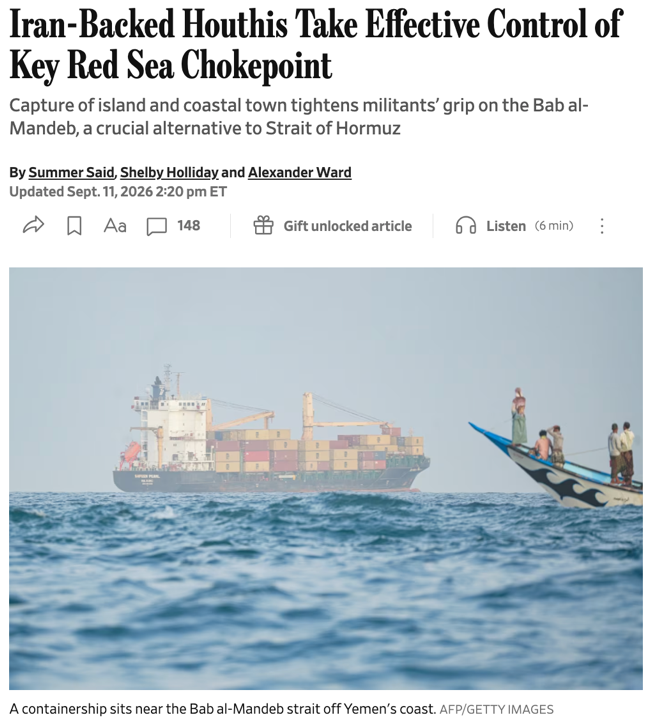
△ The Wall Street Journal reported that the Iran-backed Houthi armed forces effectively control the key chokepoint in the Red Sea.
At the same time, domestic economic and political pressures in the U.S. are also rising. The average price of diesel in the U.S. has surpassed $6 per gallon. Data released by the U.S. Department of Labor on September 11 showed that the consumer price index rose by 0.4% month-on-month and 3.4% year-on-year in August, with gasoline prices increasing by 3.9% in a single month. The continuously rising energy costs are translating into living pressures that consumers can directly feel.
Moreover, there are less than two months until the midterm elections. Trump needs to demonstrate that the U.S. can protect shipping lanes and allies, while also not wanting voters to see the U.S. opening a new battlefield in the Middle East. Therefore, the U.S. currently chooses to provide intelligence and target identification support to Saudi Arabia while avoiding direct involvement in combat.
The arrival of the Houthi armed forces at Pilin Island does not mean they can completely blockade the Bab-el-Mandeb Strait, but it does further increase the spillover risk of the U.S.-Iran conflict. Analysts believe that the Iran-backed Houthi armed forces expanding their military presence in the Bab-el-Mandeb Strait puts pressure on the U.S. to protect Red Sea shipping while addressing the situation in Hormuz. The U.S. refusal to directly strike the Houthi armed forces, while temporarily drawing a line for its involvement, still leaves uncertainty about whether it can avoid opening another front as Iran and regional allies continue to exert pressure on both maritime chokepoints. (CCTV reporter Wu Weihong)
Houthi forces advanced to Pylin Island, controlling nearby coastal areas on September 11, 2023. Saudi Crown Prince Mohammed bin Salman requested U.S. military action against the Houthis, which was denied, with the U.S. offering intelligence support instead. This escalation raises concerns about the security of maritime routes in the region and the potential for increased U.S.-Iran tensions.
- Houthi forces advanced to Pylin Island and control nearby coastal areas.
- Saudi Crown Prince requested U.S. military action against Houthi forces, which was denied.
- U.S. agreed to provide intelligence support to Saudi Arabia.
- The situation raises concerns about the escalation of U.S.-Iran tensions.
- Saudi oil production has dropped to its lowest level in over 30 years.