
Remote mine hunters silently trawl the waters as minesweepers go by the wayside
In strategic chokepoints such as the Strait of Hormuz, maritime mines threaten important military assets, shut down commercial traffic or generally cause havoc as transit lanes have to be cleared – and kept cleared – before any traffic can proceed.
The challenge is that it’s easy to mine a body of water and hard to ensure that it’s mine-free. Identifying potential mines, differentiating them from other detritus on the sea floor and neutralizing them is a painstaking, time-consuming process.
“Mines don’t have to be sophisticated,” said Bryan Clark, director of the Hudson Institute’s Center for Defense Concepts and Technology. “There are obviously very sophisticated ones that look for particular acoustic or magnetic signatures. There are some that’ll measure how many ships go across and detonate on the third or fourth ship, but they don’t need to be smart in order to be effective. All you need is somebody to detect the mine and know that it’s there, and it’s going to cause vessel traffic to stop until the mine threat has been eliminated.”
Effectively finding and neutralizing mines has become even harder in recent years, as many nations have retired or pared down their fleets of minesweeping vessels. As the threat of mines increases, however, remote mine hunting capabilities become paramount to ensuring that military, commercial and civilian vessels can safely navigate bodies of water while keeping sailors at standoff distance.
Find, fix and finish
Navies around the world use a tactic known as “find, fix and finish” to neutralize mines. Find is getting a picture of everything on the seabed, ranging from actual mines to junk such as anchors or other material that was disposed of in the water to terrain that looks like a man-made object.
Fix is evaluating everything that was found and eliminating whatever objects can be easily identified as not being mines, then classifying the remaining objects.
“This takes a long time and a lot of dedicated work,” said Mark Bock, vice president for strategy and business development at Advanced Acoustic Concepts (AAC), a Thales company. “Oftentimes it means dwelling on each of those targets one by one. You can imagine how complex this process is in highly trafficked areas such as the Straits of Hormuz.”
Finish is the final step, and it entails identifying mines that need to be neutralized and eliminating them, while protecting against the potential danger of disposing of high explosives.
Crewed and uncrewed systems working in tandem
Traditionally, mine disposal was carried out by minesweeping vessels constructed of wood or fiberglass to avoid creating a magnetic signature, equipped with sonar and other sensor arrays to identify and neutralize mines.
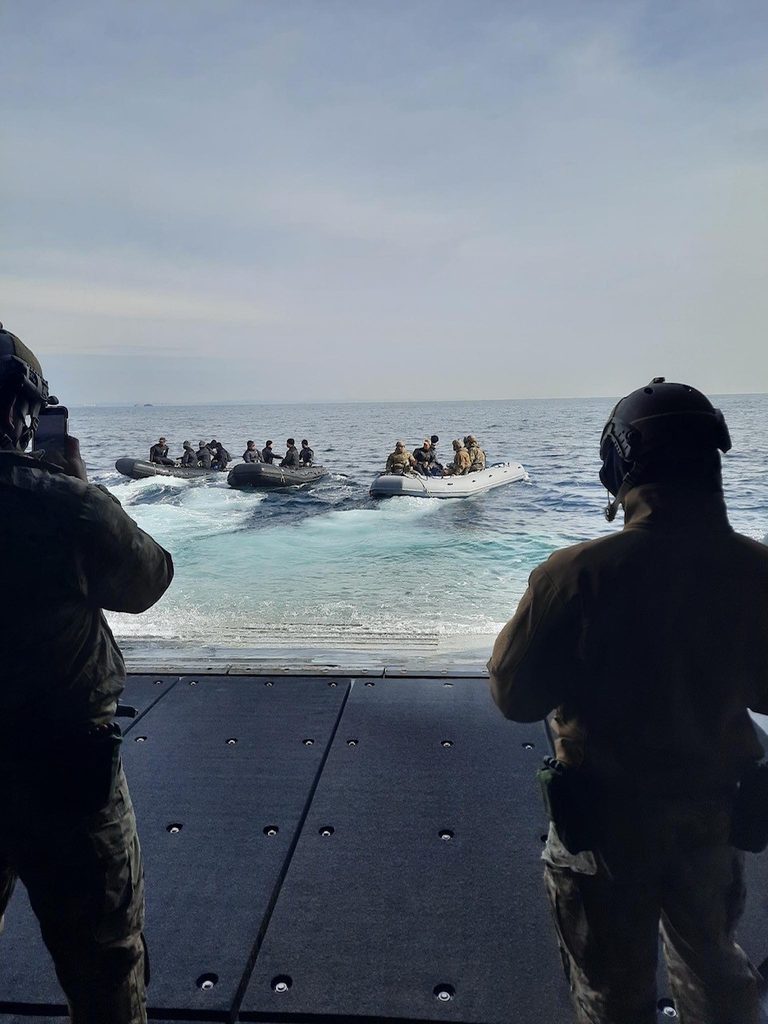 ISE BAY, Japan (Feb. 1, 2021) Japan Maritime Self-Defense Force (JMSDF) and US explosive ordinance disposal technicians, embarked on rigid hull inflatable boats, deploy from the JMSDF Ōsumi-class tank landing ship JS Shimokita (LST 4002) to conduct mine hunting operations during Mine Warfare Exercise (MINEX) 1JA 2023. During the fourteen-day exercise, participants conduct unit-level mine warfare tactics to include mine hunting, detection and prosecution. MINEX 1JA is part of an annual series of exercises between the U.S. Navy and JMSDF designed to increase proficiency in combined mine countermeasure operations and ensure the freedom of maritime navigation. (U.S. Navy Photo by Petty Officer 1st Class Charles Hardmon)
Many of those vessels have been retired, however, including those operated by the US Navy. Now, uncrewed systems are taking the lead in closing the find, fix and finish kill chain, while crewed vessels still play a role.
Towed arrays can be used on either crewed or uncrewed vessels to identify potential mines. The data they collect can be sent to human operators or a system such as an artificial intelligence (AI)-powered classification tool. Using a mixture of crewed and uncrewed vessels helps cover a larger area in a shorter period of time.
Bock gave the example of pairing one or two minesweepers with several robots, allowing for greater coverage than can be provided by crewed vessels alone.
“You can throw a lot more unmanned vessels at a problem than you can manned vessels just from an economic perspective, but also just from a bulk and size perspective,” said Bock. “For instance, the unmanned systems can be put on airplanes and flown into the region, which gives response time and capacity.”
Clark echoed that point, emphasizing that not only are uncrewed vessels cheaper and easier to move, but also can more easily be put on the shelf until they are needed.
“I can buy a lot more robots than I can buy minesweepers, because every minesweeper needs a crew and people are expensive,” he said. “If you want to expand your mine-hunting fleet, you end up having to buy a bunch of manned ships. If you’re buying robots instead, you can buy a bunch of robots, store them, and then bring them out when you need to do the mine-hunting operation.”
Going remote
As previously mentioned, remote systems allow for greater coverage at a lower risk to expensive ships and sailors. But those systems need to be able to identify potential targets and share data with human operators to make decisions on what to engage with and how to engage with it, and that is not a simple task.
“It becomes kind of like a Roomba, where the robots go up and down the route looking for mines in the water column,” said Clark. “They’ll stay near the surface and then look down into the water, and as long as the water is not extremely deep, they’ll be able to see the first 100 or 200 feet of water and detect mine-like objects.”
Effectively identifying a mine – or “not a mine” – is a challenging task in water that can be deep, murky or filled with junk that can mimic the characteristics of a mine.
“The key issue is this huge false-target rate and multiple targets you detect on the bottom – figuring out which ones are man-made and then distilling those down into what are mines,” said Bock. “An old refrigerator thrown onto the ocean bottom is not a mine, but it sometimes is roughly the same size.”
AAC tackles this with an advanced synthetic aperture sonar sensor called SAMDIS. SAMDIS is a multi-aspect imaging sonar that can illuminate targets from multiple angles in a single pass, raising the hit rate on actual targets on an initial sweep. That enables identifying mines on the first sweep through a minefield, allowing for immediate neutralization instead of having to do multiple sweeps to get different perspectives on an object to identify if it is a mine.
Once mines are identified, the company’s Angler neutralization system can eliminate the mines in a less obvious manner than blowing them up and causing a geyser of water that alerts adversaries that mines are being removed.
“The Angler countermine ROV system does not necessarily cause sympathetic detonation,” said Bock. “It will deliver an effect to the mine to neutralize it without the massive explosive reaction.
“Angler also has the capability after delivering the effects to observe the mine or seabed object and document the effects for the operators. In the tool bag of effectors, it’s the only solution today that has semi-covert attributes where the operators are a long way away depending on the scenario from the location of the dastardly deed.”
Future technologies for mine neutralization
While uncrewed systems are taking the lead in mine hunting and neutralization, technology advancements will lead to more efficient, safer mine neutralization in the future.
AI is a key part of that technological advancement, as it enables better pattern recognition, mapping of targets and identifying changes from one sweep to the next.
“By having a clear picture of what’s in the water column, we can do what’s called change detection,” said Bock. “As we tow back through again, the system using AI will find all the things that you knew were there already and haven’t changed in their classification or their location, and also find all the things that are new.”
Clark identified onboard processing and communications as a key technology improvement for remote mine hunting. Instead of the current method of having to download data from mine hunting vessels, then analyzing it, doing another pass to verify potential mines, then sending out other systems for neutralization, being able to streamline that process speeds up the find, fix, finish process.
“If instead you had onboard processing from these mine-hunting vehicles, the underwater vehicles looking for the mines could come up and transmit data back to you immediately and say, ‘I finished path one. I found a bunch of mines or potential mines. They’re here,’” said Clark. “Then you can quickly decide whether to send another vehicle out there right now to investigate, or to just send the mine neutralization system out immediately.
“You should be able to get to a point where you can do this in a way that is just robot after robot after robot.”
Remote mine hunting and neutralization operations are being conducted by the Japan Maritime Self-Defense Force and US Navy in the Strait of Hormuz. These operations are crucial due to the threat posed by maritime mines to military and commercial vessels. Advanced technologies, including uncrewed systems and AI, are enhancing the effectiveness of these missions.
- Maritime mines threaten military assets and commercial traffic in the Strait of Hormuz.
- Remote mine hunting capabilities are becoming essential due to the retirement of traditional minesweeping vessels.
- The Japan Maritime Self-Defense Force and US Navy conducted mine hunting operations during Mine Warfare Exercise (MINEX) 1JA 2023.
- Advanced technologies like AI and synthetic aperture sonar are improving mine detection and neutralization.
- Uncrewed systems are increasingly used for mine hunting to reduce risks to crewed vessels.