
Researcher Zhou Hongchao of a Certain Unit of the Rocket Force Innovates for Combat and Strives for Innovation—Forging a Sharper Long Sword for a Great Power (The Most Beautiful Revolutionary Soldier of the New Era)
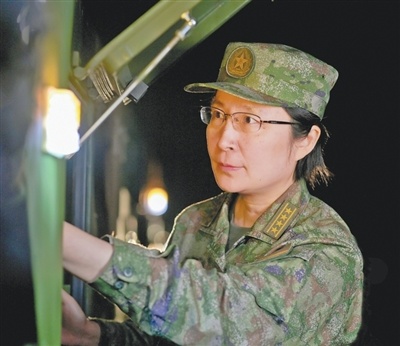
Zhou Hongchao is inspecting the equipment performance.
Photo by Liu Mingsong
In the vast desert, the smoke of gunpowder is thick, and a realistic combat drill is in full swing. Inside the command tent, a dashing female colonel leads a technical team, skillfully responding to complex situations, assisting missiles in breaking through encirclements to complete strike missions.
This female officer is Zhou Hongchao, an expert in the technical group for this drill and a researcher from a certain unit of the Rocket Force.
Her "position" is small, steadfast in the laboratory, cultivating and exploring in the world of code and data; her "world" is vast, with the skies above and the electromagnetic space as her "crossing" grounds, guiding long swords through clouds and breaking barriers.
With over 30 years of service, Zhou Hongchao has dedicated her research to warfare, innovating boldly, actively promoting the verification and development of missile weapons, and iterating and upgrading offensive and defensive tactics. She has won three first-class and nine second-class military science and technology advancement awards and has been recognized by the Rocket Force as one of the "Top Ten Sword Sharpeners."
"Exploration knows no bounds; the harder it gets, the more persistent we must be."
More than 30 years ago, with a dream of serving in the military, Zhou Hongchao was admitted to the National University of Defense Technology, studying in the Department of Systems Engineering and Mathematics, which was established under the guidance of Qian Xuesen.
Since then, the seeds of the spirit of a scientist have quietly been sown. After earning her doctorate, she embarked on the path of missile research.
Shortly after arriving at her unit, a key research project was underway, urgently needing to write and verify a massive amount of source code. She took the initiative to volunteer for this task.
During that time, she practically lived in the laboratory, immersed in the ocean of code and data, meticulously sorting and writing, repeatedly verifying and modifying, contributing to the project's successful breakthrough.
"Each generation has its mission; she has carried on the spirit of the older generation of scientists and has taken up the 'baton' of the new era," commented Academician Tang Xisheng.
That year, a fierce local war broke out thousands of miles away, and missile offense and defense issues became the focus of contention. Establishing a new research center was put on the agenda.
During the critical period of the center's construction, who would lead it? The organization approached Zhou Hongchao, wanting to hand this heavy responsibility to her. Standing at a new starting line, the difficulties were far more complex than anticipated. At that time, there was a lack of traction means in the domestic missile offense and defense field, and verifying effectiveness was challenging, making the construction of an experimental support platform particularly urgent. During that time, her office was filled with weekly plans, monthly plans, and construction progress charts, and her desk was piled high with various professional books.
When encountering "roadblocks," she always encouraged herself and her team members: "It's nothing serious; just think of it as pursuing another doctorate." In the end, Zhou Hongchao led everyone to win this "tough battle."
The verification of missile offense and defense equipment and tactics is a recognized challenge. If breakthroughs can be achieved, the contribution rate of missiles to the combat effectiveness of troops will be significantly enhanced. To this end, after systematic verification, she took the lead in proposing the construction of a certain simulation system.
"She is both a commander and a combatant," said Song Yanqi, an assistant researcher from a certain unit of the Rocket Force. During that time, Zhou Hongchao led more than ten participating research units to tackle challenges, breaking down more than ten subsystems and hundreds of key node tasks one by one, with tasks precisely assigned to days and responsibilities to individuals. The system was completed and put into use on schedule. Today, the key laboratory built primarily on this system platform has supported the completion of dozens of important research projects.
Research on missile offense and defense is the unity of "forging swords" and "forging shields," aiming to make the great nation's long sword strike farther and more accurately while repeatedly enhancing the survivability of weaponry. Zhou Hongchao said, "Exploration knows no bounds; the harder it gets, the more persistent we must be!"
"Smelling the gunpowder helps grasp the real situation better."
In the heart of the Gobi Desert, a red-blue confrontation drill has entered a stalemate phase. "Ignite!" At the command, several long swords of the great nation soared into the sky, accurately hitting the target. This means that the combat effectiveness of this type of missile has advanced another step.
Zhou Hongchao jumped up from the technical support seat and embraced everyone enthusiastically.
Over the years, she has led her team to sprint with "accelerated speed" on the "track" of combat readiness.
During one experiment, to obtain firsthand data, she decided to stay at the final area. That day, as the smoke from the explosion dissipated, she, suffering from a cold and fever, braved the raging sandstorm to push forward. A young colleague accompanying her held her back, saying, "You wait here; we'll go get the data." But Zhou Hongchao insisted, "I am the project leader; smelling the gunpowder helps grasp the real situation better."
That day, she led the team to drive and survey each location, returning to the campsite late at night. According to the requirement that "data should not be left overnight," she led everyone to tirelessly verify and analyze the massive data, and by the time they wrapped up, dawn had already broken.
In daily life, Zhou Hongchao is always seen as gentle and smiling, but once she enters research mode, she immediately seems like a different person.
"The code in our hands is meant for the battlefield in the future; 'close enough' is not acceptable." Once, she found an error in the code written by a young researcher and sternly criticized him in person, saying, "In offense and defense games, victory and defeat lie in the details; there is no room for carelessness."
During a discussion on equipment performance evaluation, Zhou Hongchao and her team proposed assessment scenarios that were more aligned with real combat and stricter evaluation ideas. The development unit believed that the standards she set were too high to achieve and approached her to see if they could negotiate and lower the indicators.
Zhou Hongchao's attitude was very clear, "No compromise on principles": "These pieces of equipment must withstand verification under complex conditions; this is a matter of principle."
Some military personnel said that if there is a problem, they can always get satisfactory answers from her. During equipment testing, a certain unit repeatedly encountered abnormal signals and could not find the cause despite multiple attempts. In desperation, they sought Zhou Hongchao's "help." She provided remote guidance, listing several possibilities for the unit to check first. The next morning, she arrived on-site to help the unit solve the problem.
"The needs of the troops are our research guiding star; the laboratory and testing ground are our smoke-filled battlefields." Zhou Hongchao often repeats this phrase and has practiced it consistently for decades.
"If you can't convince yourself, how can you convince the experts?"
"These two topics are not mature enough for verification; I suggest we hold off on reporting them." Zhou Hongchao's statement during a project proposal surprised everyone and left some puzzled.
Because everyone knew that these two topics were brought forth by a concentrated effort of capable individuals. "Can we at least report them to see if they can work out?" someone expressed a different opinion.
"We must not let a topic that cannot meet battlefield needs occupy valuable research resources." Zhou Hongchao explained her reasoning from the perspectives of cutting-edge technology outlook and future combat needs, aligning everyone's understanding.
Zhou Hongchao chooses research directions and topics not based on trends or whether they are "fruitful," but focuses on solving bottleneck issues in combat effectiveness and key technologies that are "choking" progress, setting a good example for many researchers.
Training young talent is a key focus in building research teams. Young officers sometimes encounter practical problems such as unclear research directions and growth paths.
Song Yanqi, who comes from an optical engineering background, felt lost when she first joined the team, facing the unfamiliar missile field.
Zhou Hongchao did not rush to assign tasks but started from the needs, thoroughly understanding Song Yanqi's professional background and technical strengths. After repeated studies, she tailored a "infrared + simulation" cross-research direction, retaining the original professional advantages while matching the team's development needs, helping her quickly find her focus.
Dr. Cui, a young backbone of the research office who graduated two years ago, has a deep understanding of Zhou Hongchao's strict academic requirements.
On the eve of a project acceptance, Dr. Cui compiled a technical summary report of over 100 pages and confidently submitted it to Zhou Hongchao for review. The next day, when he received the feedback document, the dense revisions made him feel pressured. Zhou Hongchao pulled up a chair and sat beside him, explaining the revisions page by page.
"Writing a project report is not just about completing a task; it's about persuading others. If you can't even convince yourself, how can you convince the experts?" For Dr. Cui, Zhou Hongchao was not just revising the document but helping him develop a rigorous and pragmatic research habit. Under Zhou Hongchao's guidance, a group of cross-disciplinary newcomers in a certain unit of the Rocket Force have stabilized their positions and rapidly grown into talents.
Zhou Hongchao leads missile research and development efforts in the Rocket Force, conducting exercises in the Gobi Desert to enhance missile capabilities. She has received multiple awards for her contributions and has developed a new simulation system to improve missile defense. Ongoing exercises demonstrate advancements in missile accuracy and effectiveness.
- Zhou Hongchao leads missile research and development efforts in the Rocket Force.
- She has received multiple awards for her contributions to missile technology.
- A new simulation system was developed to enhance missile defense capabilities.
- Missile exercises were conducted in the Gobi Desert, demonstrating improved missile accuracy.