
Romanian F-16 Shoots Down 2026 Ukrainian Drone Over Estonia
 Alexandra Reeves
Romanian F-16 Shoots Down 2026 Ukrainian Drone Over Estonia
NATO just did something in the Baltic skies that it has spent more than two decades trying not to do: it turned air policing from a reassurance mission into a live weapons engagement over allied territory.
According to Defense News, a Romanian Air Force F-16 assigned to NATO Baltic Air Policing shot down what Estonian authorities suspect was a Ukrainian drone over Estonia on May 19. The aircraft was operating from Siauliai Air Base in Lithuania, the long-running hub of NATO air policing in the Baltic region. Estonian officials said the drone was detected before it entered national airspace, then brought down shortly before 13:00 local time, with debris falling in a swampy area between Lake Vortsjarv and Poltsamaa.
That is not a world war moment. It is not Article 5. It is not proof that Ukraine is using Baltic airspace to attack Russia, which Kyiv explicitly denies. But it is a very useful warning. The alliance has built a system that can scramble fighters against suspicious aircraft. It has not yet built a politically tidy answer for one-way drones that drift, jam, misnavigate or get deliberately redirected into NATO territory.
The Shootdown Matters Because It Was Not Russian
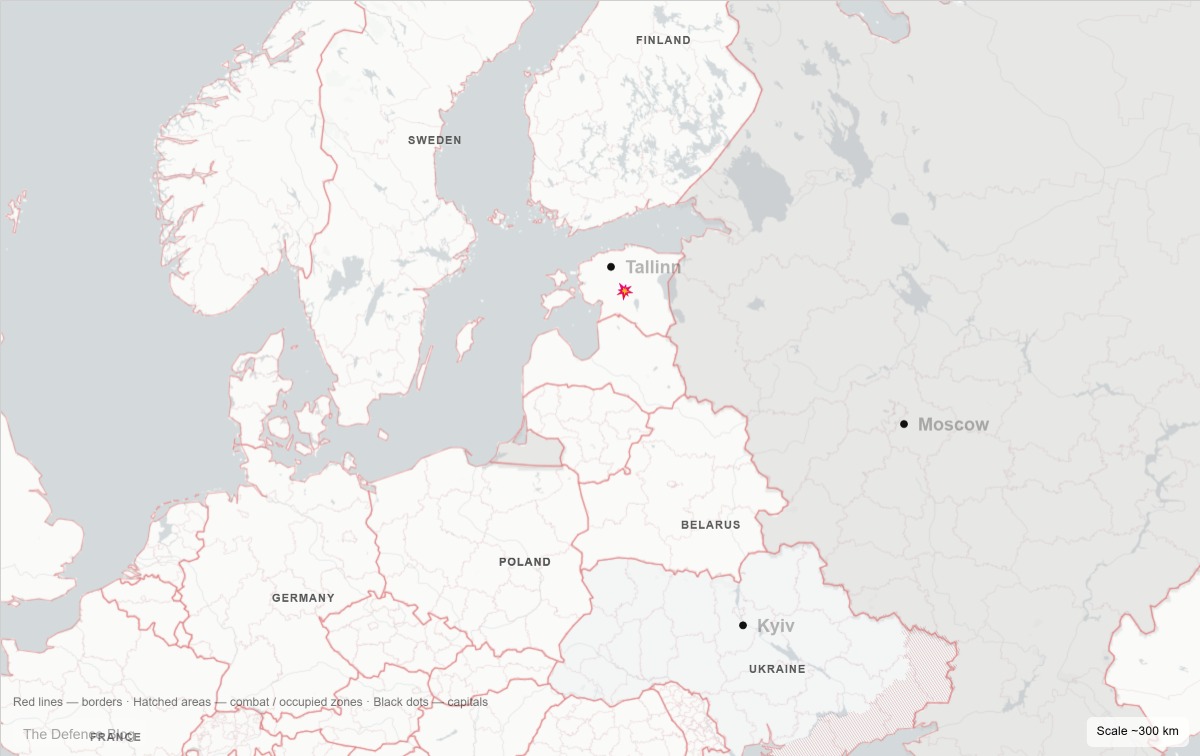
The awkward part is the origin. Estonian officials described the drone as likely Ukrainian, and Ukraine moved quickly to contain the damage. Foreign ministry spokesperson Heorhii Tykhyi publicly apologized to Estonia and the Baltic states, saying the incident was unintended. Estonia's Defence Minister Hanno Pevkur said he had spoken with Ukrainian Defence Minister Mykhailo Fedorov, who also apologized. That was the right diplomatic move. It does not solve the military problem.
The Baltic states are now living under a strange tactical spillover from a war they are not formally fighting. Ukrainian long-range strike drones are aimed at Russian military and industrial targets. Russian electronic warfare, according to Ukrainian and Baltic accounts, may be pushing some of those drones off course. Moscow then uses the resulting airspace violations to claim that NATO states are secretly enabling Ukrainian attacks. That is a neat little information operation: jam the weapon, blame the neighbour, force NATO to spend political capital cleaning up the mess.
The Defense News account noted that the shootdown came hours after Russia's SVR foreign intelligence service accused Latvia, without evidence, of preparing to let Ukraine launch drones from Latvian territory. Latvia denied it. Ukraine also said Estonia, Latvia, Lithuania and Finland have not allowed their airspace to be used for strikes on Russia. In normal diplomatic language this would be a denial. In the Baltic context it is also damage control against a Russian narrative designed to make every errant drone look like NATO participation.
Air Policing Was Built For A Cleaner Threat
NATO's own description of Air Policing is straightforward: it safeguards allied airspace, monitors air traffic and intercepts unusual or unsafe aircraft. The mission dates to 1961, and the Baltic version has operated continuously since Estonia, Latvia and Lithuania joined NATO in 2004. Because the three Baltic states do not have their own fighter fleets, other allies rotate jets through Siauliai in Lithuania and, since 2014, Amari in Estonia. Latvia's Lielvarde Air Base has also become capable of hosting air policing aircraft.
That model made sense when the problem was Russian military aircraft probing the edges of NATO airspace. A fighter scramble, a visual identification, a controlled intercept, and everyone goes home angry but alive. Drones make the geometry uglier. A Shahed-type or Ukrainian long-range strike drone is slow, relatively cheap, unmanned and often flying a pre-programmed route. It may carry a warhead. It may be lost. It may not answer any signal. It may also be exactly the kind of object that a fighter pilot can find and destroy before it reaches a town.
Using an F-16 to kill a wandering drone is militarily sensible in the moment and economically absurd as a steady-state answer. Romania's F-16s give NATO a fast reaction option, and in this case proximity mattered. But a fighter jet is an expensive, scarce tool for a target class that Russia and Ukraine both produce in volume. The Baltics do not need only more heroic quick reaction alerts. They need denser sensors, short-range air defence, electronic warfare attribution tools, debris recovery teams and rules that can be explained to the public before the next siren goes off.
The Baltic States Are Becoming The War's Error Margin
The deeper issue is that the Baltic states are becoming the margin of error for the long-range drone war. Defense News noted a pattern of previous Ukrainian drones entering Baltic airspace, including incidents involving infrastructure in Latvia, Estonia and Lithuania. Some reporting has raised the possibility that Russian jamming or spoofing helped push drones away from intended routes. Even if that is true, NATO cannot build its response around a courtroom standard of proof delivered after the wreckage is found. Air defence decisions happen in minutes.
This is where the alliance has to stop pretending that peacetime and wartime air defence are cleanly separated categories. Estonia was not under attack in the strategic sense. Yet Estonian residents received alerts, allied fighters were airborne, a live weapon was used, and officials had to warn people not to touch debris. For a citizen in southern Estonia, that is not a theoretical spillover. It is the war arriving as a navigation failure.
There is also a political trap for Ukraine. Kyiv has every military incentive to strike Russian targets deeper and more often, especially as Russia continues large missile and drone attacks on Ukrainian cities. But every Ukrainian drone that crosses into NATO territory gives Moscow a propaganda gift and gives nervous Western governments another reason to ask whether Ukraine can control escalation. That is unfair, particularly if Russian jamming is part of the story. War is not fair. Alliance politics is even less so.
What NATO Should Fix Before The Next Drone
The immediate answer is not to scold Estonia or Ukraine. Estonia did what an allied state is supposed to do: detect, respond, protect the public, and coordinate with partners. Ukraine apologized quickly, which matters. Romania's F-16 did its job. The machinery worked.
The problem is that the machinery worked in a way that reveals how much still depends on improvisation. NATO needs a standing Baltic drone spillover protocol: shared public attribution language, a rapid technical channel with Ukraine, pre-cleared engagement rules for unmanned aircraft, and more ground-based options so every incident does not become a fighter jet story. It also needs to be honest that Russian electronic warfare is not just a battlefield nuisance. It is a cross-border coercion tool when it pushes weapons, aircraft or navigation systems into allied space.
The uncomfortable lesson from Estonia is simple: NATO air policing can shoot down a drone, but it cannot shoot down the political ambiguity that sent it there.
The next test will be whether the alliance treats May 19 as an odd incident or as a preview. If it is the latter, the Baltic air defence problem is no longer about intercepting Russian jets near the border. It is about managing a drone war whose mistakes, manipulations and propaganda effects now land inside NATO territory. That is a much harder mission than the one Siauliai was built for.
A Romanian F-16 shot down a suspected Ukrainian drone over Estonia on May 19 during NATO Baltic Air Policing operations. The drone was detected before entering Estonian airspace and was brought down shortly before 13:00 local time. This incident highlights the complexities of air defense in the region, as it raises concerns about the implications of drone operations in NATO territory.
- A Romanian F-16 shot down a drone over Estonia on May 19.
- The drone is suspected to be Ukrainian.
- The incident occurred during NATO Baltic Air Policing operations.
- Estonian officials detected the drone before it entered national airspace.
- Ukraine's foreign ministry apologized for the incident.