
Romania's F-16 Downing Third Russian Drone Tests NATO Restraint
 Alexandra Reeves
Romania's F-16 Downing Third Russian Drone Tests NATO Restraint
Romania just crossed a line NATO has spent most of the Ukraine war trying not to touch.
According to Stars and Stripes, a Romanian F-16 shot down a suspected Russian drone after a third recent airspace incursion. LIGA.net, citing Romania's Ministry of Defence, reported on July 26 that Bucharest had already downed a third drone and was preparing a diplomatic protest against Russia. Ukrainian outlets separately reported fresh Romanian scrambles over unidentified targets moving near the Ukrainian border.
The facts are still narrow, and they should stay narrow: this was not NATO joining the war, not an Article 5 moment, and not a strike on Russian territory. But it was also not business as usual. For years, Russian drones and missile debris have fallen around NATO's eastern edge while alliance governments used careful language, launched aircraft, recovered wreckage, and avoided escalation. A Romanian F-16 killing an intruding drone changes the practical baseline. The frontier is no longer only being watched. It is being defended with live fire.
The Weapon Was Cheap, the Interceptor Was Not
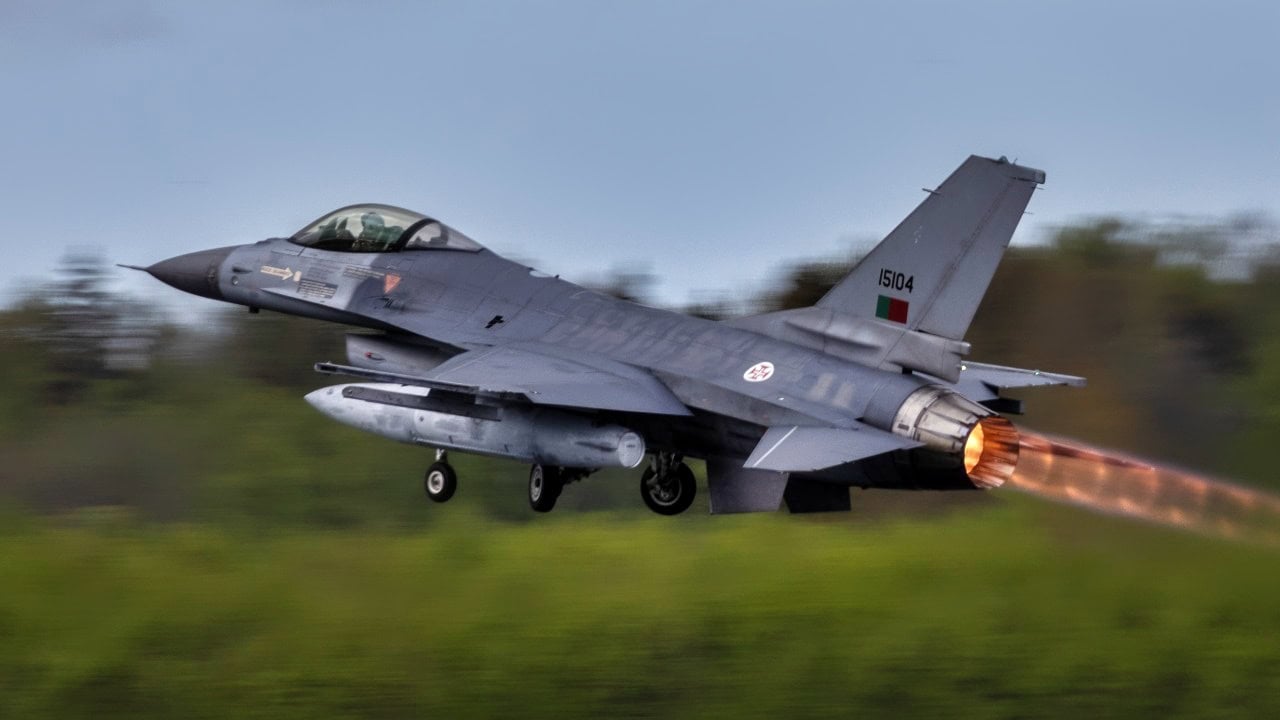
The tactical mismatch is the first problem. Romania operates F-16AM/BM fighters acquired from European partners and upgraded around NATO-compatible avionics, Link 16 communications, precision navigation, and Western air-to-air weapons. In a border scramble, the aircraft can identify, shadow, and engage a slow drone with radar, electro-optical cueing, or visual confirmation, depending on conditions and rules of engagement.
The target, if it was a Shahed-type one-way attack drone, is at the opposite end of the cost curve. Shahed-136/Geran-family drones are slow, noisy, and crude by fighter standards. They typically fly at roughly 150-185 km/h, can carry a warhead often assessed in the 30-50 kg class, and are built to force defenders into bad arithmetic. Ukraine knows this problem intimately: a $20,000 to $50,000 drone can provoke the launch of a missile worth many times more, or the scramble of a fighter that burns maintenance hours, pilot time, and readiness for a target that may already be damaged or lost.
That does not mean Romania had a better option in the moment. A drone crossing NATO airspace near populated areas is not an accounting exercise. It is a sovereign airspace violation with a warhead attached. If the drone is heading back toward Ukraine, Bucharest still has to decide whether letting it transit creates a worse precedent than shooting it down.
Russia Is Testing the Edge Without Declaring the Test
Moscow does not need to announce a deliberate NATO probe for the effect to be the same. Russian attack routes against Ukrainian ports and infrastructure near the Danube have repeatedly pushed drones, fragments, and air defence engagements close to Romanian territory. Some incidents may be navigational failure. Some may be damaged drones drifting after Ukrainian fire. Some may be calculated indifference.
That last category matters. The Kremlin has learned that ambiguity is useful. A drone over Romania can be blamed on electronic warfare, Ukrainian interception, pilotless navigation, or simple battlefield chaos. NATO, meanwhile, has to behave like a disciplined alliance of 32 governments, not an irritated border guard. Every shootdown is legally defensible if the object violates airspace. Every shootdown also creates the next Russian question: will NATO do it again, faster, and closer to the border?
This is where the usual reassurance language becomes thin. NATO air policing was built to preserve airspace integrity, especially over members without large fighter fleets. It works well against identifiable aircraft that can be intercepted, escorted, photographed, and politically messaged. One-way drones are different. They are numerous, disposable, and often arrive during mass strikes when radar tracks, civilian alerts, Ukrainian air defence fire, and electronic interference overlap.
Bucharest Has Fewer Choices Than It Pretends
Romania is not looking for a fight with Russia. That is obvious. It hosts NATO assets, watches the Black Sea, supports Ukraine's export routes, and carries the political risk of being the alliance member closest to some of Russia's nastiest air campaigns. Its government has every reason to keep incidents bounded.
But restraint can become its own vulnerability. If Bucharest repeatedly lets drones cross because each individual object is small, slow, or plausibly accidental, Russia gets a permissive border environment. If Bucharest shoots them down every time, Moscow gets a propaganda line about NATO entering the conflict. Neither option is clean.
The sharper question is whether NATO can build a layered frontier defence that does not require F-16s to chase cheap drones one by one. That means more ground-based sensors along the Danube approaches, short-range air defence around likely impact zones, counter-drone systems that can engage below the cost of an AMRAAM, and a shared NATO-Ukraine air picture that does not blur sovereignty lines. It also means politicians have to tell the public a more honest story: eastern-flank air defence is not a symbolic reassurance mission anymore. It is a live border-management problem in a war zone.
The Escalation Risk Is Real, but Often Misread
Everyone in Washington and Brussels is conditioned to ask whether this kind of incident risks escalation. It does. But the greater danger is not that one F-16 kill suddenly starts a NATO-Russia war. The danger is that repeated ambiguous incursions normalize a tactical grey zone where NATO aircraft, Russian drones, Ukrainian interceptors, and civilian territory all occupy the same compressed decision space.
That is how mistakes happen. Not through grand strategy, but through seconds of imperfect identification and weeks of political hesitation.
Romania's F-16 shootdown should therefore be read as a warning, not a triumph. It shows NATO can defend its airspace. It also shows how thin the margin has become on the Black Sea flank. The next thing to watch is not whether Moscow complains. It will. Watch whether NATO gives Romania cheaper tools, clearer rules, and enough public backing to shoot down the fourth drone without turning every incident into a mini summit.
The uncomfortable truth is simple: Russia has made NATO's border part of Ukraine's air war. NATO can keep calling that a spillover problem, but the F-16 pilot over Romania just had to solve it as a combat problem.
Sources
- Stars and Stripes reported on July 27 that a Romanian F-16 shot down a suspected Russian drone after a third airspace incursion.
- LIGA.net reported on July 26, citing Romania's Ministry of Defence, that Romania had downed a third drone and was preparing a diplomatic protest against Russia.
- Ukrainian Pravda reported on July 27 that Romania scrambled jets over an unknown target heading toward Ukraine.
- NATO public air-policing material provides the alliance context for eastern-flank airspace defence missions.
On July 26, 2023, a Romanian F-16 shot down a suspected Russian drone, marking the third such incident in recent weeks. Romania's Ministry of Defence reported the downing and is preparing a diplomatic protest against Russia. This action reflects a significant shift in NATO's response to airspace violations, as Romania actively defended its airspace rather than merely monitoring it.
- Romania's F-16 shot down a suspected Russian drone on July 26, 2023.
- This incident marks the third drone downing by Romania in recent weeks.
- Romania is preparing a diplomatic protest against Russia following the incident.
- The drone was likely a Shahed-type one-way attack drone.
- Romania's actions indicate a shift in NATO's approach to airspace violations.