
Russia Just Tested NATO's Eastern Flank With a Kh-101 in Poland
 Alexandra Reeves
Russia Just Tested NATO's Eastern Flank With a Kh-101 in Poland
A Russian cruise missile did not merely go astray over Poland on Friday. It crossed into NATO territory, struck Polish soil, and landed roughly 50 kilometres from Ukraine's border while an allied military exercise was under way nearby. Nobody was killed. That is the good news. The bad news is that Warsaw now has to explain why a precision weapon designed to fly hundreds of kilometres through defended airspace was able to turn a live war into an alliance problem.
Polish Defence Minister Wladyslaw Kosiniak-Kamysz said the missile was a Russian Kh-101 and hit a rural area near Nowy Lipowiec at about 06:30 local time. Two other objects also fell nearby, including what officials described as another suspected missile and a jet-powered drone. NATO aircraft were scrambled, and Prime Minister Donald Tusk called the incident an intentional provocation rather than an accident. Moscow has not publicly answered the accusation.
The Incident Was Timed for Maximum Political Effect
The geography matters. The United Kingdom and France are leading Koalicja 2026 near Nowa Dęba, an exercise involving 11 countries from the Coalition of the Willing. Several defence ministers visited the training ground only hours after the incident. Tusk's conclusion was blunt: it was no coincidence that the objects came down near the manoeuvres.
That claim remains an attribution by the Polish government, not a courtroom finding. But the operational message does not depend on proving Russian intent beyond doubt. Russia's air campaign against Ukraine created the flight path, the timing, and the escalation risk. The missile crossed into a state protected by NATO's Article 5 as European governments were trying to demonstrate that they could organise military support for Kyiv without waiting for Washington to do everything.
This is exactly the kind of pressure Moscow has repeatedly applied to Europe: keep the war inside Ukraine when possible, but make every neighbouring government calculate the cost of helping. A missile that kills no one can still do strategic work if it forces allies to hesitate.
What the Kh-101 Brings to the Fight
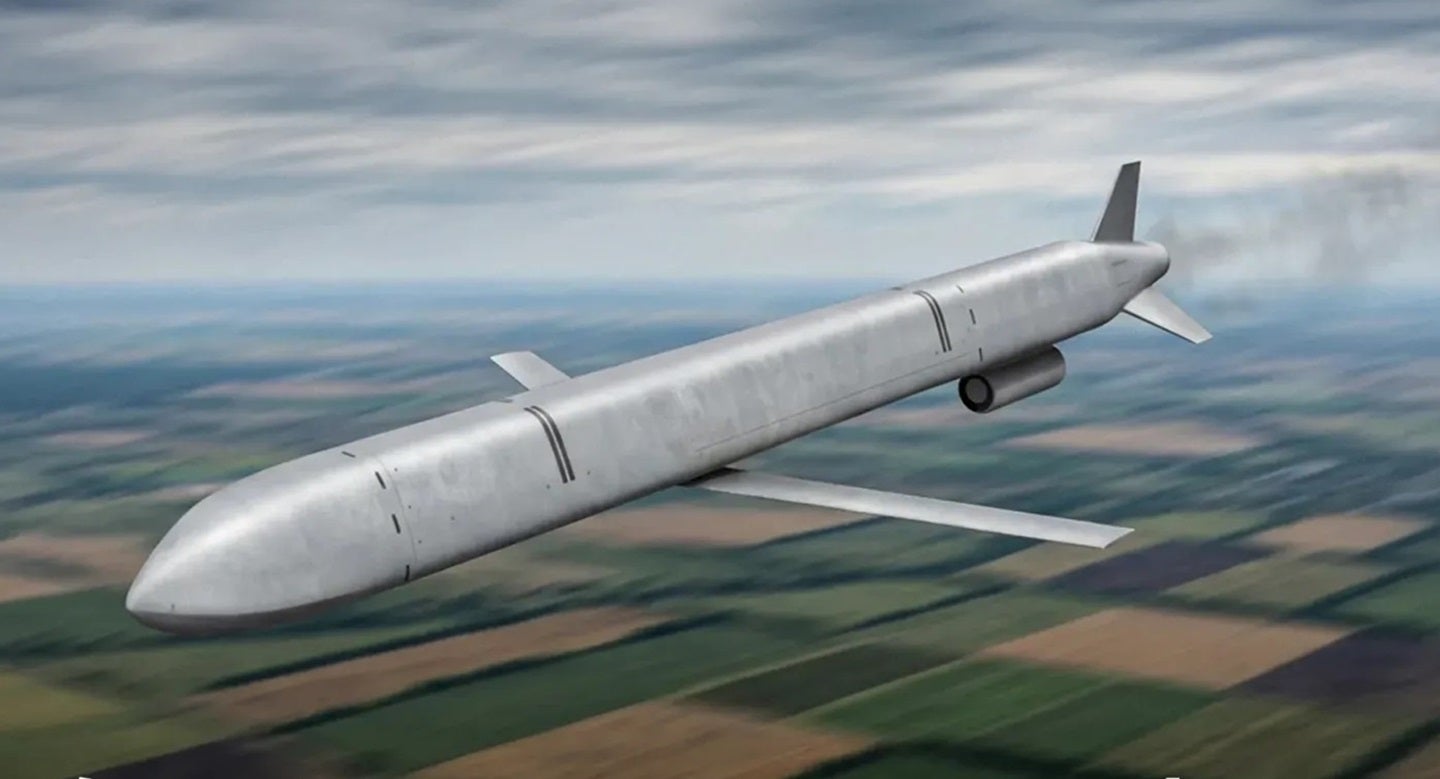
The Kh-101 is not a crude battlefield rocket. The Center for Strategic and International Studies describes it as a Russian air-launched cruise missile with a conventional warhead, a turbofan engine, and a reported range of roughly 2,500 to 2,800 kilometres. Russian claims have put the maximum range higher, but those figures are not independently established. The missile is about 7.45 metres long, carries an estimated 450-kilogram conventional warhead, and is designed to approach at low altitude while using inertial, GLONASS, terrain-matching and terminal electro-optical guidance.
Those characteristics explain why this is more than a symbolic border violation. A Kh-101 can be launched from Russian Tu-95 or Tu-160 bombers far from the target area. Its low-level flight profile is intended to complicate detection, while its precision guidance allows Russia to attack bridges, energy infrastructure and military sites rather than simply saturating a map with unguided explosives. In this case, the result was a missile in Polish territory. Whether that reflects navigation failure, deliberate signalling, or an attack geometry that accepted the risk is still unclear.
The technical lesson is uncomfortable. NATO's eastern flank is not protected by the border itself. It is protected by sensors, data-sharing, fighter patrols, rules of engagement and political decisions made in minutes. A long-range cruise missile does not need to defeat every NATO system. It only needs to create uncertainty about where the next one will land.
NATO's Response Was Correct but Not Sufficient
NATO Secretary General Mark Rutte condemned what he called grave violations of Polish airspace and said alliance jets had been scrambled. That response is necessary. It is also the minimum response expected from an alliance whose credibility depends on treating airspace violations seriously.
The harder question is what comes next. Poland is likely to request additional support, and Warsaw will be right to ask for more persistent air defence coverage, better counter-cruise-missile tracking and faster allied procedures. But European governments should resist the temptation to treat this as a one-off request for more interceptors. The problem is structural. Russia is firing large salvos at Ukraine, and the debris, decoys, drones and navigation errors are generating a wider security perimeter around the war.
Poland, Romania, Slovakia and the Baltic states are not passive bystanders in that perimeter. They are logistics hubs, training areas and staging grounds for support to Ukraine. The more effective European assistance becomes, the more Moscow has an incentive to make those support networks feel exposed without crossing into a clearly deliberate attack on NATO.
That is the grey zone in its most dangerous form. The alliance must deter intentional aggression while remaining ready for a strike that Russia will call an accident. If every incident produces only a statement and a temporary scramble, the lesson learned in Moscow may be that escalation can be tested cheaply.
The Next Test Is Political, Not Technical
European leaders have spent months arguing about security guarantees for Ukraine and the shape of a possible peace deal. On Friday, Russia answered those discussions with more than 110 missiles and over 400 attack drones against Ukraine, according to President Volodymyr Zelensky, followed by the missile incident in Poland. BBC reporting said the Russian strikes killed civilians and hit bridges and railway infrastructure in Kyiv and Lviv.
That sequence should end one comforting assumption: negotiations and battlefield pressure are separate tracks. They are not. Moscow can talk about diplomacy while using long-range fires to punish Ukraine, test NATO's airspace and shape Europe's political risk calculations.
The immediate priority is to establish the missile's exact route, determine why Polish air defences did or did not engage it, and make the findings public enough to reassure allies without exposing sensitive capabilities. The longer-term priority is harder: build an eastern-flank air defence architecture that assumes Russia will keep probing the seam between war and alliance territory.
The Kh-101 that landed in Poland caused no deaths. Europe should not mistake that for restraint. The real warning is that a Russian strike on Ukraine can now become a NATO crisis without anyone in Moscow needing to announce that decision. If the alliance wants to deter the next test, it must make the political and military cost of that ambiguity higher than the benefit of creating it.
Sources
A Russian Kh-101 cruise missile struck Polish territory near Nowy Lipowiec at approximately 06:30 local time, landing 50 kilometers from Ukraine's border during a NATO military exercise. No casualties were reported, but the incident prompted NATO to scramble aircraft and raised concerns about airspace violations. Polish officials characterized the event as an intentional provocation by Russia, highlighting the geopolitical tensions in the region.
- A Russian Kh-101 missile struck Polish territory near Nowy Lipowiec.
- The missile landed approximately 50 kilometers from the Ukrainian border.
- No casualties were reported from the incident.
- NATO aircraft were scrambled in response to the violation of Polish airspace.
- The incident occurred during a military exercise involving multiple NATO countries.