
Russia Trained 22,000 Journalists and the West Is Still Banning RT
 Alexandra Reeves
Russia Trained 22,000 Journalists and the West Is Still Banning RT
Here's a number worth sitting with: 22,000. That's how many journalists and media students Russia's state media machine says it has trained since 2018 — 15,000 through SputnikPro, another 7,000 through RT Academy since February 2024. And the pace is accelerating. ISW's new assessment, published August 17, counts at least 50 training events between July 2025 and July 2026, roughly half of them built around AI content production. The West's answer to all of this is still a sanctions list and a channel ban. That's not nothing. It's just fighting the last war.
The AI Turn Nobody Is Watching
Here's the part Western counter-propaganda units should find genuinely unsettling: the Kremlin has turned AI into a training curriculum. SputnikPro and RT Academy spent the past year teaching foreign journalists how to use AI for content creation, editorial workflows and social media management — at New Era University in the Philippines, the University of Tripoli in Libya, Prime Africa Channel in Kenya, the Communication University of Zhejiang in China, the University of Dar es Salaam in Tanzania and the University of Education in Winneba, Ghana.
Sputnik launched an AI-focused internship with New Generation, the Rossotrudnichestvo youth program, in June 2026. RT Academy and Russia House Jakarta ran an AI session for several hundred East Asian youth influencers last winter. RT Academy and RT China held discussions on neural networks in media workflows at Chinese universities in April 2026. SputnikPro ran AI content trainings at Al-Azhar University in the Gaza Strip, Sana'a University in Yemen, a journalism school in Niger and Daffodil International University in Bangladesh between February and May 2026.
Think about what this means operationally. A trained journalist in Tanzania with an AI toolkit doesn't need Moscow. They can produce Kremlin-aligned content at scale, in their own language, from their own country, without ever touching RT's brand. Sanctioning RT doesn't touch them. Banning Sputnik doesn't touch them.
This Isn't Opportunism, It's a Pipeline
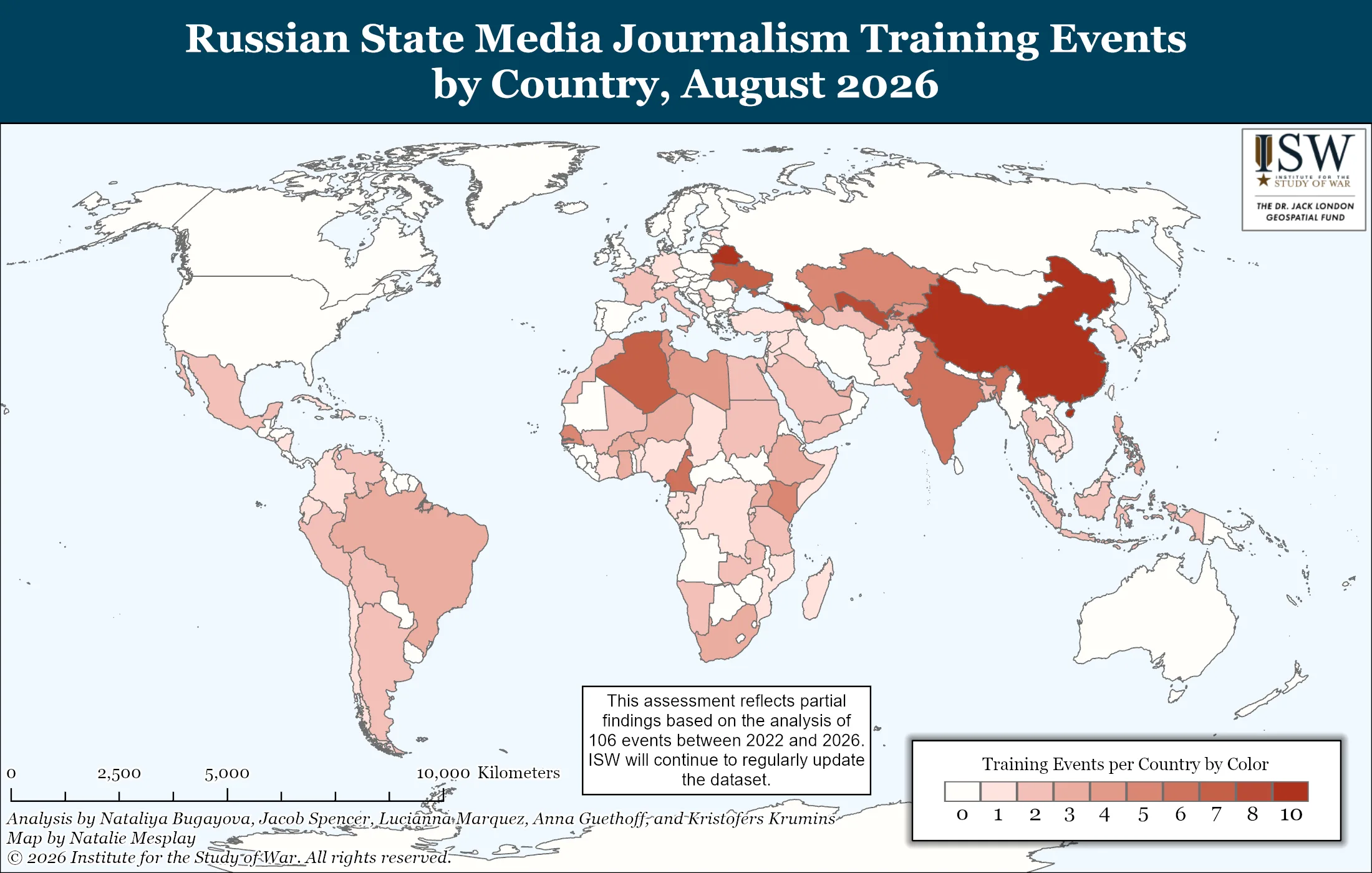
The easy read is that Russian media training is cheap propaganda theater — workshops, photo ops, handshakes. ISW's evidence says otherwise. This is structured, generational investment. At least 14 training events at foreign universities in the first six months of 2026 alone, from Tsinghua and Peking to Dar es Salaam and Winneba. Since July 2025, at least 20 training events for participants from at least 29 African countries. The map ISW published with the assessment — 106 events between 2022 and 2026, with China darkest at 10 — shows a genuinely global footprint.
The recruitment pipeline is the tell. RT Academy offers employment to high-performing graduates. African Initiative, the Kremlin agency founded in 2023, signed professional contracts with top students at its journalism school in Mali in December 2024. This isn't training the next generation of Russian state media employees. It's seeding the next generation of local media professionals with a career incentive aligned to Moscow.
The programs also have names and faces: Vasily Pushkov, Rossiya Segodnya's director of international cooperation, who shows up at training events from Africa to China; Anna Kalinkina of Sputnik Africa, who leads AI sessions for African journalists; Anna Kovtunova, head of RT Academy; and Alexander Petrov, an AI and video specialist who trains in the post-Soviet space and occupied territories.
The Occupation Playbook
Then there's the content, which is where the "training" stops being neutral. ISW documents RT Academy instructors describing Ukrainian prisoners of war as "neo-Nazis" during a training event for African journalists, and an RT correspondent pushing the false Bucha narrative in an online seminar. African Initiative's French-language editorial board reportedly taught 60 Malian journalism students to write "striking and provocative" headlines targeting Western officials — and has flown African journalists to occupied Mariupol.
Russian media training is also part of the occupation playbook: RT has run internships for journalists from occupied Donetsk since 2021; occupation authorities opened media training centers in Mariupol and Donetsk City in 2024; RIA Novosti runs SputnikPro sessions, including on AI content creation, from occupied Simferopol; RT School held AI-assisted workflow training in occupied Abkhazia in February 2026; and SputnikPro taught Telegram promotion in occupied South Ossetia in June 2026. Journalists from Transnistria have attended Moscow training programs since 2023.
The Post-Soviet Project
Separately, the Kremlin runs SputnikPro on Zubovsky for Russian-language journalists from the former Soviet states — a program whose stated goal is cooperation among Russian-language media in the post-Soviet space. September 2025 brought participants from Armenia, Belarus, Kazakhstan, Kyrgyzstan, Tajikistan, Uzbekistan and occupied Abkhazia to Moscow for multi-day trainings. RT School's 11th cohort included students from Belarus, Moldova, Tajikistan, Turkmenistan and Uzbekistan. The aim isn't subtle: rebuild the informational architecture Moscow lost when the Soviet Union collapsed, one trainee at a time.
The Uncomfortable Bottom Line
ISW's verdict is blunt: these efforts are "largely uncontested."
The U.S. and its partners are spending billions on munitions for Ukraine — necessary, but not sufficient. The information domain is being ceded by default. Countering this doesn't require another multibillion-dollar program. It requires treating journalism training as a strategic arena: exposing the ideological content of these programs, funding real alternatives for young journalists in Africa and Asia, and treating the media cadre as what it is — a long-war capability that survives every channel ban.
The uncomfortable truth is that the West is defending the present while Russia builds the people who will write the future's headlines. You can sanction a channel. You can't sanction a generation of journalists trained to see the world from Moscow's angle — unless someone starts training the other side.
Russia has trained 22,000 journalists and media students globally since 2018, focusing on AI content production. This training is part of a strategic effort to influence media narratives in various countries, including conflict zones. The Kremlin's initiatives are seen as a long-term investment in shaping global media perspectives aligned with Russian interests.
- Russia has trained 22,000 journalists since 2018.
- Training includes AI content production and is conducted globally.
- The Kremlin's training programs are seen as a long-term strategy for media influence.
- Russian media training is part of the occupation playbook in conflict areas.
- The U.S. and its allies are not effectively countering these efforts.