
Russian bombs turn Kramatorsk into a zone of forced exodus — 30 dead in October 2026
 Dmitri Volkov
Russian Aerial Bombs Turn Kramatorsk into a Zone of Forced Exodus — 30 Dead in October 2026
Thirty dead and eighteen injured after a strike on two passenger buses in Kramatorsk is not just another episode of the Russian air campaign. It is a demonstration of how Moscow combines operational pressure on Donbass with a methodology of forced depopulation of cities. According to Ukrainian rescuers and the Donetsk regional administration, on October 8, a Russian guided aerial bomb struck buses carrying civilians. During the same period, three more people were killed in the Kramatorsk community, and public transport in Kramatorsk and neighboring Sloviansk was halted (BBC, October 9, 2026).
It is important to separate the established from the presumed. The type of munition and the number of casualties were reported by the Ukrainian side; the Russian Ministry of Defense had not publicly presented its own version at the time of preparing this material. Therefore, the assertion of a deliberate choice of buses as a target should be viewed as an accusation from Kyiv rather than as an independently proven motive. However, the military logic of the consequences is quite clear: a strike on a transport hub in a city that connects frontline areas with the rear simultaneously affects troop mobility, supply, and the ability of the civilian population to remain in place.
Guided Bomb as a Tool of Operational Pressure
The Russian system of guided aerial bombs with a unified planning and correction module has changed the balance of risk and destructive power. Wings and a navigation module turn a conventional aerial bomb into a standoff weapon, allowing the carrier aircraft to avoid deep penetration into the zone of Ukrainian air defense. Unlike expensive cruise missiles, such munitions are cheaper, easier to scale, and can be used in series. Their weak point is limited accuracy and dependence on the quality of intelligence data, but in urban environments, even a miss by hundreds of meters becomes a mass casualty event.
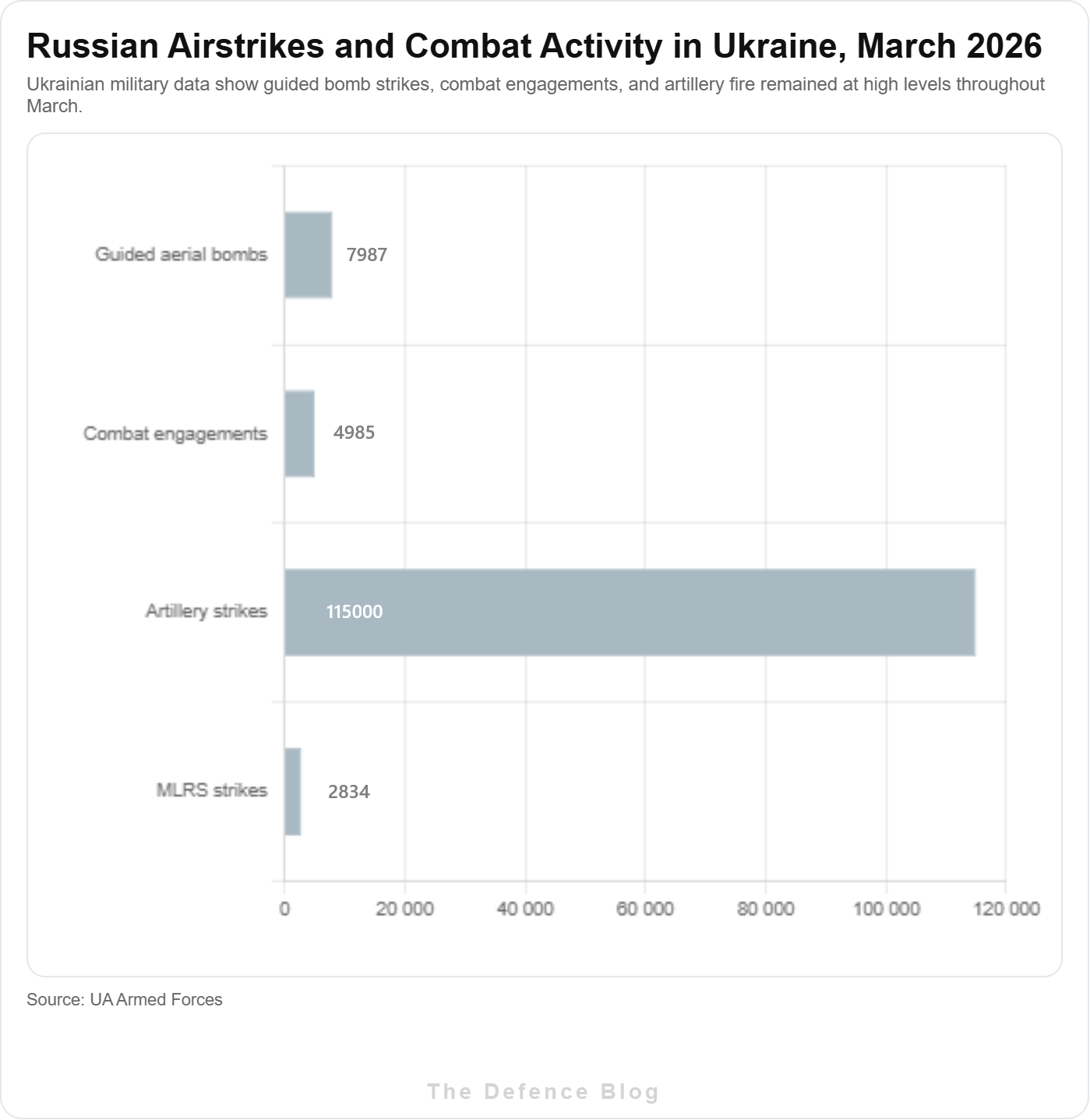
The context shows the scale of the problem. Visualization of Ukrainian data for March 2026 recorded 7,987 uses of guided aerial bombs compared to 4,985 combat engagements and 2,834 strikes from multiple rocket launchers. These figures require caution, as they are based on data from one side; however, the trend aligns with observations from the BBC and other sources regarding regular strikes on Kramatorsk and Sloviansk. At the end of August, according to Ukrainian authorities, up to nine such bombs were launched in a single day against Kramatorsk. This is no longer a one-time attack but a systematic method of disrupting normal life in a key area.
Kramatorsk and the "Fortress Belt" of Donbass
Kramatorsk is located within the Ukrainian defensive belt of the Donetsk region, which Moscow seeks to capture as part of its demand for control over all of Donbass. For the Russian army, this is not a symbolic goal. The city has long been a logistics and repair hub for Ukrainian forces, and its transport network facilitated the movement of people and goods along the front. However, turning a bus into a site of mass death shows that the impact on military infrastructure here is inseparable from the impact on the civilian environment.
This is precisely the institutional feature of the current Russian campaign. Soviet and post-Soviet military culture traditionally views urban infrastructure as part of the theater of operations, but modern guided bombs give this logic a significantly greater radius. Moscow may not capture a populated area immediately, but it can already make it economically and demographically unviable. Halting buses is not a secondary administrative effect but an indicator of the achieved result.
Strike on Transport and Preparation for Winter
The strike on Kramatorsk coincided with the expansion of the Russian campaign against Ukrainian cities. Attacks on energy facilities, bridges, gas stations, and other elements of urban infrastructure continue in Kyiv. The BBC reports that the approach of winter and power outages are already causing some residents of the capital to leave; a September survey by Gradus showed that 40 percent of respondents are considering relocation if conditions continue to worsen. In the east of the country, this is compounded by the direct destruction of transport routes.
Militarily, such a campaign pursues three interrelated goals. The first is to complicate Ukrainian logistics without the obligation to immediately conduct costly ground operations. The second is to force Kyiv to spend more on air defense and the restoration of facilities than Moscow spends on individual munitions. The third is to create a flow of internally displaced persons, thereby overloading Ukrainian cities, the social system, and allies. This does not mean that Russia is capable of quickly breaking the Ukrainian state: previous winter campaigns have shown its ability to adapt. But the cost of adaptation is constantly rising.
Strategic Significance and Limits of Russian Tactics
The Kremlin likely hopes that the combination of strikes on frontline cities and the energy sector will change the political calculations of Kyiv and Western capitals. However, the attack on the buses produces a dual effect. It indeed accelerates evacuation from dangerous areas, but at the same time strengthens Ukraine's argument that negotiations under fire do not replace mechanisms for deterring and protecting civilians. President Volodymyr Zelensky's statement about the inevitability of a response should be understood not only as a promise of military action but also as a signal of an expanded list of Russian military and industrial targets that Kyiv considers legitimate.
The Russian model also has a material limit. The guided bomb accomplishes the task of destruction but does not solve the task of holding territory. If, after the strike, buses stop running, residents leave, and repair crews cannot work, Moscow ends up with an empty space but not sustainable governance. This resembles the experience of late Soviet and post-Soviet conflicts: firepower can accelerate the collapse of urban life, but it does not create legitimacy and does not replace institutions.
The Russian army has learned to destroy Ukrainian cities more cheaply, but it has yet to prove that it can turn destruction into political control.
My forecast is cautiously grim. Continued strikes on transport and energy nodes should be expected before winter, especially where they simultaneously support the front and prevent the population from evacuating. Kramatorsk has become not an exception but a warning of an expanding risk zone. However, if Ukraine maintains layered air defense, mobile logistics, and the ability to quickly resettle civilians, the Russian aerial bombing campaign will remain a tool of attrition rather than a quick path to conquering Donbass.
Sources
- BBC News, “Russian strike on buses kills at least 30,” October 9, 2026 — https://www.bbc.co.uk/news/articles/c875pwq134l3o
- BBC News, “Russian strikes and approaching winter force many in Kyiv to pack bags and flee,” October 9, 2026 — https://www.bbc.co.uk/news/articles/c6zjx7jexz1do
- Reuters, “Zelenskiy accuses US of inaction as Russian strikes kill over 70 in two days,” October 8, 2026 — https://www.reuters.com/
- Al Jazeera, “Russian attack on buses in Ukraine’s Kramatorsk kills at least 30,” October 8, 2026 — https://www.aljazeera.com/
Russian airstrikes targeted civilian buses in Kramatorsk on October 8, 2026, resulting in 30 deaths and 18 injuries. This attack is part of a systematic effort by Russian forces to disrupt civilian life and logistics in the region, coinciding with broader strikes against urban infrastructure. Kramatorsk, a vital logistical hub for Ukrainian forces, has seen increased military pressure as winter approaches.
- 30 civilians killed and 18 injured in Kramatorsk due to Russian airstrikes on buses.
- The attack is part of a broader Russian strategy to disrupt civilian life and logistics in the region.
- Kramatorsk is a key logistical hub for Ukrainian forces in Donetsk Oblast.
- The use of guided bombs allows for strikes from a distance, complicating Ukrainian air defense efforts.
- The attack coincides with a Russian campaign targeting urban infrastructure as winter approaches.