
Russian Drone Hits Romania and Exposes NATO's 4 Minute Problem
 Alexandra Reeves
Russian Drone Hits Romania and Exposes NATO's 4 Minute Problem
Four minutes is not a defence plan. It is a warning label.
That is roughly the window Romanian commanders had on Friday after a Russian drone crossed into national airspace during an overnight strike on Ukraine and crashed onto the roof of an apartment building in Galați. Two people were injured. Emergency crews put out the fire. Bucharest scrambled two F-16s and a helicopter, with crews reportedly authorised to engage, but there was no clean shot before the drone reached a dense urban area.
Everyone will now reach for the familiar Article 5 vocabulary. That is understandable, but it is also too easy. The harder question is whether NATO has built a practical border air-defence posture for the actual war Russia is fighting: cheap one-way attack drones, GPS interference, ambiguous trajectories, and very little time between detection and political consequence.
The Incident Was Small Until It Wasn't
Romania's defence ministry said the Russian Federation resumed drone attacks overnight on civilian and infrastructure targets in Ukraine near the Danube border. One drone entered Romanian airspace, was tracked by radar toward the southern part of Galați, and then struck a residential building. CNN, Reuters-linked reporting, AP, and the Guardian all carried the same core account, with the Romanian ministry as the primary source.
The geography matters. Galați sits near the Danube corridor opposite southern Ukraine and close to Moldova. Russian forces have repeatedly attacked Ukrainian ports including Izmail and Reni because the Danube has become one of Ukraine's lifelines for grain, fuel, military logistics, and commercial survival. Romania is not a bystander in this airspace problem; it is the NATO country next to the target set.
According to reporting citing Romanian officials, the drone entered national airspace around 1:54 a.m. local time. F-16s were launched from Fetești, and an IAR 330 SOCAT helicopter also joined the response. The aircraft were reportedly authorised to engage. They did not. Romanian officials later argued the available time was too short and the conditions for destroying the drone without endangering civilians were not present.
That is the uncomfortable part. The decision not to fire may have been correct. A missile or cannon engagement over a city can create its own casualties. But a correct tactical decision can still reveal a strategic failure.
NATO's Eastern Flank Is Being Tested Below the War Threshold
Mark Rutte said NATO was ready to defend every inch of allied territory and called Russia's behaviour a danger to the alliance. Romania summoned Russia's ambassador, convened its supreme defence council, and asked NATO to accelerate the transfer of anti-drone capabilities. The European Commission condemned the incident. Moscow denied responsibility, as it usually does when plausible deniability is more useful than credibility.
But Russia does not need to announce an attack on NATO for the alliance to face a defence problem. The operational pattern is already clear. Russia launches large drone packages against Ukrainian infrastructure near NATO borders. Some drones are jammed, spoofed, damaged, misprogrammed, or simply fly beyond the intended path. NATO radars see them. Fighter aircraft launch. Residents receive alerts. Debris lands somewhere that was not supposed to be part of the war.
Until Friday, Romania could treat many of these episodes as debris management. Fragments in a field are politically irritating but manageable. A drone exploding on an apartment building is different. It turns a border incident into a public test of whether NATO territory is functionally protected against the most common weapon in Russia's current strike campaign.
The answer, at least in this case, was no.
The F-16 Is the Wrong Tool for a Rooftop Problem
Romania's F-16s matter. They are fast, capable aircraft, and they provide a serious air-policing asset against manned aircraft and higher-value targets. But using fighter jets to chase a Geran-2 or Shahed-type drone over a city is an awkward solution to the wrong class of threat.
A Geran-2 is slow, cheap, noisy, and expendable. It is dangerous precisely because it imposes expensive and politically delicate response decisions on defenders. If an F-16 fires an air-to-air missile, the interceptor may cost more than the drone by an order of magnitude. If it uses guns, the geometry and safety margins are ugly over populated terrain. If commanders wait too long, the drone decides the outcome for them.
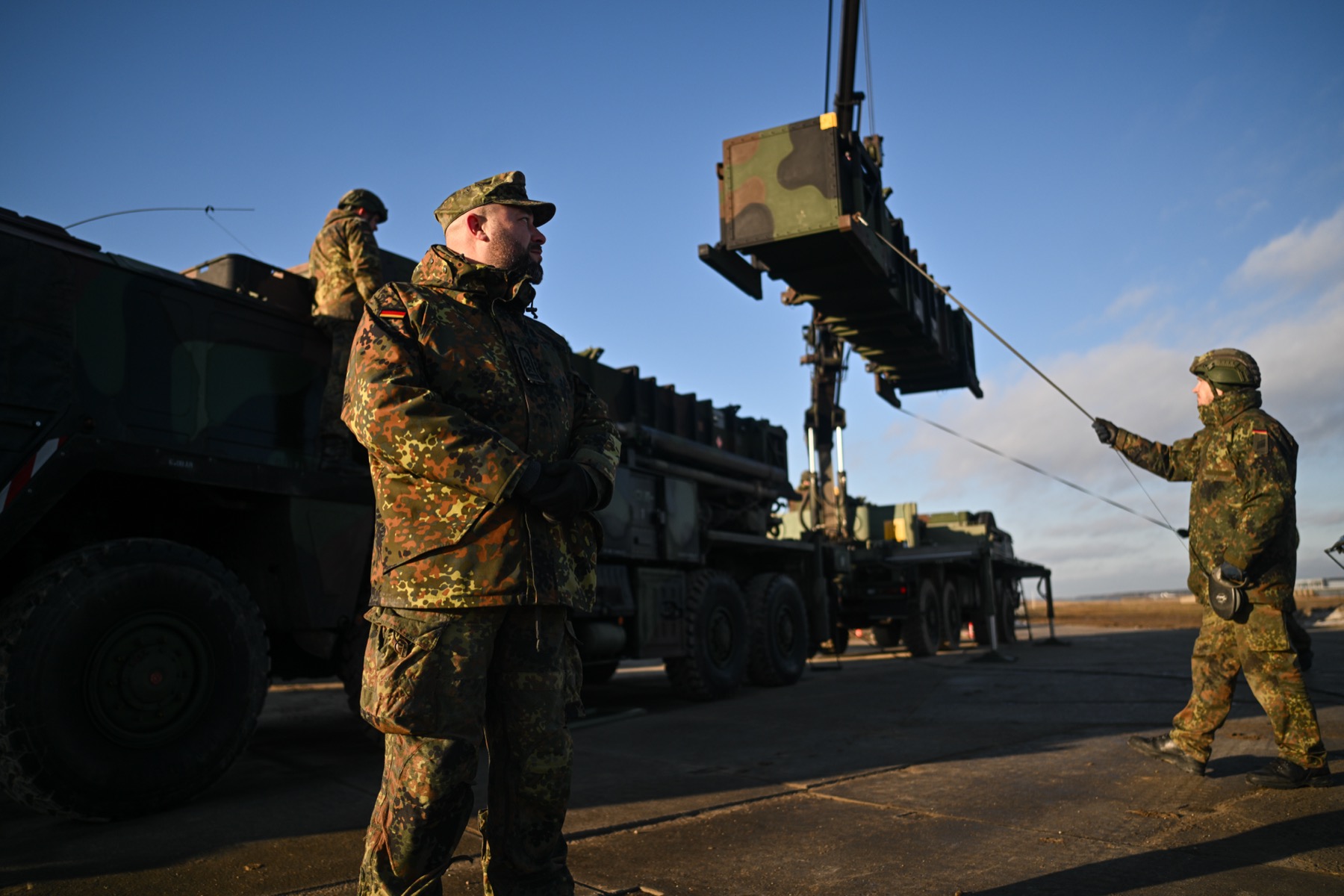
This is why NATO's eastern flank needs layered counter-UAS defence more than another round of reassurance language. The relevant kit is not only Patriot, although Patriot remains essential against ballistic missiles. It is also short-range air defence, mobile gun systems, electronic warfare, passive detection, radars tuned for low and slow targets, interceptors cheap enough to use repeatedly, and command rules that allow local units to act within seconds.
Ukraine has learned this brutally. Mobile fire groups, electronic warfare teams, Gepard guns, interceptor drones, and improvised sensors have become part of daily survival. NATO countries bordering Ukraine have watched that learning curve from the right side of the border. Friday's incident suggests watching was not enough.
Article 4 Is More Useful Than Article 5 Here
There will be calls for a maximal NATO response. The emotional case is obvious: a Russian weapon injured civilians inside a NATO member state. But the alliance has to be careful about confusing resolve with performative escalation.
Article 5 is the wrong first instrument unless Romania determines this was a deliberate attack on its territory. Romanian military officials have already signaled a more careful reading, describing Russia as a threat to regional security while stopping short of calling the incident an intentional strike on Romania. That distinction matters.
Article 4, by contrast, is built for exactly this sort of problem. It forces consultations when a member believes its security is threatened. It creates a formal venue to demand concrete measures without pretending the alliance is ready to go to war over an ambiguous drone trajectory. If Bucharest invokes it, the agenda should be blunt: anti-drone deployments along the Danube, shared engagement protocols, NATO-funded sensor coverage, and a standing cross-border air picture with Ukraine where politically possible.
The alliance should also stop treating these incursions as isolated accidents. Romania, Poland, Latvia, Estonia, and Finland have all faced drone or airspace incidents linked to the Russia-Ukraine war. Some involved Russian systems, others suspected Ukrainian drones diverted by electronic warfare or long-range strike operations. The source can vary. The defence requirement does not.
The Strategic Signal Is Not What Moscow Says
Russia's official denial is less important than the behaviour pattern. Moscow is escalating strike volume against Ukraine while accepting higher spillover risk into NATO territory. AP reported separately this week that Volodymyr Zelenskyy is pressing Washington for more Patriot missiles to counter ballistic attacks, while Ukrainian reporting said Russia launched a ballistic missile and hundreds of drones overnight on May 29. The pressure on Ukrainian air defence is rising, and the Danube corridor remains exposed.
That makes Romania's problem a European problem. If Ukraine's air defences are saturated, more Russian drones will leak toward border states. If NATO border states lack dense counter-UAS coverage, more incidents will become urban emergencies. If every incursion requires a slow national-level decision cycle, Russia will keep benefiting from the gap between radar detection and political permission.
The lesson from Galați is not that NATO should panic. It is that NATO should stop pretending air policing and strategic messaging are substitutes for short-range defence at the edge of the war.
Friday's drone did not start a NATO-Russia war. That is the good news. The bad news is that it showed how little time the alliance may have when the next one comes in lower, faster, or closer to a school instead of a roof. The next test will not ask whether NATO's communiques are firm enough. It will ask whether someone on the eastern flank can kill a cheap drone in four minutes without setting a city on fire.
A Russian drone crashed onto a residential building in Galați, Romania, at 1:54 a.m., injuring two people. Romanian F-16s and a helicopter were deployed but did not engage due to safety concerns. The incident highlights NATO's challenges in air defense against drone threats, prompting Romania to seek enhanced anti-drone capabilities.
- A Russian drone crashed in Galați, Romania, injuring two people.
- Romanian F-16s and a helicopter were scrambled but did not engage the drone.
- The incident raises concerns about NATO's air defense capabilities against drone threats.
- Romania's defense ministry reported the drone entered national airspace around 1:54 a.m.
- The drone strike is part of a pattern of Russian drone attacks near NATO borders.