
Russian Missile in Poland Tests NATO’s Air Defence Nerves
 Alexandra Reeves
Russian Missile in Poland Tests NATO’s Air Defence Nerves
One missile in a Polish field should not be mistaken for a side story. It is the part of Russia’s latest strike package that tells NATO something uncomfortable about the war next door.
During a large Russian missile and drone attack on Ukraine on July 30, Polish and allied aircraft were scrambled, and multiple news organisations reported that a missile fell inside Poland. Reuters reported that Russia’s overnight attack killed nine people in Ukraine, including children. NBC News and the Los Angeles Times reported that NATO jets were scrambled after the missile incident in Poland. Bloomberg, TVP World and Anadolu reported that NATO Secretary General Mark Rutte attributed the airspace violation to a Russian missile, while Polish authorities examined the impact site.
The obvious answer is to treat this as spillover, a dangerous but accidental overflow from a war whose air routes now run painfully close to NATO territory. That may even be true. But it is not the whole point. Russia does not need to deliberately attack Poland to test NATO. It only needs to keep launching complex strike packages near NATO borders and watch how the alliance responds.
The Border Is Becoming Part of the Battlespace
Poland has lived with this problem since the early months of the full-scale war. Russian missiles aimed at western Ukraine do not have to travel far off course to create a NATO crisis. The 2022 Przewodow explosion, which Western officials later assessed was most likely caused by a Ukrainian air-defence missile, already showed how quickly the fog of air warfare can collide with Article 5 politics.
This new incident is different in one important respect: it reportedly came during a Russian strike that was both large and geographically broad. According to Radio Free Europe/Radio Liberty and other outlets, Russia used a mix of missiles and drones across Ukraine. Ukrainian reporting cited ballistic, cruise and possibly hypersonic weapons in the package. That blend matters because NATO air policing is not being asked to track one simple trajectory. It is being asked to monitor a moving cloud of threats, some aimed at Ukraine’s grid and cities, some intercepted by Ukraine, and some potentially failing or drifting near allied territory.
That is the modern version of escalation management. It is not a red button moment. It is a radar screen full of ambiguous tracks.
Why A Russian Cruise Missile Is Harder Than It Looks
If the missile is confirmed as a Russian Kh-101, as Ukrainian-linked and regional reports suggested, the technical problem is not trivial. The Kh-101 is an air-launched, subsonic cruise missile designed to fly long distances at low altitude. Open-source assessments commonly put its range in the thousands of kilometres, with a conventional warhead usually described in the 400-kilogram class. It is not a wonder weapon. It is, however, exactly the sort of weapon that forces defenders to make fast decisions with incomplete information.
A cruise missile can exploit terrain, approach from awkward angles and blend into civilian air-traffic clutter unless airspace has already been cleared. Ukraine has become very good at dealing with that problem under wartime conditions. NATO countries, by contrast, are trying to do something more politically delicate: protect alliance territory without turning every Russian strike on Lviv or Volyn into a NATO-Russia exchange.
Here is the thing Washington and Brussels often understate. Air defence is not just about interceptors. It is about rules of engagement, identification authority, radar coverage, command latency, and the political tolerance for shooting at something near a border when the wrong call could kill civilians or trigger a diplomatic crisis.
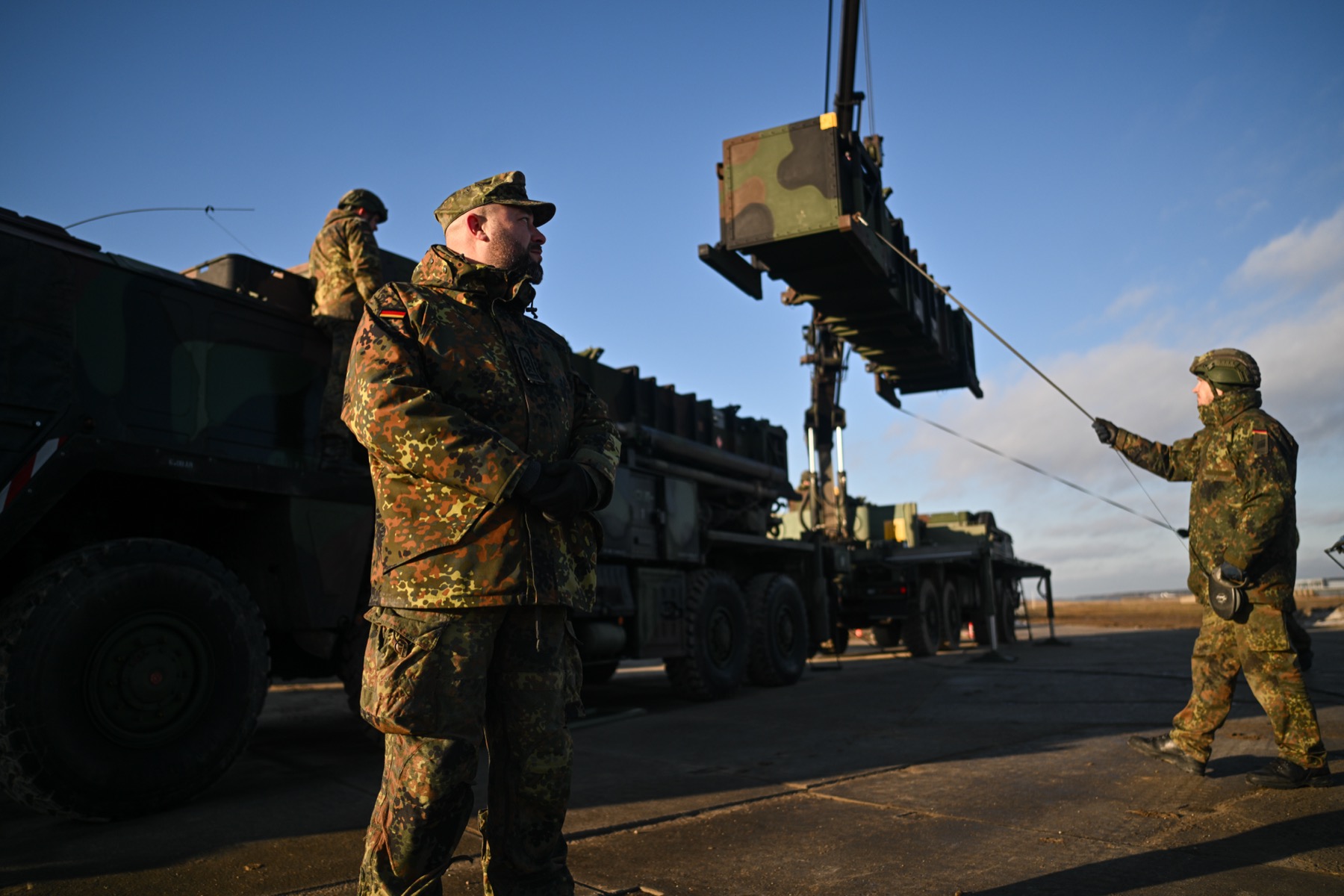
Poland can scramble fighters. NATO can increase combat air patrols. Patriot batteries, German or American, can be positioned near critical corridors. None of that removes the central problem: Russia can generate more ambiguous border incidents than NATO can comfortably absorb.
Russia Is Learning From Every Scramble
There is no need to assume Moscow planned this specific missile to land in Poland. The better question is what Russia learns when one does.
It learns how quickly Polish aircraft are launched. It learns how NATO public messaging separates an accidental violation from an intentional attack. It learns whether allied governments speak with one voice or spend the first six hours hedging. It learns whether the Ukrainian demand for more air defence becomes louder, and whether European capitals respond with systems or statements.
That last point matters. Zelenskyy has been warning allies about interceptor shortages before winter. Axios reported that he pressed Washington for missile interceptors to prevent another winter disaster. Breaking Defense reported that the Pentagon has been weighing options to license Patriot production to Ukraine. Those are not abstract procurement debates anymore. A missile falling in Poland turns Ukraine’s shortage into NATO’s border-management problem.
Everyone in DC likes to say NATO will defend every inch of allied territory. Fair enough. But defending every inch from a battalion crossing a border is one problem. Defending every inch from stray, failed, spoofed or deliberately provocative missile tracks is a different one. It requires persistent air-defence depth, not just political certainty.
The Alliance Has Three Bad Options
NATO’s first option is to keep doing what it is doing: scramble jets, monitor strikes, issue careful statements and avoid direct engagement with Russian missiles over Ukraine. That reduces escalation risk, but it leaves Poland, Romania and the Baltic states living under a recurring airspace lottery.
The second option is to harden the eastern flank with more integrated air and missile defence. That means Patriots, SAMP/T batteries, medium-range systems, radars, electronic warfare and more allied aircraft on rotational duty. It is expensive, and Europe’s stockpiles are already stretched by Ukraine’s needs. But it is the only option that treats the problem as structural rather than episodic.
The third option is the one nobody wants to discuss honestly: some form of limited air-defence cooperation over western Ukraine. That could range from shared tracking to intercepting threats that are clearly headed toward NATO territory. It would be militarily logical and politically explosive. Moscow would call it direct NATO entry into the war, even if Russia’s own strike patterns created the problem.
For now, NATO will almost certainly choose a cautious version of option two. More aircraft, more sensors, more Polish and allied readiness, and renewed pressure to expand Patriot missile production. That is sensible. It may also be late.
What To Watch Next
The immediate questions are forensic. Polish investigators need to identify the missile type, impact pattern and likely flight path. NATO needs to clarify whether the missile merely entered airspace, fell inside Polish territory, or both. Ukraine’s air force reporting will matter, but so will independent radar and debris analysis.
The larger question is strategic. If Russia continues launching heavy strike packages toward western Ukraine, NATO’s eastern airspace will keep being pulled into the war’s physics even if NATO’s politicians insist on staying outside the war’s politics.
That is the uncomfortable conclusion. Russia does not have to want a war with NATO to make NATO behave as if the border is already contested. One missile in Poland is not World War Three. It is a reminder that deterrence is no longer a communique from Brussels. It is a radar operator, a pilot in a cockpit, and a government deciding in minutes how much ambiguity it can live with.
A Russian missile fell in Poland during a large missile and drone attack on Ukraine on July 30, prompting NATO jets to scramble. The missile, likely a Kh-101 cruise missile, raises significant concerns regarding NATO's air defense and the potential for escalation. Polish authorities are currently investigating the impact site and missile type, while NATO assesses its response to the incident.
- A Russian missile fell in Poland during a strike on Ukraine.
- NATO jets were scrambled in response to the incident.
- The missile is believed to be a Kh-101 cruise missile.
- The incident raises concerns about NATO's air defense capabilities.
- Poland is investigating the missile's impact site.