

Throughout the Cold War, the United States and the Soviet Union were locked in an undersea arms race to develop stealthier and deadlier submarines. The Project 641 (NATO designation: Foxtrot-class) was developed to replace the faulty Zulu-class ships, which suffered from mechanical unreliability. Despite their archaic design, the Foxtrot-class formed the backbone of the USSR’s submarine fleet for decades, with some remaining in Russian service into the early 2000s.
Several ships were exported abroad to Cuba, India, and Libya, while former Soviet states also inherited a few subs.
Although they were quickly outclassed by future submarines in the 70s and 80s, the Foxtrot-class served in the Soviet Navy from 1958 until the end of the Cold War.
Design and Development
The Foxtrot-class was designed to replace the troublesome Zulu-class (Project 611) ships.
These ships suffered from several structural weaknesses and were prone to heavy vibrations, which limited their submerged speed and diving depth and compromised their stealth.
Developed under the supervision of S.A. Egorov and Z.A. Deribin, and designed by Pavel P. Pustintsev, the hull featured slight sheer and a pointed, chined stem, intended to improve surface performance.
The Foxtrot-class was one of the last subs in the world to feature such a design, as later ships would adopt the teardrop layout for better underwater performance and a lower acoustic signature.
At the time, the Soviet Union was building nuclear submarines, but the USSR continued to build conventionally powered ships, unlike the Americans, under the rationale that conventional propulsion systems were quieter than the turbo-gear units on nuclear submarines.
Two of the ship’s three decks were dedicated to battery storage for its three electric motors.
This gave the ships an undersea endurance of 10 days, which was impressive at the time of their introduction but was later outclassed by subsequent designs.
The ships had a range of 20,000 nautical miles and could travel at around 16 knots when submerged and 15 knots at the surface.
The Foxtrot-class had a submerged displacement of roughly 2,475 tons.
Later ships in the class, sometimes referred to as Project 461K submarines in Russian sources, had their original Type-37D diesel engines replaced with more efficient Type 2D42 engines.
The engines were placed in sound-proof enclosures to minimize their acoustic signature, although the ships’ three-propeller configuration made them louder than other most other submarines at the time.
The Workhorse of the Soviet Navy
Each ship carried ten 533mm torpedo tubes: six in the bow and four in the stern.
For their time, the Foxtrot-class carried a sophisticated systems suite of active and passive sonar arrays, along with surveillance, navigation, and communications equipment.
The USSR also frequently upgraded these ships, installing new digital systems as the technology became more rapidly available.
New equipment included hydroacoustic listening systems, radar equipment, the Arktika-M active sonar system, and the Svet-M passive sonar system.
The Foxtrot-class could accommodate a total of 70 officers.
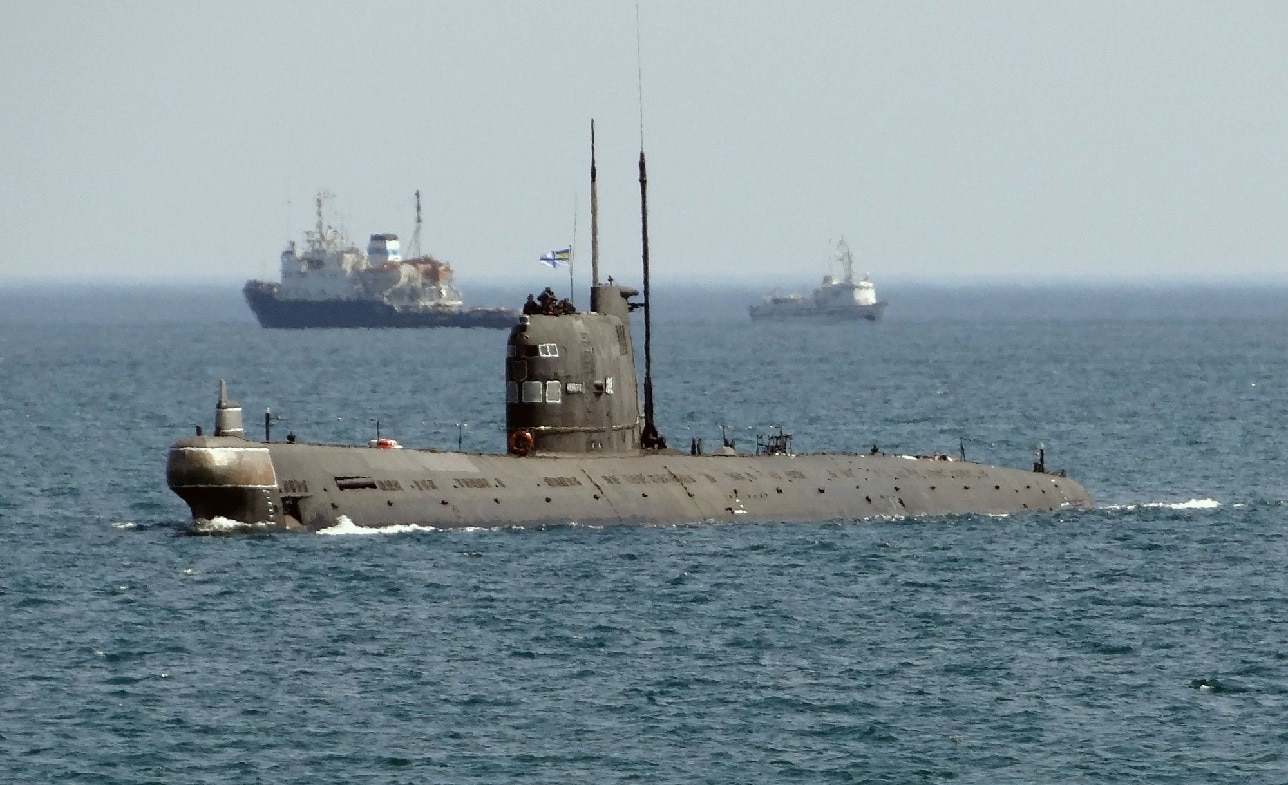
Foxtrot-class submarine. Image Credit: Creative Commons.
Life aboard a Foxtrot was rough, with extremely cramped living spaces, even by submarine standards, and temperatures sometimes reaching 40 degrees Celsius (104 degrees Fahrenheit).
The Soviets exported three Foxtrot-class submarines to the Cuban Navy, four to the Indian Navy, and six to the Libyan Navy.
The Polish Navy inherited two submarines after the end of the Cold War, which it deactivated in 2003.
Ukraine likewise inherited a single Foxtrot-class submarine, which was seized during the 2014 annexation of Crimea.
In 4 Words: Foxtrot Almost Started WWIII
During the Cuban Missile Crisis, the Soviet Navy deployed four Foxtrot-class ships to the Caribbean, as tensions with the U.S. were reaching their boiling point.
As the two superpowers navigated the incredibly delicate situation, the aircraft carrier USS Randolph (CVA–15) discovered a Foxtrot-class submarine, B-59, operating near Cuba.
B-59 was operating too deep to monitor radio traffic, so the crew had no idea whether the crisis had escalated into a full-blown war.
Naturally, the American destroyers in the area hatched the brilliant idea of dropping training depth charges on the submarine to force it to surface.
The Russian crew had no idea that the Americans were dropping blanks on them and were forced to surface, fearing the worst.
To make matters worse, the ship reportedly came under machine-gun fire while surfacing, forcing the captain, Valentin Savitsky, to consider launching its 15-kiloton nuclear torpedo.
Per Soviet doctrine, the procedure to launch a nuclear torpedo requires the unanimous consent of the ship’s three senior officers.
According to some accounts, Savitsky and the ship’s political officer, Ivan Semyonovich Maslennikov, both agreed to launch the torpedo, but the Deputy brigade commander, Captain 2nd rank Vasiliy Arkhipov, was the lone dissenter.
Accounts differ on the exact details, but either way, B-59 ultimately refused to launch its nuclear torpedo.
Long after the incident, Thomas Blanton, director of the National Security Archive, remarked, “A guy called Vasily Arkhipov saved the world.” Two other Foxtrot-class submarines were also detected around Cuba during the Crisis, one of which was B-36, which was also shelled by depth charges and forced to surface. Luckily, neither other ship considered starting WWIII.
About the Author: Isaac Seitz
Isaac Seitz, a Defense Columnist, graduated from Patrick Henry College’s Strategic Intelligence and National Security program. He has also studied Russian at Middlebury Language Schools and has worked as an intelligence Analyst in the private sector.