

Summary and Key Points: Kilo is a kilogram, the letter K, and NATO’s name for a Soviet diesel-electric submarine designed by Rubin in 1980 and in service ever since, through three generations to today’s Project 636.3 Improved Kilo-II-class submarine, whose final boat, Yakutsk, joined Russia’s Pacific Fleet in June 2025. The Kilo-II displaces 3,950 tons submerged, makes 20 knots, dives to a 980-foot test depth, stays out 45 days with 60 aboard, and carries 18 torpedoes or four Kalibr cruise missiles.
Mee the Improved Kilo-II-Class Submarine from the Russian Navy
In addition to being short for “kilogram” in the metric system, the word “Kilo” can mean one of two things: (1) the letter “K” in the NATO Phonetic Alphabet, or (2) the NATO reporting name for a ubiquitous family of Cold War-era Soviet submarines, the Kilo-class diesel-electric boats. Today, we’ll focus on the so-called Improved Kilo classes.
‘Black Hole’ Kilo-Class Initial History and Tech Specs
The original Kilos were designed in 1980 by Rubin Central Design Bureau—headquartered in Leningrad, which reverted to its pre-Communist name of St. Petersburg after the Soviet collapse—and entered into operational service with the Soviet Navy that same year, known to the Soviets themselves as the Project 877 Paltus (“Halibut”).
The Paltus was superseded in the mid-1990s by the Project 636 Varshavyanka (“Lady of Warsaw”), which NATO designated the “Improved Kilo-class”, and again in the mid-2010s by the Project 636.3, which NATO labeled the “Improved Kilo-II”).
On or about 12 June 2025, the final ship of the 636.3-class. the Yakutsk, was officially accepted by the Russian Navy and designated for its Pacific fleet.
Tech specs and vital stats of the Improved Kilo-IIs include a displacement of 2,950 tons on the surface and 3,950 tons submerged & fully laden, a hull length of 242 feet, a draught of 20 feet 8 inches, and a beam width of 32 feet 5 inches.
Test depth, aka safe operating depth, is 980 feet, though practical operational depth is limited to 790 feet. Operational range is 7,500 miles at 7 knots and 400 miles at 3 knots, with an endurance of 45 days.
The crew complement is comprised of a combined 60 commissioned officers and enlisted sailors.
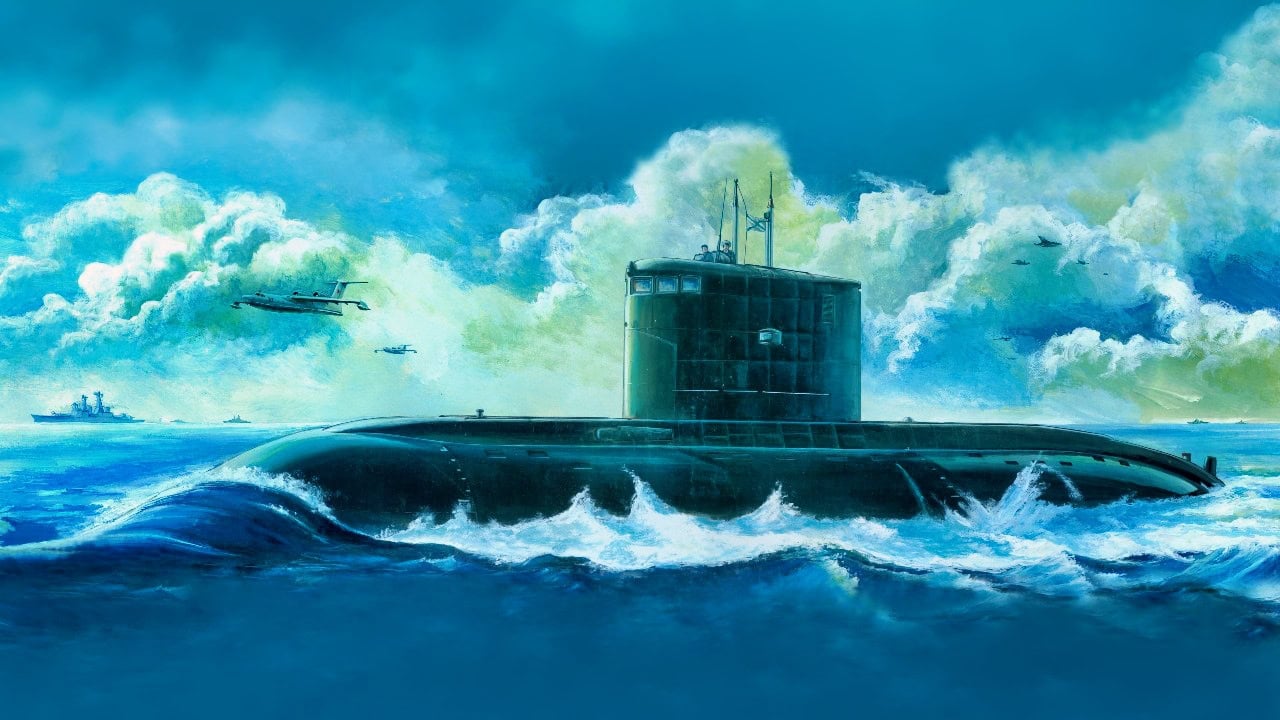
Kilo-Class Submarine
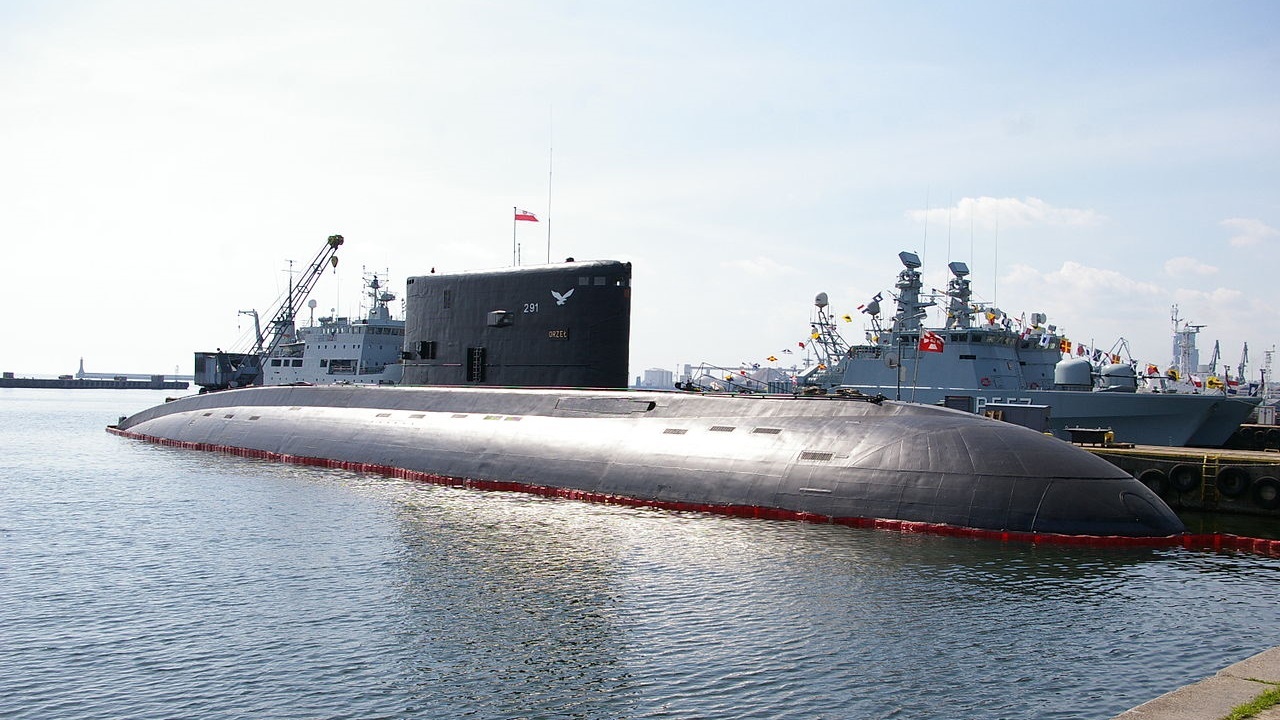
Polish Navy submarine, Kilo-Class.
As for armament, these warships pack six 21-inch forward torpedo tubes, with a capacity for 18 torpedoes—six in the torpedo tubes and 12 stored on the racks—or mines, or four Kalibr land-attack cruise missiles.
It also carries eight Igla-1 (NATO reporting name: SA-N-10 “Gimlet”) or 9K34 Strela-3 (NATO reporting name: SA-N-8 “Gremlin”) surface-to-air missile (SAM) launchers.
The powerplant consists of two diesel generators, the main propulsion motor, a fuel-economic motor, and a single shaft driving a seven-blade fixed-pitch propeller; this propulsion package enables the boats to reach a top speed of 11 knots surfaced and 20 knots submerged.
The Kilos have a reputation for being among the quietest diesel-electric submarines in the world.
This is due to the use of anechoic tiles, which are fitted on casings and fins to absorb the sound waves of the active sonar, resulting in a reduction and distortion of the return signal.
Anechoic tiles also help attenuate sounds emitted from the sub, reducing the range at which the boat may be detected by passive sonar.
So, What Exactly Makes Them “Improved” Kilos?
To answer that question, we turn to the U.S. Army’s ever-handy OE Data Integration Network (ODIN) Worldwide Equipment Guide (WEG): “Newer Project 636 boats are equipped with improved MGK-400EM [Rubikon, NATO reporting name “Shark Gill”], with MG-519 Arfa [NATO reporting name “Mouse Roar”] also upgraded to MG-519 EM. MGK 400E can detect submarines with 0.05 Pa/Hz noisiness at 16 km and surface vessels with 10 Pa/Hz noisiness at 100 km.
The improved sonar systems have reduced the number of operators needed by sharing the same console via automation.”
Operational History in Brief
The Kilos are quite battle-proven. According to Eric Wertheim of the US Naval Institute publication Proceedings, “Russia’s Improved Kilo II–class submarines first conducted long-range attacks against Islamic State targets in Syria during 2015.
Since 2022, Russian Black Sea Fleet 636.3 submarines have made extensive use of the Kalibr missile to attack Ukraine.”
On 14 August 2013, one of the Indian Navy’s Kilo-class submarines, the INS Sindhurakshak, caught fire after an explosion in a Mumbai dockyard.
It took firefighters several hours to douse the blaze, with 18 Indian Navy sailors tragically losing their lives.
The submarine sank in dock, making it the first known total loss of a Kilo-class sub.
SIDEBAR NOTE: The Indian Navy officially designates its Kilos as the Sindhughosh-class, which translates to “Roar of the Sea.”
As for the first known combat losses of Kilos, well, that dubious distinction belongs to the Islamic Republic of Iran, thanks to Operation Epic Fury: On or about March 2, 2026, the IRIS Taregh (S901) was reportedly sunk at her berth in Bandar Abbas Naval Base.
In One Word: Obsolete?
Out of 75 Kilos built, an estimated 56 hulls—Type 877s and 636s alike—remain in service worldwide; besides Russia and India, current users include the navies of Algeria, China, Iran, Myanmar, Poland, Romania, and Vietnam.
The Russian Navy is in the process of replacing the Kilos with the fourth-generation Project 677 Lada-class (NATO reporting name: St. Petersburg-class) subs; however, as is true of a lot of up-and-coming Russian military weapons systems, production isn’t proceeding anywhere near as smoothly as originally hoped.
About the Author: Christian D. Orr
Christian D. Orr is a Senior Defense Editor. He is a former Air Force Security Forces officer, Federal law enforcement officer, and private military contractor (with assignments worked in Iraq, the United Arab Emirates, Kosovo, Japan, Germany, and the Pentagon). Chris holds a B.A. in International Relations from the University of Southern California (USC) and an M.A. in Intelligence Studies (with a concentration in Terrorism Studies) from American Military University (AMU). He is also the author of “Five Decades of a Fabulous Firearm: Celebrating the 50th Anniversary of the Beretta 92 Pistol Series,” whose second edition of which was recently published.