
Russia’s next-gen Armata tank remains stuck a decade after debut
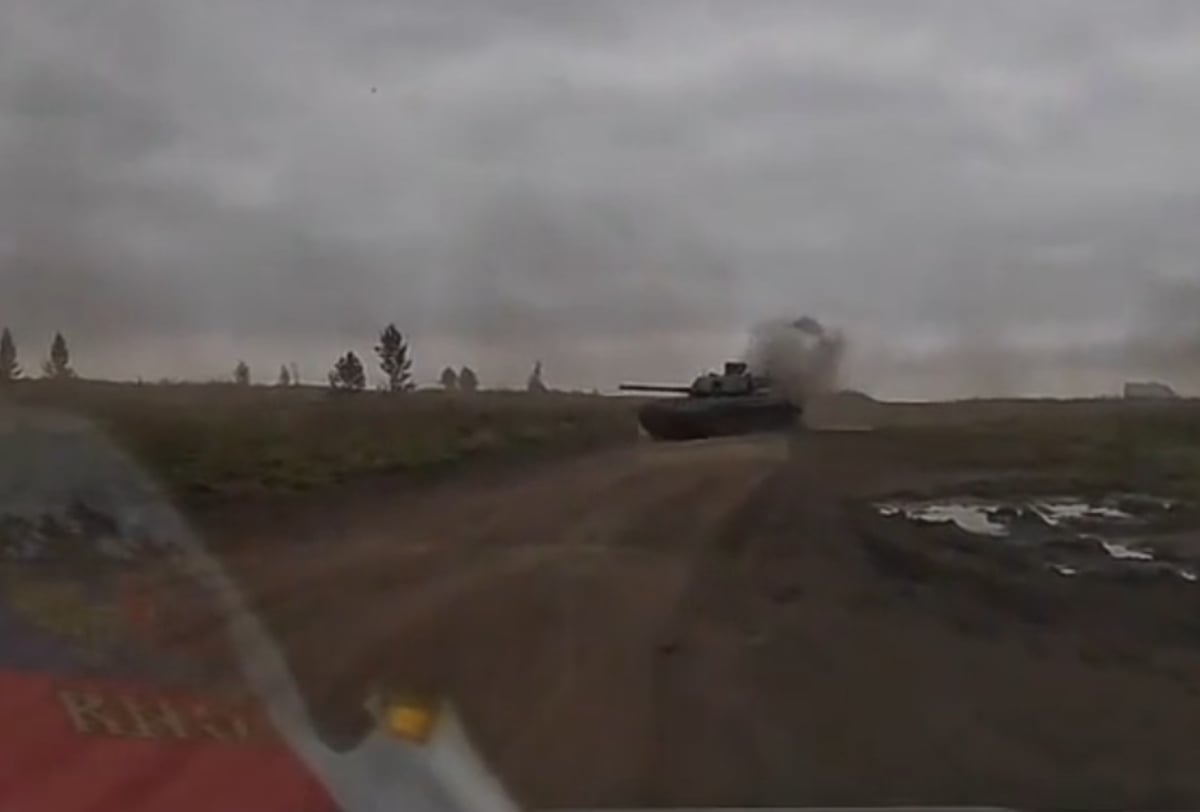
New dashcam footage circulating on Russian state-aligned media this week shows a T-14 Armata tank crossing a dirt road toward a firing range, the latest glimpse of a next-generation tank program that has spent a decade struggling to move beyond testing.
No new technical details accompanied the footage, and it does not appear to show anything beyond a routine range exercise. The clip, recorded from a passing civilian vehicle’s dashcam, adds to a long pattern of brief, unofficial sightings that have periodically resurfaced online since the T-14 was first unveiled during rehearsals for Russia’s 2015 Victory Day parade.
The T-14 represented a sharp break from Soviet-era tank design when Uralvagonzavod introduced it, built around an unmanned turret, a separately armored crew capsule, and the Afghanit active protection system meant to intercept incoming projectiles before they hit the vehicle. Russia originally planned to build more than 2,300 of the tanks by 2020. A decade later, estimates put the actual number built at roughly 20, most of them prototypes or pre-production vehicles rather than a true production run.
Cost has been the central obstacle. Estimates for the T-14 range from about $8 million to $15 million per vehicle, compared with $1.5 million to $2.5 million for an upgraded T-90M, the tank Russia has relied on instead throughout its war in Ukraine. Despite repeated claims from Russian officials and pro-government media that the T-14 has seen combat, no independently verified evidence has emerged confirming it ever fought at the front. Russian media reported in mid-2023 that a small number of Armatas reached Ukraine and fired from standoff range before being withdrawn within months, but outside analysts were never able to confirm those claims. British defense intelligence assessed at the time that Russian troops were reluctant to accept the tanks into service and that any deployment would likely serve propaganda purposes rather than combat need.
Even Rostec, the state conglomerate that oversees the T-14’s development, has acknowledged the program’s limits. Rostec chief executive Sergey Chemezov told Russian state news agency in March 2024 that while the Armata outperformed everything else in Russia’s inventory, it was too expensive to field at scale, and that the war would instead be fought with upgraded T-90Ms and refurbished T-72s. Uralvagonzavod, the world’s largest tank plant and the T-14’s manufacturer, has since turned much of its production capacity toward exactly that work, rebuilding older T-72 hulls and building new T-90Ms rather than expanding Armata output.
Some Russian defense industry figures have floated a different path forward, arguing that individual technologies developed for the T-14, its firepower, protection or mobility systems, could be transferred into the more widely fielded T-90M and T-72 rather than fielding the Armata itself in large numbers. Russia has also offered to transfer T-14 technology to India for local production under that country’s domestic manufacturing program, though that arrangement has not produced any confirmed manufacturing to date.
Analysts who track the program have grown increasingly skeptical of its future. Long development timelines and design choices that outside experts say have not kept pace with battlefield lessons from Ukraine have led some to describe the Armata as functionally dead on arrival as a mass-production tank, even as isolated footage like this week’s clip keeps the program in public view.
Content preview only. Full article available at source. View Full Article
New dashcam footage shows a T-14 Armata tank crossing a dirt road toward a firing range in Ukraine. The tank program has struggled for a decade, with only about 20 units built, primarily prototypes. Despite claims of combat use, no verified evidence supports these assertions, and the T-14's high cost has limited its production compared to the T-90M.
- T-14 Armata tank has been in development for a decade with limited production.
- Only about 20 T-14 tanks have been built, mostly prototypes.
- Russian officials claim T-14 has seen combat, but no evidence confirms this.
- The T-14 is too expensive to produce in large numbers compared to T-90M.
- Rostec acknowledges limitations in the T-14 program.