
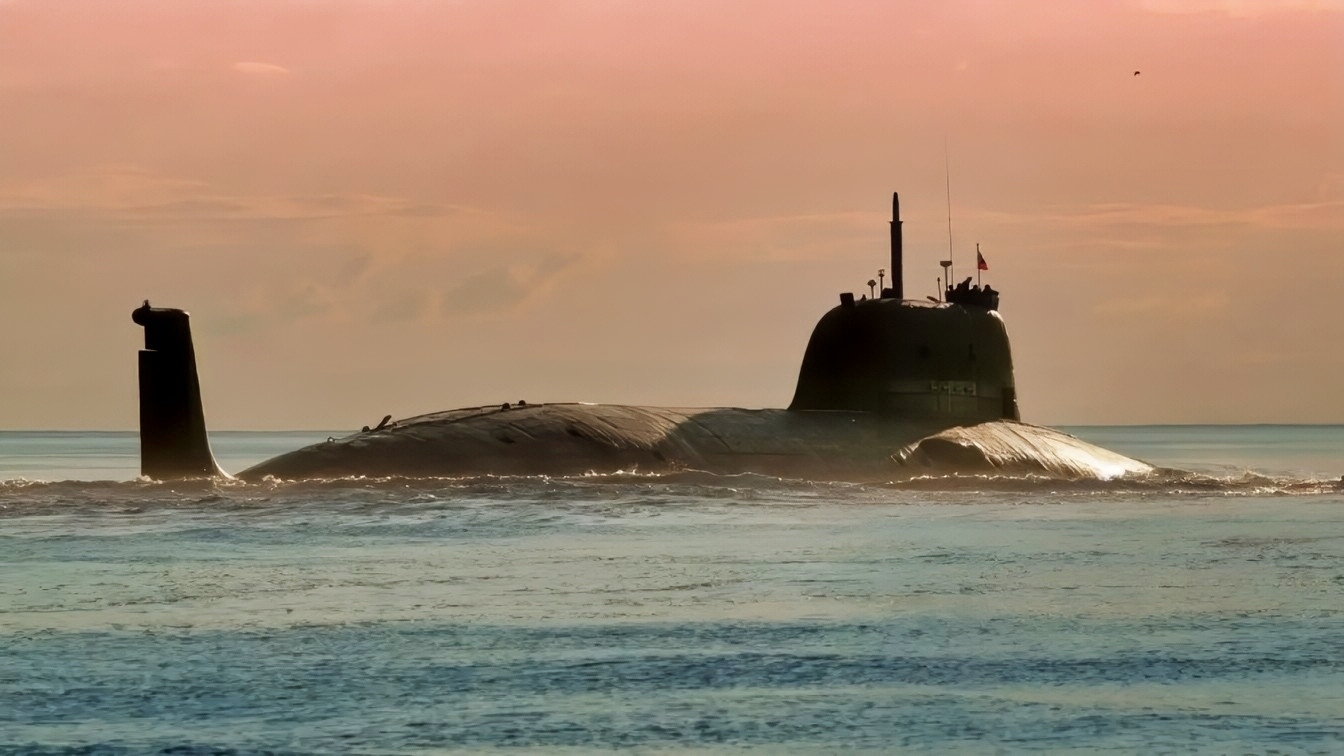
 Yasen-Class Submarine Russian Military Photo
Summary and Key Points: Russia’s Yasen-class is the first new attack submarine design finished since the Soviet collapse, and its lead boat, Severodvinsk, nearly died: laid down in 1993, due in 1998, work stopped by 1996, commissioned in 2014. Each boat carries eight vertical launch cells holding four Oniks or Zircon missiles apiece, or five Kalibrs, for 32 to 40 cruise missiles.
Russia’s Project 885M Yasen-class Is a Beast
On June 14, 2014, the Russians commissioned the Severdvinsk (K-560). The nuclear-powered attack submarine (SSN) was the first Project 885M Yasen-class vessel that the Russian Federation completed and the first next-generation SSN built since the Soviet Union collapsed.
The Yasen-class is a significant improvement over its predecessors.
These vessels are not only far stealthier than their predecessors, but they also carry a deadlier payload. Armed with eight Vertical Launching Systems (VLS), the Yasen-class can carry a variety of cruise missiles, including the Kalibr, the P-800 Oniks, and the Zircon hypersonic cruise missile.
The ships are currently Russia’s most advanced and formidable attack submarines.
Troubled Development for Yasen Subs
The Soviet Union began developing the Yasen-class in the 1970s.
The Malakhit Design Bureau designed the ships. Originally, the Soviets envisioned several types of non-strategic SSNs to perform various tasks (i.e., anti-submarine, anti-aircraft carrier, multi-purpose, etc.).
However, the Bureau settled on a single design capable of multiple missions. B.N. Pyadov designed the ships under the leadership of program manager G.A. Efremova.
The Yasen-class was designed to incorporate the latest cruise missiles of the time, including the P-800 Oniks. The ships were the USSR’s answer to NATO’s growing anti-submarine warfare (ASW) capabilities.
When the USSR collapsed, the Yasen-class’s future was uncertain.
With the formation of the new Russian Federation, the defense budget was significantly curtailed, leaving Russia’s shipbuilders with virtually no funds to complete the new submarine.
Severodvinsk, laid down in 1993, was originally scheduled to launch in 1995 and be commissioned in 1998.
However, due to a lack of funding, work on the lead ship had completely stopped by 1996.
According to some rumors, by 1999, Severodvinsk was less than 10% complete. Going into the 2000s, the Yasen-class faced a bleak future.
However, the Russian Navy was still interested in the project and allocated more funds to Severodvinsk in 2003.
Although Russia wanted and needed the Yasen-class, it gave greater priority to the Borei-class SSBN. With funds still limited in the 2000s, Severodvinsk was delayed yet again.
However, in 2009, the second ship of the class, Kazan (K-561), was laid down, indicating that the Yasen-class had a secure future in the Russian Navy.
Severdvinsk finally entered service in 2014, followed by her sister ship in 2021.
2 Reasons These Submarines Are Dangerous: Stealth and Weapons
The Yasen-class features a conventional tear-shaped hull for improved hydrodynamic performance.
The ships are constructed using high-tensile steel and use a one-and-a-half-hull layout.
The class is the first Soviet/Russian submarine to use a spherical sonar, the MGK-600 Irtysh-Amfora (or “Ajax,” according to some Russian sources).
The ships also use the MRK-50 Albatros system, which consists of bow, flank, and towed arrays with both active and passive capabilities.
The Yasen-class electronic and battle management systems are classified, though they are likely more sophisticated and capable than their predecessors.
According to Russian sources, the submarines also use improved periscopes and a complex suite of other sensors and communications technology.
The ships likely also carry electronic and acoustic countermeasures to improve survivability.
In terms of stealth, the Yasen-class is significantly stealthier than most Russian submarines.
Even the U.S. Navy has claimed the ships are a significant improvement over previous Soviet designs and are much harder to track than their predecessors.
One factor contributing to its lower noise profile is its nuclear reactor.
The ships are fitted with an OK-650V reactor (OK-650KPM for the Yasen-M ships), which has a core life of around 25 to 30 years.
According to Russian claims, the reactor uses a new cooling system that naturally loops cooling water back into the reactor without utilizing the main circulation pumps, one of the main causes of noise on a nuclear submarine.
Like other Russian submarines, the Yasen-class is likely coated in rubber anechoic tiles to absorb sonar waves and reduce its noise profile.
Russia’s Most Advanced Attack Submarines
Severodvinsk carries ten 533mm torpedo tubes. Subsequent ships, designated Project-885M (Yasen-M), carry only eight 533mm tubes.
The torpedo tubes can launch Fultyar heavyweight torpedoes or Otvet anti-submarine missiles. The class’s main armament, however, is its eight 3S-14 VLS cells.
Each cell can hold four P-800 Oniks anti-ship missiles or Zircon hypersonic cruise missiles for newer ships, or five Kalibr cruise missiles, for a total of 32 to 40 missiles (some sources claim the ship’s VLS cells can accommodate only three Oniks/Zircon missiles).
The Kalibr family comes in many different variants. Some versions have a stated range of up to 2,500 km (1,553 miles).
The Russian Navy currently has five Yasen-class submarines in service, with seven more planned to join the fleet.
Each ship following Severdvinsk is reportedly built to the Yasen-M standard, which reportedly incorporates modernized onboard systems and reduces the crew from 85 to 64 personnel.
Because of their nuclear propulsion, the ships have nearly unlimited range, constrained only by crew endurance and food supplies.
They have a submerged displacement of 13,800 tons and a top speed of 35-40 knots underwater, or 20-28 knots when traveling in silent mode.
Perm (K-572) is currently finishing her sea trials, while Ulyanovsk (K-563) was launched earlier this year. Both are expected to enter service by the end of the year or early 2027.
About the Author: Isaac Seitz
Isaac Seitz, a Defense Columnist, graduated from Patrick Henry College’s Strategic Intelligence and National Security program. He has also studied Russian at Middlebury Language Schools and has worked as an intelligence Analyst in the private sector.