

Summary and Key Points: The Project 885M Yasen-M is the most recent class of nuclear-powered attack submarines (SSNs) built by the Russian Navy. These ships are highly versatile and extremely stealthy, capable of conducting anti-submarine warfare and attacking land-based targets with VLS-launched cruise missiles. Originally based on the Project 885 Yasen-class, the ships received upgrades to their weapons and onboard combat systems in the 2010s under the Yasen-M program. The ships are expected to replace older Soviet-era vessels in Russian Navy service and form the backbone of Russia’s nuclear attack submarine fleet.
Although Russia does not produce submarines as quickly as China or the U.S., the Yasen-M is a capable, sophisticated vessel that enables the Russian Navy to expand its operations beyond its national waters.
From Yasen to Yasen-M
In the 1980s, the U.S. and the USSR sought to build a new generation of nuclear-powered attack submarines.
The U.S. developed the technologically sophisticated Seawolf-class; however, it was forced to reduce the Seawolf fleet from 29 ships to only three.
Instead, the U.S. pursued the cheaper but still perfectly capable Virginia-class submarine.
Russia experienced the reverse situation.
The original Yasen-class was highly ambitious and capable, but budget concerns shortly after the fall of the USSR forced the Russians to scale down the project.
The Malakhit Design Bureau, led by B.N. Pyadov, designed it.
The first ship of the class, Severodvinsk, was seen as a stopgap while the shipbuilding industry recovered from the tumultuous 90s.
After the Cold War ended, the Yasen-class faced uncertain prospects.
It was originally supposed to be commissioned in 1998, but Russia’s dire financial situation delayed the plans indefinitely.
In the early 2000s, work on Severodvinsk continued, but the Ministry of Defense clarified that the new Borei-class SSBNs took precedence over the Yasen-class.
In 2009, Russian news media announced that construction of another ship, Kazan, had begun.
This ship, and future ships of the class, would receive significant modernization and upgrade packages under the new designation Yasen-M. Severodvinsk officially entered service in 2014, followed by Kazan and Novosibirsk in 2021.
Krasnoyarsk joined the fleet in 2023, followed by Arkhangelsk in 2024.
Two other Yasen-Ms, Perm and Ulyanovsk, have been launched and are undergoing sea trials, with two more ships under construction.
Yasen-Class: A Story in Photos
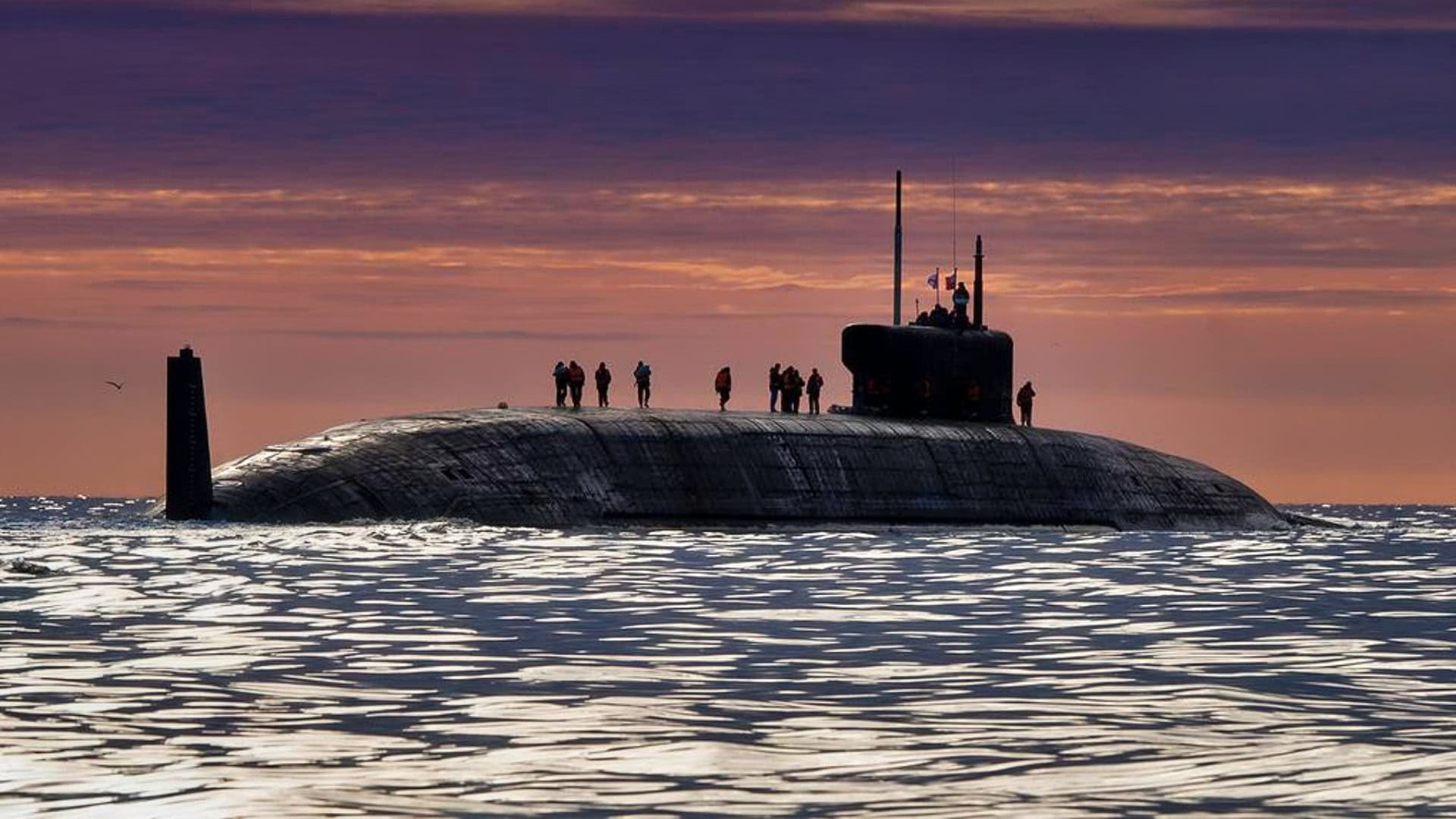
The Russian Navy is experiencing a resurgence, with new ships and submarines entering service despite ongoing challenges.
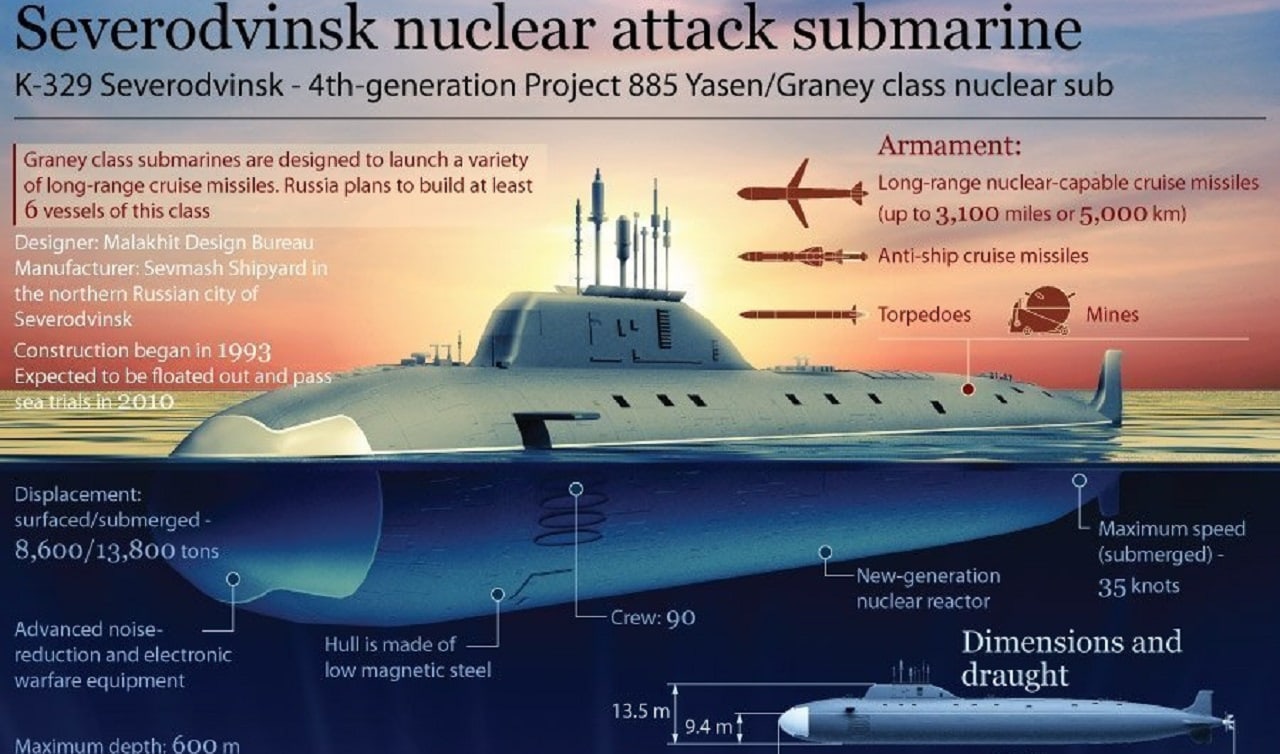
Yasen submarine diagram from Russian state media.
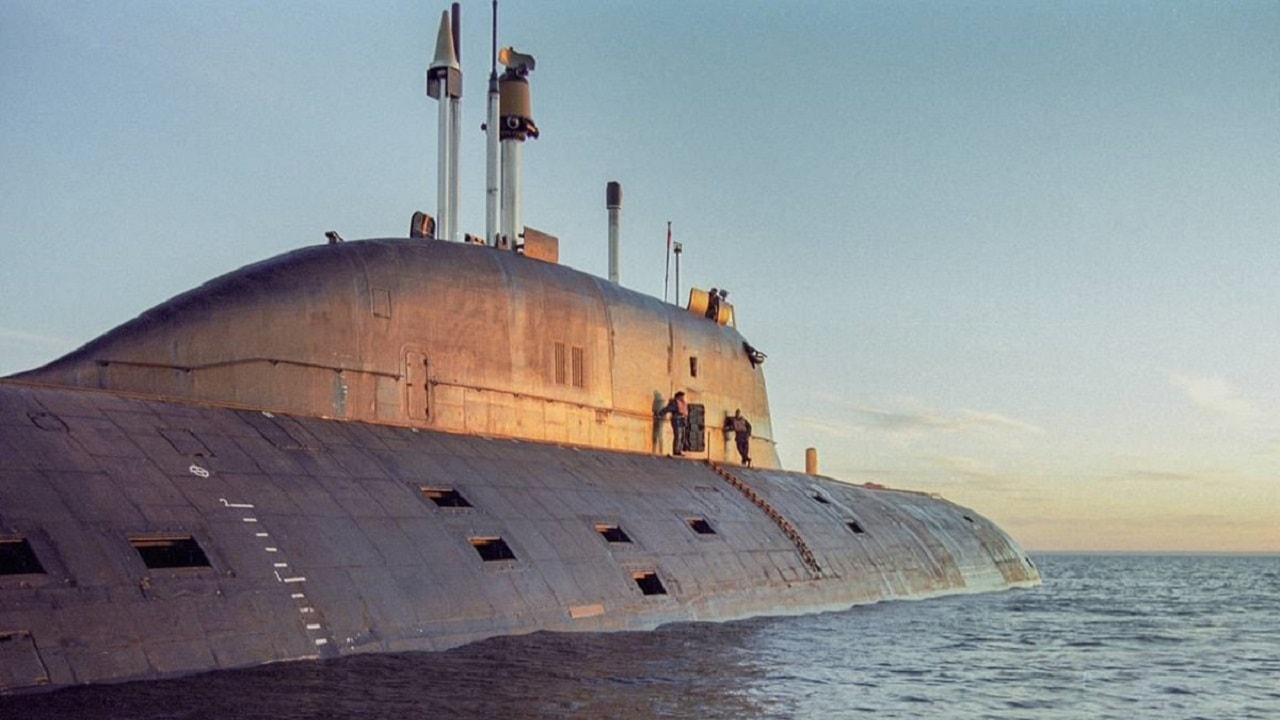
Yasen-Class. Image Credit: Creative Commons.
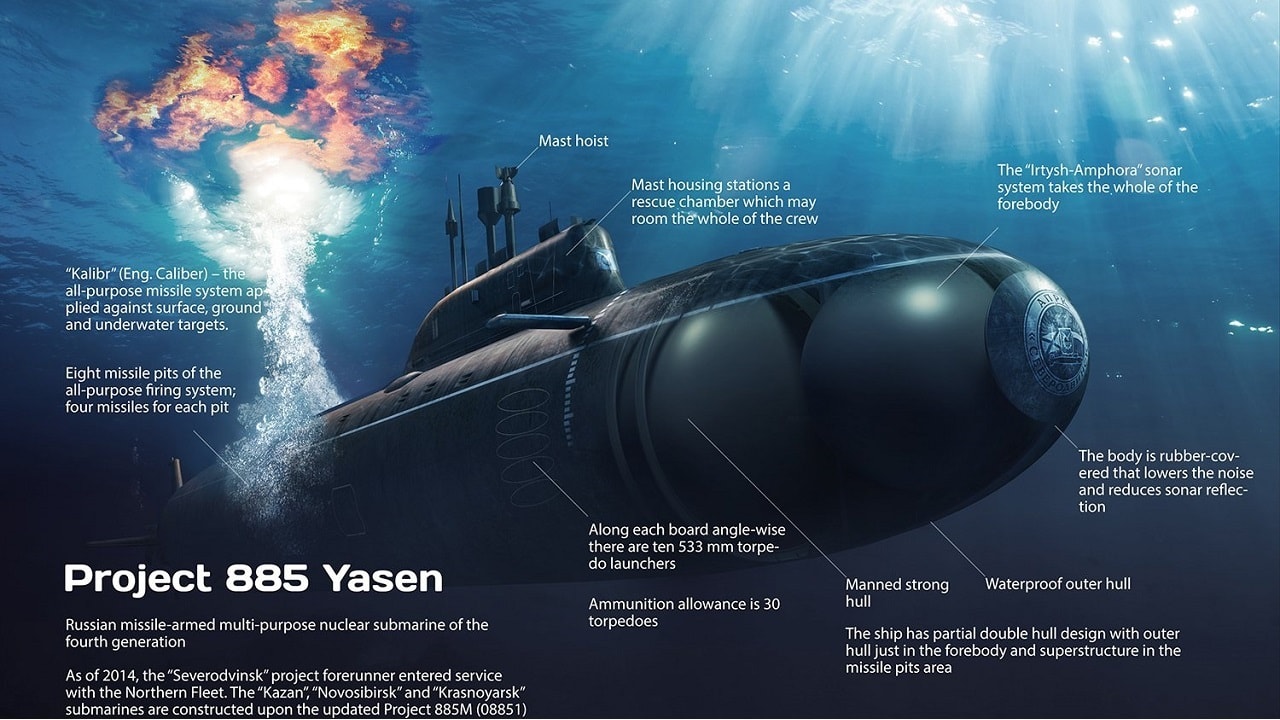
Yasen-M attack submarine. Image Credit: Russian Government.
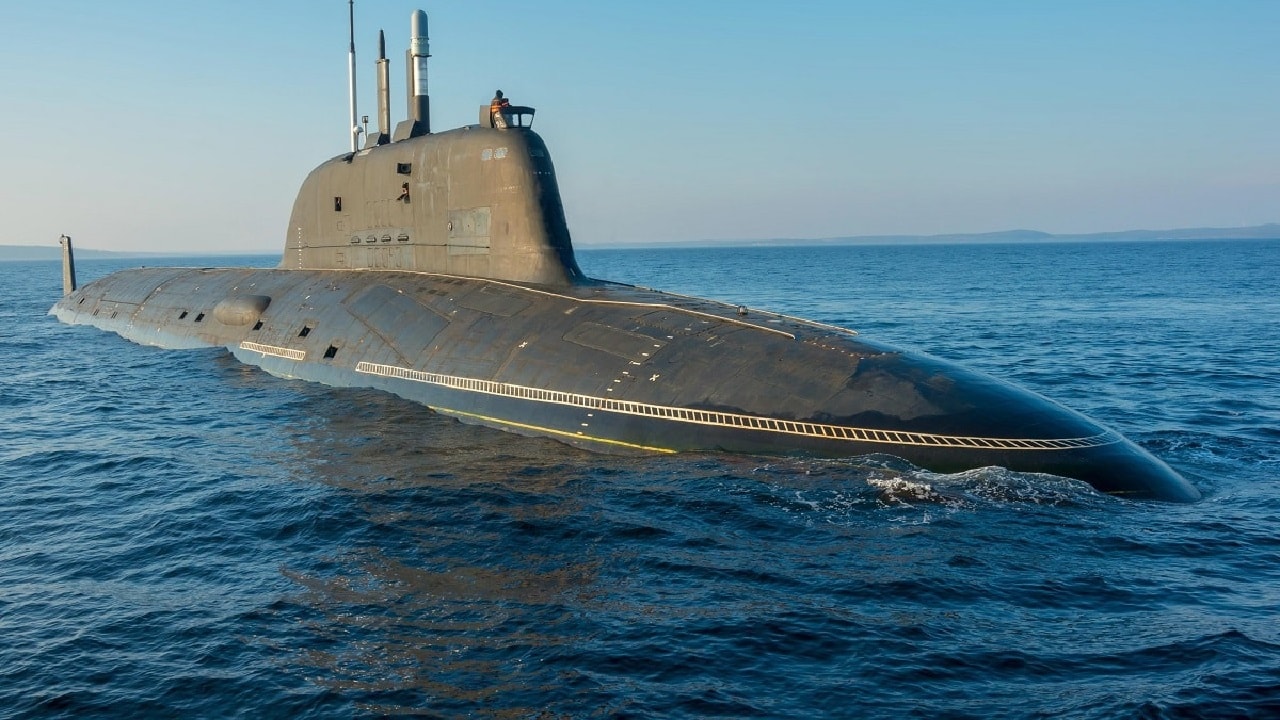
Russian Yasen-class Submarine.
Russia’s Stealthiest Attack Submarines
The Yasen-M measures 120-130 meters long and 12-15 meters high (sources vary considerably on these figures).
Although the ships are often compared to the Seawolf-class, the Yasen-M is considerably heavier, with a submerged displacement of around 13,800 tons, while the Seawolf-class has a submerged displacement of 9,137 tons.
The ship has a teardrop hull with a one-and-a-half-hull configuration.
It is powered by an OK-650KPM nuclear reactor, enabling the Yasin-M to travel at around 20-28 knots in silent mode, with a top speed of 30-35 knots (figures vary by source).
Thanks to their nuclear propulsion, the ships have nearly unlimited range, their only limitations being food supplies and crew endurance.
The Yasin-M-class is considerably stealthier than previous Soviet-era submarines.
The ships’ hulls and propellers are designed to improve undersea performance while reducing cavitation.
The hull appears to be fitted with anechoic tiles, while the reactor’s cooling station is designed to operate without the constant use of its circulation pumps, which is often the main source of noise on nuclear submarines.
In 2019, during an interview with 60 Minutes, the U.S. Navy admitted that the lead ship, Severodvinsk, slipped into the Atlantic Ocean and evaded detection for several weeks.
Keep in mind that Severodvinsk was the only ship in the class not updated to the Yasen-M standard.
How Advanced Are Russia’s Yasen-M Submarines?
In terms of armament, the Yasen-M-class carries eight 533mm slanted torpedo tubes.
The main armament, however, is its eight (some sources say ten) missile silos, each capable of carrying up to five, for a total of 40 Kalibr cruise missiles.
The Yasen-class was originally designed to carry the P-800 Oniks anti-ship cruise missile, but the Yasen-M program allowed the ships to carry a more diverse payload.
According to Russian news media, Perm, currently undergoing sea trials, has been modified to carry the Zircon hypersonic cruise missile, making it one of the first nuclear submarines armed with a hypersonic weapon.
Future ships will reportedly also integrate Zircon missiles as the Russian Navy continues to expand its hypersonic capabilities.
The Yasen-M-class submarines are fitted with a complex suite of sensors and electronic equipment, the exact characteristics of which are heavily classified.
It was the first Russian submarine fitted with the MGK-600 Irtysh-Amfora sonar suite, which consists of a large bow array, flank arrays, and towed arrays. Unfortunately, reliable data on its combat systems and electronic equipment is scarce.
One interesting detail of note is that the Yasen-M requires a smaller crew than the original Yasen series.
While the Yasen requires a crew of 85, the Yasen-M requires only 64.
This suggests greater automation aboard the Yasen-M subs and indicates that the onboard systems on Russia’s newest submarines are indeed significantly more advanced.
About the Author: Isaac Seitz
Isaac Seitz, a Defense Columnist, graduated from Patrick Henry College’s Strategic Intelligence and National Security program. He has also studied Russian at Middlebury Language Schools and has worked as an intelligence Analyst in the private sector.