

The Sukhoi Su-37 “Super Flanker” (also known as the Su-37 Terminator) was one of Russia’s most impressive warplanes ever built. An airshow sensation throughout the 1990s, the Su-37 sadly never entered operational service. In fact, only one prototype was ever made, and the aircraft was ultimately destroyed in an unfortunate crash in 2002.The Su-37 was a sensation because it did not fly like a regular warplane. Instead, it operated like a spacecraft.
Defying Conventional Aerodynamics: Meet the Su-37 Terminator
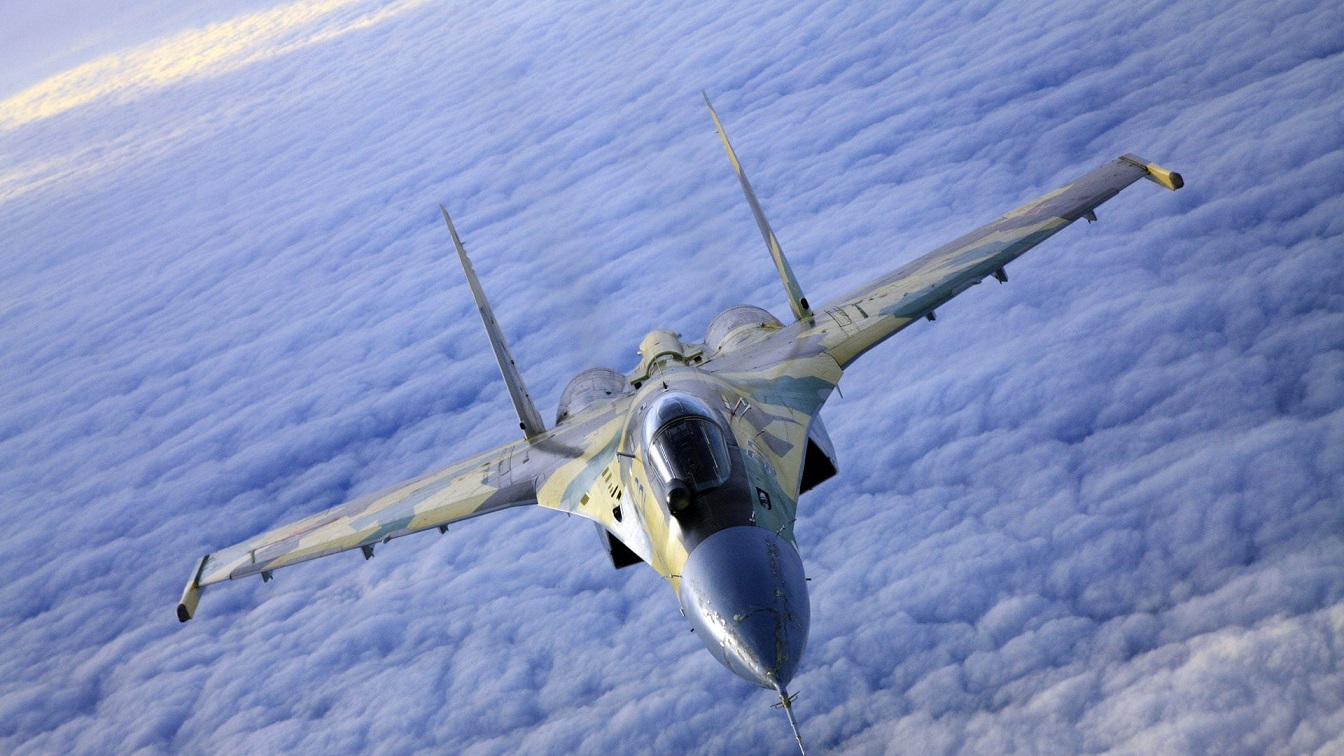
Su-37 fighter from Russia. Image Credit: Creative Commons.
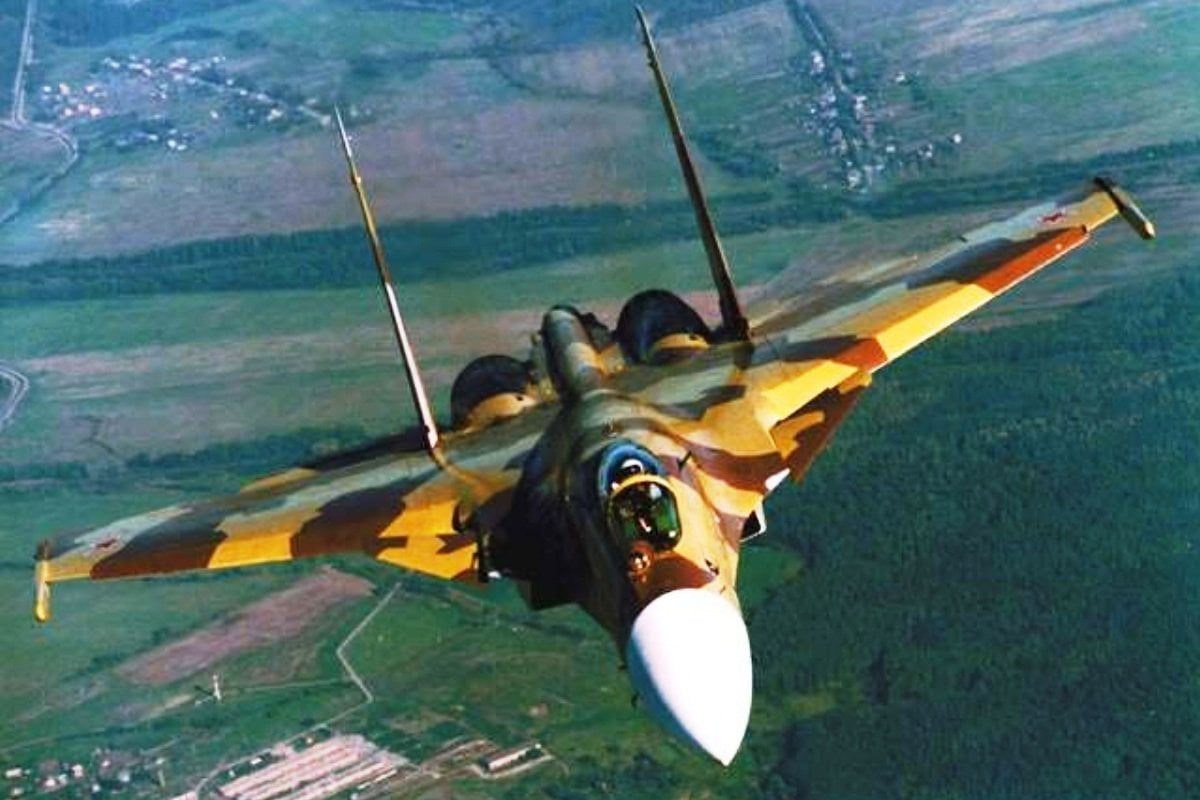
Sukhoi Su-37 Flanker-F
It defied conventional aerodynamic principles and could easily handle extremely high angles of attack.
Although the Su-37 prototype was lost in 2002, the Russians used the plane as a testbed for new technologies and techniques that would ultimately be used in other parts of the Flanker family (the progenitor plane being the iconic Su-27).
What began as Sukhoi’s bid to improve the Su-27 model evolved into the creation of the legendary Su-37 in the 1980s.
The Cold War was in its final decade.
At the time, though, the Soviet military design bureaus were still churning out unique designs for lethal systems, like the Su-37.
One thing Sukhoi began experimenting with at the time was thrust-vectoring engines. The famous design bureau first tested thrust-vectoring technology on the Su-27M.
That technology would inevitably be associated with the Su-35 as well.
Conventional fighters struggled to integrate this new technology.
When these planes attempted very high angles of attack and extremely low speeds, the normal aerodynamic control surfaces became less effective because insufficient airflow passed over them.
So Sukhoi’s ingenious workaround was to have the engines themselves help control the aircraft.
T10M-11 was the designation of the eleventh of Sukhoi’s Su-27M prototypes.
The firm fitted it with Lyulka-Saturn AL-37FU afterburning turbofan engines with thrust-vectoring nozzles that deflected about 15 degrees up or down.
T10M-11 eventually became the Su-37. It first took to the air under the control of famed Russian test pilot Yevgeny Frolov from Zhukovsky on April 2, 1986.
The changes Sukhoi implemented to the T10M-11 Su-27M model, which eventually became the Su-37, worked.
The plane could maneuver even as its aerodynamic control surfaces lost effectiveness.
The Su-37 was particularly significant for the Russians because it was an early example of combining thrust vectoring with a digital fly-by-wire flight-control system.
That was key because it integrated the control of the plane and its engines, allowing greater maneuverability, even at lower speeds.
Indeed, at the 1996 Farnborough International Airshow, the Su-37 performed the “Super Cobra” combat maneuver for a stunned audience below.
This was a more dangerous adaptation of the Pugachev’s Cobra maneuver.
Thanks to its unique aerodynamic design and thrust-vectoring engines, the Su-37 could easily perform the Frolov Chakra (“Kulbit”) maneuver, in which the pilot rotated the plane 360 degrees while remaining within a very small area of the sky.
The Add-Ons
Any conventionally powered warplane would have stalled while performing these maneuvers.
Sukhoi also installed advanced cockpit sensors.
Specifically, the N011M Bars radar could purportedly track up to 20 airborne targets and engage 8 at once.
The aircraft carried a rear-facing radar along with an impressive infrared search-and-track system (IRST). Meanwhile, the cockpit itself had four multifunction displays.
This was a great improvement over the Soviet-era planes that came before the Su-37.
The Su-37 had a maximum takeoff weight of 77,000 pounds. Its maximum speed exceeded Mach 2.5, and its service ceiling was 59,000 feet.
But this plane wasn’t just for show.
It possessed significant combat capabilities.
The plane had twelve external weapons stations capable of carrying 17,600 pounds of ordnance.
Had the Su-37 gone into full production, it’d have been compatible with the R-73 short-range air-to-air missiles and the R-77 beyond-visual-range missiles.
It also could have carried air-to-ground weapons.
A single 30mm GSh-30-1 cannon with 150 rounds provided internal armament.
Unfortunately, the Su-37 was killed by the chaotic politics and economic doldrums of post-Soviet Russia.
Even before its fateful crash in 2002, the plane wasn’t going into full-rate production because the Russian defense budget had contracted significantly and Sukhoi was basically surviving on foreign sales.
The Su-37 spent its career either buzzing impressed onlookers at airshows or being a testbed for new technologies that would ultimately be folded into other Russian warplanes.
Useful But Limited
Sukhoi did use the Su-37 prototype to court foreign buyers.
However, no one ever wanted to pay to start an entirely new production line for the Su-37.
By the time the plane crashed near Shatura, outside Moscow, on December 19, 2002, the Su-37’s original thrust-vectoring engines had been replaced with conventional ones because the originals were old.
An assessment of the crash data by Russian authorities determined that the plane suffered from structural fatigue, which may have contributed to its ultimate demise.
But the Su-37’s role as a technology demonstrator made it so useful for the Russians.
While the Su-37 never went beyond the prototype stage and met an ugly end, the Russians made great use of what they had (as Russia so often does).
About the Author: Brandon J. Weichert
Brandon J. Weichert is the Senior National Security Editor at 19FortyFive.com. He also manages The Weichert Brief on Substack. Weichert also hosts “National Security Talk” on Rumble. He is the author of four bestselling national security books, most recently A Disaster of Our Own Making: How the West Lost Ukraine (Encounter Books). Follow him via Twitter/X @WeTheBrandon.