
Saab GlobalEye with a 10.1 billion kronor deal enters the Middle East and reshapes early warning 2030
 Ahmed Al-Rashid
Saab GlobalEye with a 10.1 billion kronor deal enters the Middle East and reshapes early warning by 2030
On July 27, 2026, Saab announced that it had received an order for the purchase of two GlobalEye aircraft from a country in the Middle East, valued at 10.1 billion Swedish kronor, with deliveries scheduled for 2030. The news is brief in its official wording, but it is not small in its military significance. When a Middle Eastern country purchases two early warning and air control aircraft of this type, it is not just buying a flying radar; it is buying additional time for decision-making, a unified aerial, maritime, and land picture, and the ability to manage the battle before missiles and drones reach the last line of defense.
Notably, Saab refrained from naming the customer, justifying this by the nature of the industry and national security interests. In our region, secrecy in such deals is not a mere protocol detail. Concealing the buyer's name often means that the deal is linked to a sensitive balance with Iran, or to internal calculations among Gulf states, or to a desire not to prematurely announce a new command and control network before its ground and communication infrastructure is complete.
What GlobalEye practically adds
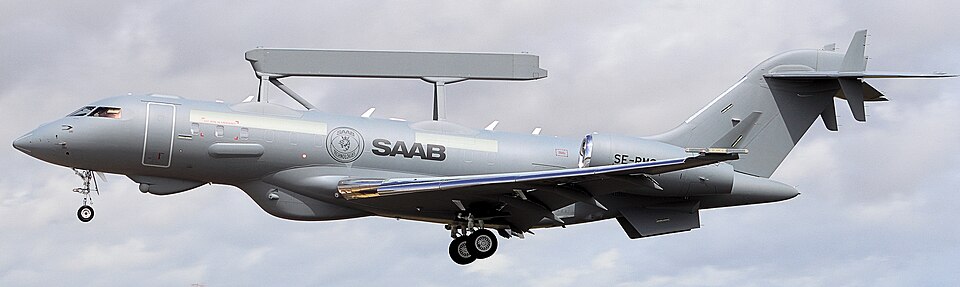
GlobalEye is built on the Bombardier Global 6000 or 6500 platform and carries the Erieye Extended Range radar with a suite of active and passive sensors and a multi-domain command and control system. According to Saab's data, the system can detect and track targets in the air, sea, and land, including aircraft, helicopters, cruise missiles, small targets like drones, and even distinguish between birds and drones in certain conditions. The company states that the detection range can reach up to 350 nautical miles, or about 650 kilometers, depending on altitude, operational environment, and target type.
This point is important because most Gulf defenses, even when expensive and modern, operate in separate layers. Ground radar here, a Patriot battery there, a THAAD system in another location, and fighter jets relying on ground guidance or American information. GlobalEye does not solve all these problems on its own, but it adds an upper layer above them. Practically, the aircraft that sees further gives the commander extra minutes, and in a missile and drone war, those minutes are not a small amount of time; they are the difference between organized interception and chaos in the operations room.
Why two aircraft are not a small number
The reader may wonder why a deal for only two aircraft is treated as a significant event. The answer is that early warning aircraft are not measured by their numbers like tanks or armored vehicles. Two aircraft mean a core capability, not a full fleet. If trained crews, stable maintenance, and secure data links are available, each aircraft can cover wide areas in alternating patrols. However, the number remains limited: one in the air, one for maintenance or readiness, and there is not much margin for breakdowns or ongoing tension.
Here lies the old knot of the Middle East. We buy the excellent platform, only to discover that the platform needs a complete life system around it. GlobalEye requires flight crews, air surveillance officers, signal analysts, maintenance engineers, encrypted data links, and operational understandings with air defense, naval forces, and fighter aviation. Any military personnel who has served in the region knows that buying the aircraft is easier than building a shared work culture among the forces.
The unknown customer and the Gulf message
The natural assumption is that the buyer is from the Gulf, as the need there is clear. The UAE operates GlobalEye and has a support contract with Saab worth nearly $190 million until 2026, making Abu Dhabi a regional reference in this field. Saudi Arabia, Qatar, Bahrain, and Kuwait, in turn, face a complex threat from ballistic missiles, cruise missiles, and drones coming from Iran or its proxies. Oman usually considers calmer calculations, but it is located on a maritime knot that is no less sensitive.
If the customer is a country that already possesses American defenses, then choosing the Swedish GlobalEye carries a dual message. The first message to Washington: American protection is important, but it is not enough on its own. The second message to the neighbors: anyone wanting to strike oil facilities, ports, or air bases will face a broader detection network than before. This does not mean complete military independence, but it is a step towards possessing a national operational picture instead of waiting for the picture from a third party.
The equation with Iran and drones
Iran and its allies have learned in recent years that cheap multi-directional attacks exhaust expensive defenses. A cheap drone does not need to overwhelm the entire air defense system; it is enough to force the opponent to activate their radars, launch costly interceptions, and scramble their fighters. In the face of this pattern, the value of GlobalEye is not only in seeing the target but in classifying it and distributing information quickly: is the target a small drone, a cruise missile, a deviating civilian aircraft, or a low-signature maritime target?
Here, realism is necessary. An early warning aircraft does not prevent an attack on its own, nor does it shoot down the missile by itself. But it prevents surprise, and surprise is half the blow in modern wars. A good early warning means that Patriot or NASAMS batteries or any other system do not operate as isolated islands. It means that fighters do not take off blind. It means that political leadership receives a clearer assessment before choosing between escalation and containment.
The cost of sovereignty is not just in the bill
A value of 10.1 billion Swedish kronor, or nearly one billion dollars, seems large for two aircraft. However, it is not strange in the AEW&C market, as the price usually includes platforms, sensors, mission equipment, training, and spare parts or initial support. The problem is not just in the number. The problem lies in the question that follows: will the purchasing state invest in doctrine, training, and networking with the same seriousness as it invests in the aircraft?
- Without reliable data links, GlobalEye becomes an excellent eye that does not always find someone to listen to it.
- Without experienced national crews, sovereignty remains tied to foreign advisors.
- Without long-term maintenance, the aircraft turns from an operational capability into an expensive symbol in the hangar.
This is the angle that does not appear in Saab's statement. The company sold an advanced system, and this is a clear Swedish industrial success. As for the Middle Eastern customer, they bought a promise of operational awareness. Between the sale and the promise lie years of silent work, often more challenging than the signing ceremony.
Summary by Ahmed Al-Rashed
In my opinion, the new GlobalEye deal is more important than many fighter deals that receive greater media attention. Fighter jets shine at air shows, but early warning is what makes the fighter know where to go, when to launch, and when to withdraw. From a military perspective, whoever has a better picture of the sky and sea holds part of the decision of war, and those who do not have it remain waiting for others to explain to them what is happening above their heads.
Nevertheless, one should not exaggerate. Two aircraft in 2030 will not change the balance of the Middle East on their own. They will add an important layer to a defensive network that still relies on the United States for armament, networking, and political deterrence. And as the old military saying goes, the eye that sees far does not win the battle if the body is slow. The contradiction will remain the same: Gulf states want greater operational sovereignty, but they are still building this sovereignty with imported tools and long-term support contracts.
Saab announced on July 27, 2026, that it received an order for two GlobalEye aircraft from an undisclosed Middle Eastern country for 10.1 billion Swedish Krona, with deliveries expected in 2030. This acquisition aims to enhance early warning and control capabilities, providing a unified aerial, maritime, and ground picture. The deal signifies a strategic shift in regional defense, particularly in relation to threats from Iran and its proxies.
- Saab received an order for two GlobalEye aircraft worth 10.1 billion Swedish Krona.
- Delivery of the aircraft is scheduled for 2030.
- The buyer is a Middle Eastern country, not publicly named due to security reasons.
- GlobalEye enhances situational awareness and command capabilities in military operations.
- The deal reflects a shift in regional defense dynamics, particularly concerning Iran.