
Salaknib 2026 USV Escort Shows U.S. Army Philippine Sea Denial Gap
 Marcus Chen
Salaknib 2026 USV Escort Shows U.S. Army Philippine Sea Denial Gap
The number that matters from Casiguran is six miles. That is how far U.S. Army unmanned surface vessels escorted a Logistics Support Vessel into port during Salaknib 2026, according to Defense News reporting on the June exercise in the Philippines. Six miles is not a theater-wide answer to the China problem. It is a useful tactical proof point: the Army can now put a cheap sensor boat ahead of a slower logistics craft and push risk away from the crew.
That is worth taking seriously. It is also easy to overstate.
A Small Escort for a Big Vulnerability
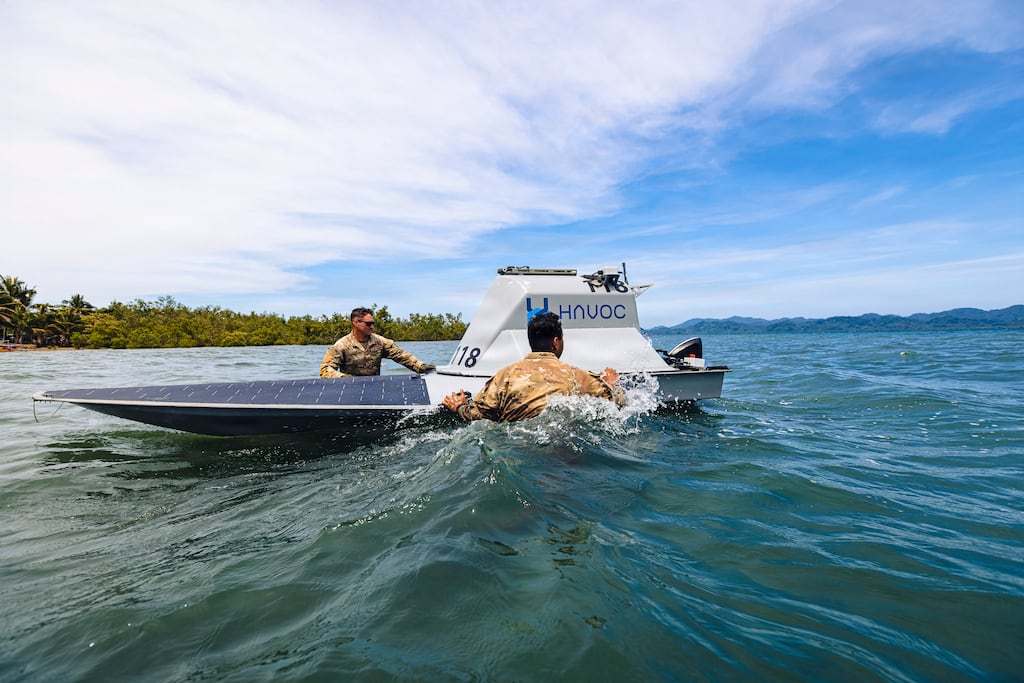
The reported mission took place in Casiguran Sound, where soldiers from the 125th Intelligence and Electronic Warfare Battalion, 25th Infantry Division, used unmanned surface vessels to scout ahead of a U.S. Army LSV supporting movement of Philippine personnel and vehicles. The movement covered more than 260 miles to Port Casiguran. One soldier described the boats as autonomous intelligence, surveillance, and reconnaissance platforms that escorted the LSV from about six miles out, giving commanders a live picture before the ship entered the port area.
That is the right use case. An LSV is not a destroyer. It is a big, slow Army logistics asset, useful because it can move equipment around an archipelago without needing a large commercial port. In a fight around Luzon, Batanes, or the eastern approaches to Taiwan, those vessels would matter less for glamour than for tonnage. Fuel bladders, ammunition pallets, radars, generators, trucks, and engineering gear do not move themselves. The problem is that the same profile that makes an LSV useful also makes it vulnerable: predictable route, low speed, limited self-defense, and an operating pattern that may require it to come close to austere ports.
The Army Is Learning a Naval Lesson
Anyone who has stood watch on a surface combatant understands the basic geometry. The ship that sees first gets more time to decide. The ship that has to wait until a contact is close has already lost options. An unmanned boat six miles ahead of a logistics vessel is not a shield, but it buys minutes. In restricted water, minutes matter.
Defense News quoted an industry representative saying the USV can compress the commander decision cycle from hours to seconds by helping find, fix, target, kill, and confirm. That formulation is too clean for the real world, but the direction is right. A small USV can check a pier approach, inspect suspicious craft, confirm where the water is cluttered, or force an adversary to reveal itself before the manned ship is at the worst point in the channel.
This is a naval lesson the Army has been relearning in the Pacific. Sea denial is not only about missiles. It is also about keeping logistics alive under observation and pressure. The Marine Corps has made that point with Navy-Marine Expeditionary Ship Interdiction System deployments. The Army version is less visible but just as important: if Army units are going to disperse across islands, they need their own maritime sensing, landing craft support, and electronic warfare protection. Otherwise the first island chain becomes a map exercise with no sustainment behind it.
Six Miles Does Not Solve the Scale Problem
The catch is scale. One escorted entry into Casiguran does not tell us whether the U.S. can protect dozens of daily movements across Luzon, Palawan, Batanes, Mindanao, and allied ports under missile and drone threat. A single LSV movement of 260 miles is a useful rehearsal. A wartime logistics cycle would require repeated runs, spare parts, control links, batteries or fuel, trained operators, maintenance crews, and rules for who owns the data once U.S. and Philippine units are operating in the same water.
The Navy has said it expects medium unmanned surface vessels to grow from roughly four in April to more than 30 by 2030, alongside thousands of smaller USVs and unmanned aircraft systems. That sounds large until it is divided across the Pacific. Thirty medium boats spread across Japan, Guam, the Philippines, Hawaii, and maintenance pipelines is not a blanket. It is a starting inventory. The smaller systems are more promising for mass, but they also create a command-and-control burden. Cheap boats still need operators, networks, and a recovery plan.
The Casiguran photos reportedly showed soldiers wading into chest-deep water to recover a HAVOC-branded USV. That detail matters. It says the system is practical enough to be handled by soldiers in an austere setting, not just by engineers at a pier. It also says the U.S. is still in the gritty phase where recovery, launch, weather, surf, and communications decide whether the concept survives contact with the coastline.
What China Would Actually See
From the People’s Liberation Army side, the emergence of Army USVs in the Philippines is not decisive by itself. China already has more ships, more coast guard hulls, more maritime militia, and shorter routes from its own bases to most likely flashpoints. A few small American scout boats do not reverse that advantage.
What they can do is complicate Chinese planning at the tactical edge. If U.S. and Philippine logistics movements begin to include unmanned scouts by default, Beijing has to decide whether to jam them, spoof them, ignore them, capture them, or destroy them. Each option has a signature. Jamming reveals electronic warfare activity. Physical interference risks escalation with Philippine forces. Ignoring them gives U.S. commanders a cleaner approach picture. Destroying them turns a cheap U.S. asset into an expensive political signal.
That is the value of unmanned systems in the first island chain. Their best contribution is not that they are magical. It is that they let the U.S. and its allies distribute risk more cheaply than they can distribute destroyers.
The Hard Part Is the Boring Part
The Pentagon should resist turning Salaknib into a victory lap. The hard work is not proving that a small USV can escort one Army vessel for six miles. The hard work is writing the operating agreements with Manila, training Philippine units on the same picture, keeping spare parts in theater, and integrating the data with fires without creating a fragile network that collapses under jamming.
If the U.S. wants to use Philippine geography as more than a talking point, it needs hundreds of small maritime sensors, not a handful of demonstrations. It needs LSVs, landing craft, port repair teams, air defense, deception, and enough stocks forward to keep moving after the first wave of missiles changes the plan.
Salaknib 2026 showed the right instinct. Put unmanned eyes ahead of the manned ship. Push risk outward. Treat every port entry as a tactical problem. But six miles of escort is not sea control. It is the first short leg of a much longer logistics race.
U.S. Army utilized unmanned surface vessels to escort a Logistics Support Vessel six miles into Casiguran Sound during the Salaknib 2026 exercise in June 2026. This operation involved the 125th Intelligence and Electronic Warfare Battalion, showcasing the Army's efforts to enhance logistics and maritime operations in the Philippines. The exercise underscored the importance of unmanned systems in supporting logistics under potential threats.
- U.S. Army used unmanned surface vessels to escort a Logistics Support Vessel in Casiguran Sound during Salaknib 2026.
- The escort covered a distance of six miles ahead of the LSV.
- The operation involved soldiers from the 125th Intelligence and Electronic Warfare Battalion, 25th Infantry Division.
- The exercise highlighted the logistical challenges of U.S. operations in the Philippine archipelago.
- The report emphasizes the need for improved maritime sensing and logistics support for U.S. forces.