
Saudi Arabia intercepts a ballistic missile and three drones on October 17, 2026, and tests resilience capability
 Ahmed Al-Rashid
Saudi Arabia intercepts a ballistic missile and three drones on October 17, 2026, and tests resilience
On October 17, 2026, the Saudi leadership announced the interception of a ballistic missile headed towards Yanbu, in addition to two cruise missiles over the Red Sea and three drones over southern regions and Riyadh. On the same day, the leadership spoke about the destruction of two ballistic launch platforms in Saada, while two missiles fell near Aden Airport, and the Houthi group claimed responsibility for targeting a Saudi command center. This is not a list of separate incidents; it is a picture of a war in which missiles and drones are attempting to shift pressure from the Yemeni front to airports, ports, and energy networks within the kingdom.
The numbers reveal the nature of the battle
Yanbu is not just a symbolic target. It is a port on the Red Sea and an important center for energy exports, so its threat tests the kingdom's ability to protect an economic hub rather than an isolated military site. As for Riyadh, it faces a different kind of pressure: any repeated alerts regarding King Khalid International Airport impose operational costs even when systems succeed in intercepting the projectiles. Canceling or rerouting flights, redistributing civilian aircraft, and keeping air defense units on high alert are all outcomes that do not appear in the interception statistics.
According to Gulf News, the Saudi leadership announced the interception of the projectiles and mentioned that U.S. warnings to travelers included the possibility of airport closures and flight disruptions. It also stated that the coalition released footage of operations targeting what it described as networks smuggling maritime weapons to Houthi-controlled areas in Hodeidah, while confirming that this narrative has not been independently verified. In another report, Reuters conveyed that the Houthis pledged to continue striking Saudi airports and oil facilities. The difference between the two sources is significant; the military announcement describes what Riyadh claims it has done, while the news report explains the adversary's ability to maintain pressure.
Air defense does not equal control of the airspace
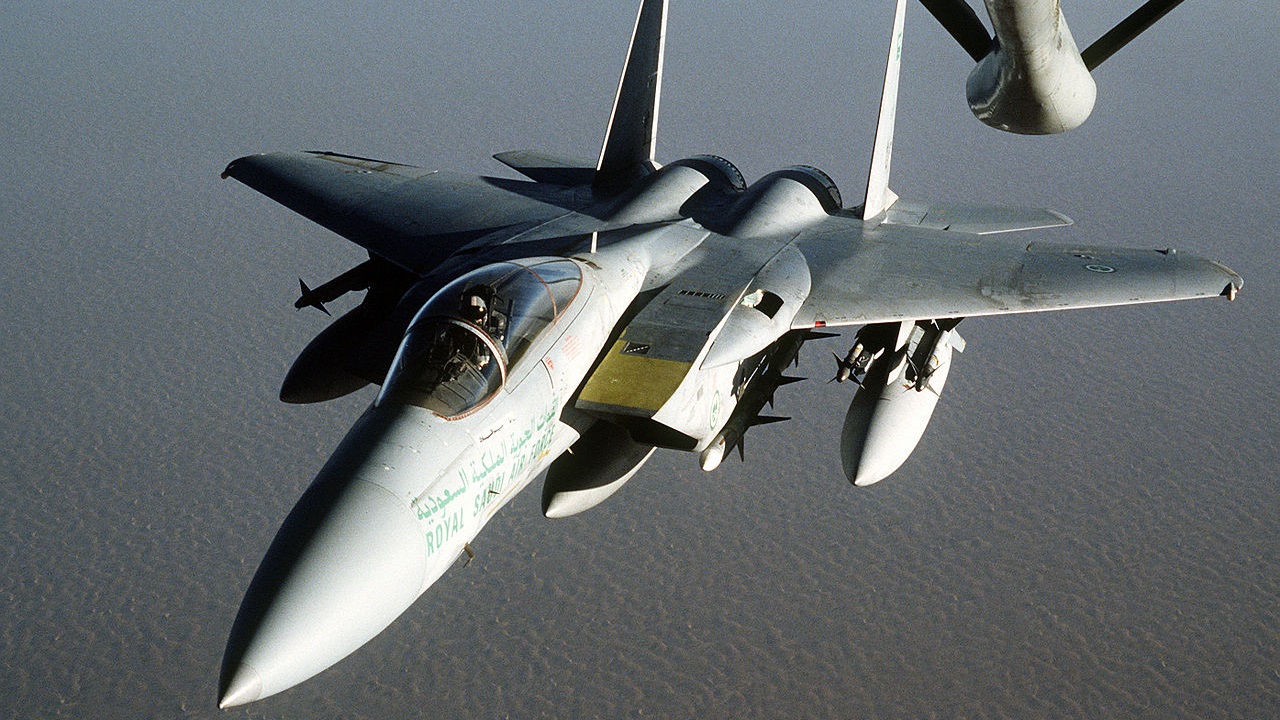
From a military perspective, successful interception does not mean that the kingdom has regained the initiative. Air defense capability is measured by three interconnected elements: equipment, training, and institutions. Saudi Arabia possesses radars, interception systems, fighter jets, and a command and control network that are far superior to most parties in the conflict. However, the war of cheap drones and missiles imposes a harsh attrition equation: the cost of an intercepting missile may exceed the cost of the target, and it may be sufficient for the adversary to launch a number of projectiles to force the defender to activate its systems around numerous civilian and economic targets.
The second problem is continuity. Intercepting one missile over Yanbu does not answer questions about ammunition, spare parts, flight hours, and the crews' ability to operate for weeks on end. Additionally, striking platforms in Saada may temporarily reduce the threat, but it does not eliminate mobile stockpiles or maritime and land transport networks or the adversary's ability to change the timing of launches. Any military personnel who has served in the region knows that battles are not decided by the best defensive night, but by who can maintain the pace when the state of emergency turns into routine.
Israeli offer for assistance and the Saudi decision-making dilemma
The political dimension became more complicated when U.S. President Donald Trump urged Riyadh to accept Israeli assistance to confront the Houthis, stating that Israel had been beneficial to Saudi Arabia. The kingdom has not announced acceptance of the offer. This hesitation is understandable. Operationally, Israel may be able to provide early warning or expertise in defending against drones and missiles or information about launch networks. However, its public involvement in the Yemeni war would provide the Houthis and Iran with valuable propaganda material and could transform a conflict over borders and facilities into an Arab-Israeli confrontation in regional consciousness.
Here, the limits of external reliance become apparent. Washington provides the broadest umbrella, Israel has technical expertise, and Turkey, Pakistan, and Egypt have previously announced their readiness to support collective defense commitments with Saudi Arabia. However, having many partners does not automatically create a unified operations room. An effective coalition requires clear rules of engagement, real-time data sharing, joint training, and a chain of command that does not stop at the political calculations of each capital. Purchasing the system is easier than building the institution that uses it.
The Red Sea is the real center of gravity
The strikes on Aden and the talk of arms smuggling through Hodeidah link the skies of Saudi Arabia to the Red Sea. If the Houthis can threaten ports and airports simultaneously, they will force Riyadh to distribute defenses among energy facilities, air corridors, and shipping lanes. This raises the value of maritime surveillance, human intelligence, and operations against supply networks, not just the number of batteries. Conversely, Saudi airstrikes on Saada may provide operational depth, but they carry the risk of expanding the war without guaranteeing the cessation of attacks.
Even in the Strait of Hormuz, where U.S. Central Command reported that more than 40 commercial vessels passed through in 24 hours, maritime passage remained contested, with reports of ships being hit since October 11. This illustrates that the security of the Gulf and the Red Sea are no longer separate pathways. Pressure on energy routes can shift from Bab el-Mandeb to Hormuz, while forces are drained in protecting dispersed targets.
Conclusion
Saudi Arabia succeeded in preventing some projectiles from reaching their targets on October 17, which is a genuine defensive achievement. However, it is not the end of the story. The battle now lies between the kingdom's ability to translate technical superiority into sustainable defense and the Houthis' ability to make every alert, every airport closure, and every change in a ship's course a political and economic cost. The ongoing contradiction is that Riyadh wants independence in security decision-making, yet it needs, at almost every layer, a network of external partners; and in modern warfare, it is not enough to have the shield if the adversary has the time and flexibility to decide where and when to test it.
Sources
- Reuters, Houthis bring the war to Riyadh, October 14, 2026
- Reuters, Houthi attacks and attempts to target Saudi facilities, October 15, 2026
- Gulf News, Developments in the Middle East war, October 17, 2026
- GlobalSecurity, Iran War Report and Developments in the Red Sea and Strait of Hormuz, October 16, 2026
On October 17, 2026, Saudi Arabia intercepted a ballistic missile targeting Yanbu and three drones over southern regions and Riyadh. The Saudi Armed Forces reported the destruction of two ballistic missile launch platforms in Sadaa, while two missiles fell near Aden, attributed to Houthi forces. The ongoing conflict highlights the strategic importance of Yanbu as a key energy export port.
- Saudi Arabia intercepted a ballistic missile aimed at Yanbu.
- Two ballistic missiles fell near Aden, claimed by the Houthi group.
- Saudi forces destroyed two launch platforms in Sadaa.
- The U.S. warned travelers about potential airport closures in Saudi Arabia.
- Houthi forces vowed to continue targeting Saudi airports and oil facilities.