
Sea Hunter Gives RIMPAC 2026 Sensors Without More Shooters
 Marcus Chen
Sea Hunter Gives RIMPAC 2026 Sensors Without More Shooters
Sea Hunter left Pearl Harbor on July 7 with no missile cells, no crew, and no political drama. That is exactly why the small unmanned surface vessel matters at RIMPAC 2026. It is not trying to be a destroyer. It is trying to make the destroyers harder to surprise.
USNI News reported on July 10 that the US Navy medium displacement unmanned surface vessel departed Joint Base Pearl Harbor-Hickam to begin the at-sea phase of Rim of the Pacific 2026. The same weekly Western Pacific roundup noted live-fire events already underway, including a Royal Canadian Navy HMCS Ottawa torpedo firing and a Japan Maritime Self-Defense Force JS Kongo SM-2 surface-to-air missile shot. Pacific Fleet says this RIMPAC iteration brings together 30 nations, more than 30 surface ships, five submarines, 15 national land forces, more than 206 aircraft, and 30,000 personnel through July 31.
The Sensor Is Not the Shooter
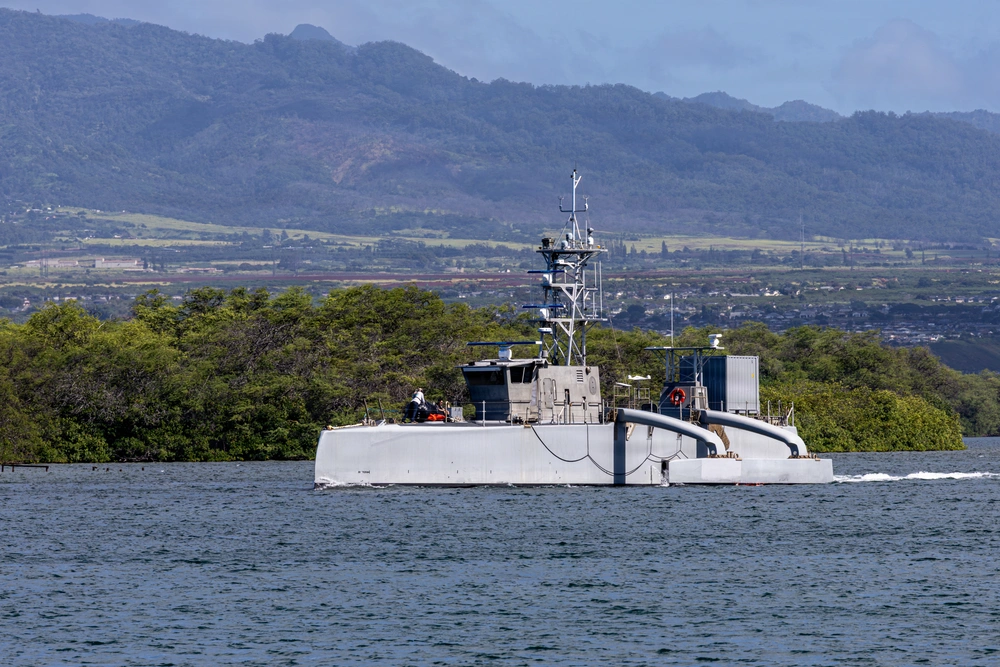
The useful way to read Sea Hunter at RIMPAC is not as a prototype victory lap. It is a test of whether the Navy can push sensing, tracking, deception, and communications into places where a $2 billion guided-missile destroyer should not have to loiter. In a Taiwan or Philippine Sea fight, the first problem is not only finding Chinese submarines, aircraft, and surface groups. It is keeping contact long enough to pass a target-quality track to a shooter that still has weapons aboard.
That distinction matters. A Sea Hunter-type vessel can extend the screen. It can carry sensors, serve as a picket, force an adversary to classify one more contact, and make a commander less dependent on manned ships sitting inside missile range. But it does not add vertical launch cells. It does not reload SM-6, Tomahawk, LRASM, or torpedoes. It does not repair a damaged radar at sea with a chief and a repair locker. It can help build the kill chain; it does not close the magazine gap.
RIMPAC Shows the Real Fleet Math
The US contingent described by USNI is a useful inventory. USS Theodore Roosevelt leads the exercise with Carrier Air Wing 9. The list includes cruiser USS Chosin, destroyers USS Paul Hamilton, USS Decatur, USS Wayne E. Meyer, and USS Carl M. Levin, amphibious assault ship USS Essex, attack submarines USS Charlotte and USS Columbia, two fleet oilers, a dry cargo ship, and Coast Guard cutter Kimball. That is a serious force package for an exercise. It is also a reminder that naval power is still a stack of scarce hulls, trained crews, munitions, fuel, and maintenance windows.
Anyone who has served on a destroyer knows the uncomfortable truth behind the briefing slide. The ship can be assigned to air defense, ballistic missile defense, escort duty, strike warfare, anti-submarine warfare, maritime security, and partner training in the same patrol cycle. Every new mission is real. The ship does not get a second crew or a second magazine because the concept has become more elegant.
Sea Hunter helps with one part of that load. If unmanned vessels can screen ahead of a carrier, trail a suspected submarine contact, or act as distributed nodes in a maritime operations center network, they reduce the number of times a destroyer must expose itself just to maintain awareness. That is operationally valuable. It is not the same as adding another Arleigh Burke to the line.
China Gets a Vote
The timing is not subtle. In the same July 10 Western Pacific picture, USNI tracked Chinese and Russian ships leaving Qingdao for Joint Sea 2026, including Russian cruiser Varyag, attack submarine Ufa, PLAN cruiser Anshan, destroyer Kaifeng, frigate Wuhu, fleet oiler Kekexilihu, and a Yuan-class attack submarine. Japan also tracked PLAN ships near Amami Oshima and a Chinese Y-9 electronic intelligence aircraft operating around southwest Japan. In other words, RIMPAC is taking place while the other side is practicing its own surveillance, anti-submarine warfare, air defense, and live-fire routines.
That is why the Sea Hunter experiment should be judged against Chinese targeting pressure, not against a peacetime technology checklist. In a contested first-island-chain environment, the unmanned vessel has to communicate without becoming an easy emitter to geolocate. It has to operate through jamming. It has to be cheap enough to lose, but capable enough that losing it does not make the whole screen useless. It has to pass data to ships, aircraft, submarines, and shore nodes without creating a brittle network that collapses after the first cyber or electronic attack.
The Hard Part Is Scaling
The Navy has spent years talking about unmanned systems as a way to distribute risk. The phrase is fine. The math is harder. One or two unmanned vessels in an exercise give commanders experience. Dozens operating across the Philippine Sea, Luzon Strait, and approaches to Guam would require bandwidth, maintenance crews, pier space, spares, autonomy rules, and command authorities that are still maturing.
The other issue is doctrine. If Sea Hunter finds something, who owns the contact? Which commander can task it? How quickly does the data move from an unmanned surface vessel to a P-8A, a destroyer, a submarine, or an aircraft wing? What happens when the track quality is good enough to worry about but not good enough to shoot? These are not academic questions. They decide whether a carrier strike group gets another five minutes of warning or another false contact to chase.
RIMPAC 2026 is the right place to test that because the exercise has the full mix: submarines, air defense shots, torpedo events, carriers, oilers, amphibious ships, and allied command relationships. A small unmanned vessel only becomes militarily relevant when it has to plug into that messy fleet, not when it looks clever in an innovation demo.
What Sea Hunter Actually Changes
The best case for Sea Hunter is modest and important. It gives the Navy more eyes at sea without putting more sailors inside the first salvo. It complicates Chinese planning by adding ambiguous contacts and distributed sensors. It gives allied navies a practical way to train around unmanned nodes before a crisis forces them to improvise.
But it does not solve the central Pacific problem. The US Navy still needs escorts with missiles, submarines with torpedoes, oilers that can survive the route, and yards that can repair battle damage faster than China can generate pressure. Sea Hunter can make the fleet smarter. It cannot make the fleet larger.
That is the line Washington should keep clear. Unmanned vessels are not a substitute for naval mass. They are a way to spend that mass more intelligently. If RIMPAC proves that, Sea Hunter will have done something useful. If it becomes another reason to pretend sensors are the same as shooters, the Navy will have learned the wrong lesson in the most expensive ocean on earth.
The U.S. Navy's Sea Hunter unmanned surface vessel departed Pearl Harbor on July 7, 2026, to participate in RIMPAC 2026, which involves 30 nations and extensive naval operations. The exercise aims to test the integration of unmanned vessels in maritime operations while Chinese and Russian naval forces conduct their own exercises nearby. The Sea Hunter is designed to enhance surveillance and tracking capabilities without adding more manned ships to the fleet.
- Sea Hunter departed Pearl Harbor on July 7, 2026, for RIMPAC 2026.
- RIMPAC 2026 involves 30 nations, over 30 surface ships, 5 submarines, and 30,000 personnel.
- The exercise includes live-fire events and various naval operations.
- Chinese and Russian naval activities are occurring concurrently with RIMPAC 2026.
- The Sea Hunter unmanned vessel is being tested for its operational capabilities in a contested environment.