
Seven Iranian Missiles on Kuwait and Bahrain Reveal the Limits of the American Gulf Shield 2026
 Ahmed Al-Rashid
Seven Iranian Missiles on Kuwait and Bahrain Reveal the Limits of the U.S. Gulf Shield 2026
On the evening of June 5, 2026, U.S. Central Command stated that Iran launched seven ballistic missiles towards Kuwait and Bahrain just hours after downing four attack drones near the Strait of Hormuz. The number is small compared to Iran's missile stockpiles, but it is large enough to reveal the dilemma known to every military personnel who has served in the Gulf: U.S. bases protect Gulf capitals, but at the same time, they make these capitals part of Iran's target bank.
According to the Associated Press, U.S. forces intercepted six missiles, while the seventh did not reach its target. Kuwait announced that its defenses were dealing with missile and drone attacks, while Bahrain sounded alarms and urged residents to move to safe places. The Iranian Revolutionary Guard stated that the strike targeted Ali Al-Salem Air Base in Kuwait and facilities of the U.S. Fifth Fleet in Bahrain. Washington denied any damage to its forces but responded by striking Iranian coastal radar sites in Gork and Qeshm Island.
What Changed in the Recent Attack
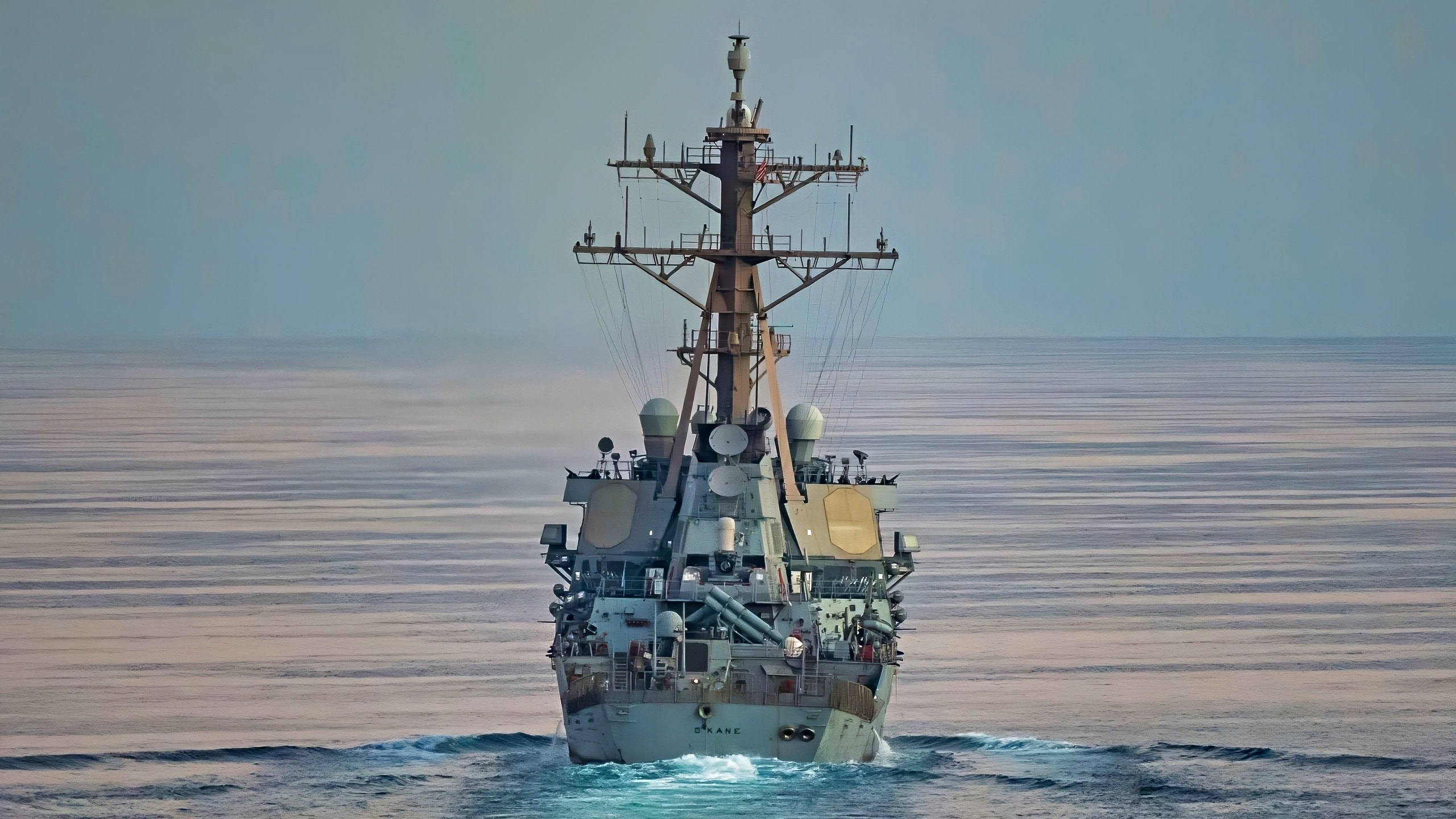
The new aspect is not that Iran launched missiles at U.S.-related targets. This has happened more than once in recent months. What is new is that the strike came in a dual operational sequence: drones towards the maritime corridor in Hormuz, then missiles towards Kuwait and Bahrain, followed by a U.S. response to coastal radars. This is not just a symbolic exchange, but a test of three layers of deterrence simultaneously: maritime security, base protection, and Iran's ability to maintain military pressure while negotiating a broader ceasefire.
Practically, the choice of Kuwait and Bahrain is not random. Ali Al-Salem Air Base represents an important air and logistical hub for U.S. forces, and Bahrain hosts the Fifth Fleet, which manages a large part of the U.S. maritime presence in the Gulf and the Arabian Sea. When the Revolutionary Guard announces that it has struck these two names, it is not only addressing the Pentagon; it is also addressing the Gulf communities that hear the alarms and realize that hosting U.S. protection does not mean staying out of war.
Interception Capability Does Not Mean the End of Danger
The apparent result is reassuring: six missiles intercepted, one missile failed, and no reported American casualties. However, this superficial reading conceals the question of cost and attrition. Central Command did not announce the type of interception means used, but the air defense environment in the Gulf typically relies on a mix of Patriot PAC-3 batteries, naval assets linked to the Aegis system, and U.S. and Gulf early warning radars. Each successful interception consumes expensive ammunition and reveals that defense operates at the edge, not in a comfortable exercise.
A short or medium-range ballistic missile does not need perfect accuracy to achieve a political effect. It is enough to force an airport to close, or to trigger alarms in Manama, or to compel Washington to strike a radar in Qeshm, for it to become part of the pressure equation. Therefore, the usual Gulf talk about purchasing more systems is not sufficient. Equipment is important, yes, but it is only one side of the capability triangle: equipment, training, and institution. Many Gulf countries possess the first side and rent part of the second side, but they have not always built the third side sufficiently.
Kuwait and Bahrain Between Sovereignty and Dependence
Kuwait is a sensitive case because it is not just a site for U.S. bases. It is a small country with a memory of Iraqi invasion, and it knows that U.S. guarantees have been a matter of survival since 1991. Therefore, any call to reduce dependence on Washington seems unrealistic if stated as a slogan. However, complete dependence has a price. When the Iranians strike near Kuwait, the Kuwaiti citizen does not ask about Central Command maps; they ask about the airport, about the city, and about their army's ability to make an independent decision in the first minutes before the full American picture arrives.
Bahrain is more complex. The presence of the Fifth Fleet gives it a security weight that exceeds its geographical size, but it also makes it a fixed target in any U.S.-Iranian crisis. This is a familiar equation in the Gulf: protection raises status, and status raises the level of risk. In my opinion, Manama cannot abandon this role, but it needs to treat it as a permanent civil and military defense burden, not just as a symbol of alliance.
The U.S. Response and the Qeshm Message
Targeting radar sites in Gork and Qeshm carries a clear technical significance. Washington does not only want to intercept projectiles after they are launched, but it also wants to weaken the Iranian coastal eyes that help monitor ships and direct attacks. Qeshm, in particular, is not a marginal island; its location at the Strait of Hormuz makes it part of the structure that connects coastal reconnaissance, boats, drones, and anti-ship missiles. Striking the radar there means attempting to cut the targeting chain before it is completed.
However, this approach has its limits. Every U.S. strike on a radar or control station gives Tehran a justification for a subsequent strike on a base or maritime corridor. Every failed Iranian strike gives Washington a reason to increase pressure. Thus, deterrence turns into a machine that produces its own justifications. In military academies, we say that the best defense is the one that prevents the enemy from firing, not the one that prides itself on intercepting the bullet after it has been fired. In the Gulf, we still celebrate interception too much and discuss too little how to prevent the launch cycle altogether.
The Broader Implication for Gulf States
The Gulf states will read the numbers from June 5 in two ways. The first is reassuring: defenses worked, damage is limited, and U.S. protection is still effective. The second is less reassuring: Iran was able within hours to link Hormuz with Kuwait and Bahrain and force Washington to respond again, while political negotiations remain suspended. If this happens while discussing a fragile ceasefire, what will happen if the agreement collapses completely?
The answer does not lie in purchasing a single new system. IBCS in Kuwait, or an additional Patriot in Bahrain, or a long-range radar in Qatar, are all useful tools if they are part of a real Gulf command and control network. However, if each country continues to buy its own battery and waits for the American officer to piece together the picture, we will remain with an expensive defense that lacks complete sovereignty. This is the contradiction that has haunted the Gulf for decades: it wants full American protection, complete decision independence, and limited political cost. In war, as the old military saying goes, there is no umbrella without a shadow.
Sources
This analysis relied on Associated Press reports on June 5 and 6, 2026, regarding the interception of missiles and drones, on a Reuters summary published via GMA News regarding the Central Command statement, and on a statement from the Revolutionary Guard published via Press TV to determine the Iranian narrative. Main source: https://apnews.com/article/iran-war-hormuz-drones-a9495a8e67035b8596a3739c8cde0978
On June 5, 2026, Iran launched seven ballistic missiles towards Kuwait and Bahrain, targeting U.S. military installations. U.S. forces intercepted six of the missiles, while one failed to reach its target. In response, Kuwait activated its defenses, and Bahrain issued safety alerts for its citizens. The U.S. retaliated by striking Iranian radar sites to disrupt further attacks.
- Iran launched seven ballistic missiles towards Kuwait and Bahrain.
- U.S. forces intercepted six missiles, with one failing to reach its target.
- The Iranian Revolutionary Guard Corps claimed the strikes targeted U.S. military bases.
- Kuwait and Bahrain activated their air defense systems in response to the attacks.
- The U.S. retaliated by striking Iranian coastal radar sites.