
U.S. Navy's "Ford" Aircraft Carrier Fire Aftermath: How Severe is the Damage?
A recently released video by American media shows that the "Ford" aircraft carrier, which experienced a fire, had approximately 600 sailors' sleeping quarters completely destroyed, the ceiling's fireproof layer burned through, wires hanging in mid-air, and the floor covered in charred ashes. In March of this year, the "Ford" was on a combat mission against Iran in the Red Sea when a fire broke out in the ship's laundry room and quickly spread. American media reported that the fire lasted for over 30 hours. The "Ford" is expected to require at least a year of repairs before it can be put back into service. What impact will the "offline" status of the "Ford" have on the global deployment of U.S. military forces?
How extensive is the damage from the burned ceiling?
The ceiling of the "Ford" in the burned compartment was burned through, with wires hanging down. The internal cabling of the aircraft carrier is extremely complex, connecting power, communication, and weapon systems. How significant is this level of damage? Besides the sleeping quarters and cables, what other hidden dangers could this 30-hour fire pose to the "Ford"?
Military Expert Li Yaqiang: The issue is not just the loss of cables or the burned ceiling, but the fact that this fire lasted for 30 hours. Such a large fire, it will cause an indescribable damage to the steel strength of this part of the hull, because overheating will have a huge impact and destruction on the entire steel structure. Whether this part of the structure can continue to maintain its technical status according to the original design requirements is the big problem.
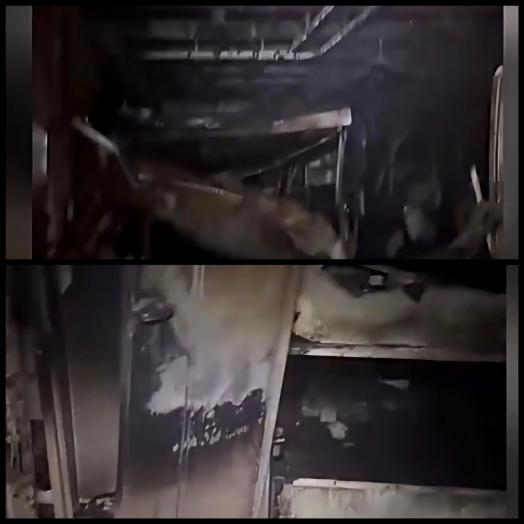
△ Details of the fire damage on the "Ford" have been revealed
Military Expert Li Yaqiang: The burning of 600 sleeping quarters itself does not have a very serious impact on the normal operation of U.S. aircraft carriers. What it really brings is a psychological shock, and the loss of 600 berths, which is close to a 10% loss for an aircraft carrier, will have a significant impact on the overall living order, and may even force the implementation of a three-shift system for using the berths. The main issue is the psychological and political impact.
U.S. military damage control level has significantly declined
As the latest and most advanced nuclear-powered aircraft carrier in the U.S., the internal firefighting system surprisingly had major issues. According to a sailor and a senior official from the "Ford," after the fire broke out, the firefighting system failed, and it was the crew's efforts that managed to extinguish the fire. Li Yaqiang pointed out that the problem is not just with the seemingly advanced firefighting system.
Military Expert Li Yaqiang: The U.S. military's damage control level has always ranked among the top in the world’s navies, with very high standards and well-trained personnel. During World War II, U.S. aircraft carriers suffered very few losses, largely due to their comprehensive damage control capabilities and equipment, as well as high training levels. However, from the perspective of the 30-hour fire on the "Ford," the U.S. system may have suffered significant damage, and its original level may have decreased considerably.
Just in the living quarters section, it took 30 hours to extinguish the fire, indicating that there must have been significant issues with the overall damage control capabilities, which could be related to equipment or training.
Ships have different methods for dealing with different types of fires. Chemical firefighting (such as firefighting agents), inert gas firefighting, sprinkler systems, cooling, and even high-pressure steam firefighting can be used. The most extreme measure is to close all watertight doors and windows in the burning compartment, spray water around it to cool it down, preventing significant damage to the entire structure. Once the air inside is burned out, it will naturally extinguish. Regardless, a fire lasting 30 hours indicates that its damage control system, training, and overall level must have significantly declined, without a doubt.
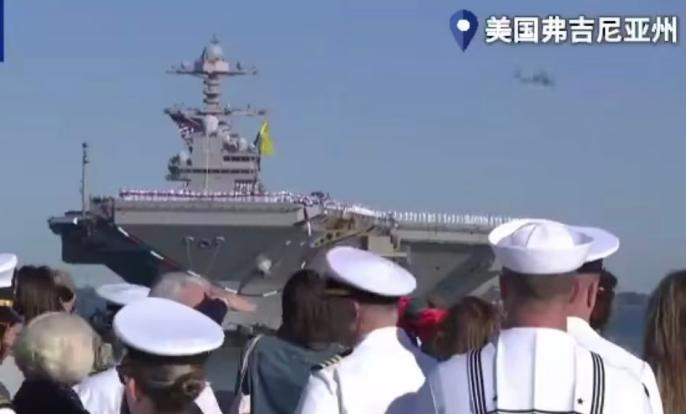
△ The "Ford" returning to its home port.
Repairs will take at least a year
U.S. Navy aircraft carriers are facing a gap in capability
The "Ford" has faced a series of misfortunes during this deployment, and before the fire, it was reported that hundreds of toilets were clogged. Sailors on board described, "If you are at the bow, you have to walk all the way to the stern to find a usable toilet." American media revealed that the clogged toilets indicate a fundamental problem with the ship's entire sewage system. After suffering from both "water and fire disasters," the "Ford" returned to the U.S. last month, ending a continuous 326-day deployment at sea, and will undergo repairs at the shipyard, including upgrades to the toilet sewage system.
An official told the media, the "Ford" will need at least a year before it can set sail again. The "Ford" is the newest and most expensive aircraft carrier in the U.S. Navy, and after less than four years of operational deployment, it is set to begin a year-long "extended vacation." What impact will this have on the U.S. Navy, which has long been flexing its military might globally?
Military Expert Li Yaqiang: Saying a year might still be optimistic. It needs to clear the shipyard, clear the dry dock, and after entering the dock, it will take its time to repair, which will not be short. After repairs, it will also need sea trials and to reassign personnel. Many of its older aircraft carriers are set to be decommissioned, which are already insufficient for use, with aging hulls and increasing failure rates. The "Ford" has encountered issues, and the newly built "Kennedy" cannot be completed, leading to a situation of capability gaps. Additionally, with its overall condition declining, its combat effectiveness will certainly be affected.
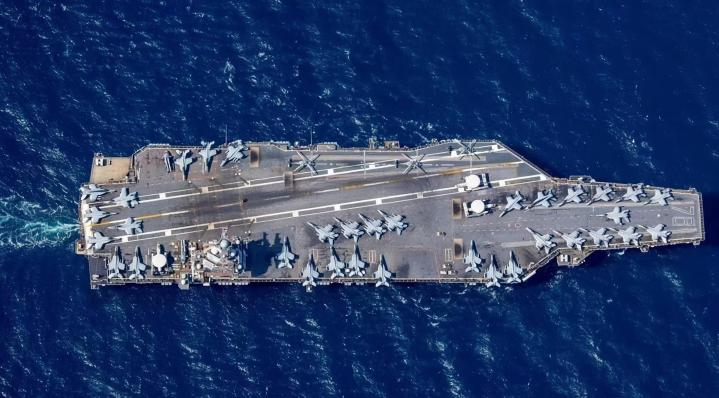
△ Currently, only the "Ford" has an electromagnetic catapult installed, but it cannot launch the most advanced F-35 carrier-based aircraft.
The U.S. Navy currently has 11 nuclear-powered aircraft carriers in service, but due to lengthy overhauls and refueling cycles, along with a backlog of repair orders at shipyards, only about 3 to 5 can usually be deployed at any time. Now that the "Ford" will be out of commission for at least a year, the "Lincoln" and "Bush" are still deployed in the Middle East, while the already decommissioned "Nimitz" nuclear-powered aircraft carrier has had to be reactivated to appear in the Caribbean and off the coast of Jamaica for combat readiness patrols.
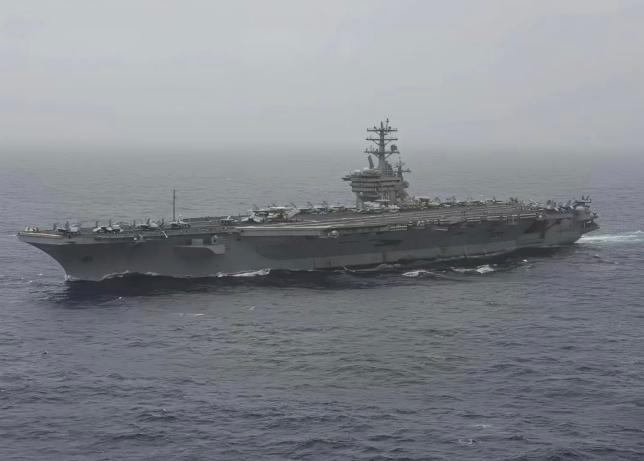
△ The "Nimitz," which has endured for half a century, is still holding up the facade of a naval power
The hollowing out of the shipbuilding industry chain and the gap in skilled labor have created a vicious cycle of new ships not being built and old ships not being repaired, which has spread from aircraft carrier construction and maintenance to the entire shipbuilding industry. The deep structural decline of domestic manufacturing is dragging down the U.S. Navy, and at this moment, the U.S. Navy can only hope that the second ship of the "Ford" class, the "Kennedy," which was originally scheduled for delivery in 2018, can be delivered on time in March next year.
Supervised by丨Wu Zhehua Yang Sen
Reporters丨Yang Jun Tian Wang Jiyun
Video丨Ning Bo
A fire on the USS Ford aircraft carrier lasted over 30 hours in March 2023, destroying approximately 600 sailors' sleeping quarters and damaging critical systems. The fire compromised the ship's structural integrity and fire suppression capabilities, leading to concerns about the U.S. Navy's readiness. The USS Ford is expected to undergo repairs for at least one year, impacting the Navy's operational capacity.
- USS Ford suffered a fire lasting over 30 hours in March 2023.
- Approximately 600 sailors' sleeping quarters were destroyed.
- The fire compromised the ship's fire suppression system and structural integrity.
- USS Ford is expected to undergo repairs for at least one year.
- The incident raises concerns about the readiness of the U.S. Navy's carrier fleet.