
Shield AI and Thunder Tiger's Seashark 800 USV Will Change Taiwan Strait Defense in 2026
 Tanaka Takashi
Shield AI and Thunder Tiger's Seashark 800 USV to Transform Taiwan Strait Defense in 2026
The small unmanned vessel "Seashark 800," running on Taiwan's waters, is equipped with the autonomous software Hivemind from the U.S. company Shield AI. The memorandum announced on May 13 between Shield AI and Taiwan's Thunder Tiger is too significant to be dismissed as just a corporate partnership. The first demonstration is scheduled to take place this summer using Thunder Tiger's unmanned surface vessel (USV).
Exporting AI Pilots Instead of Vessels
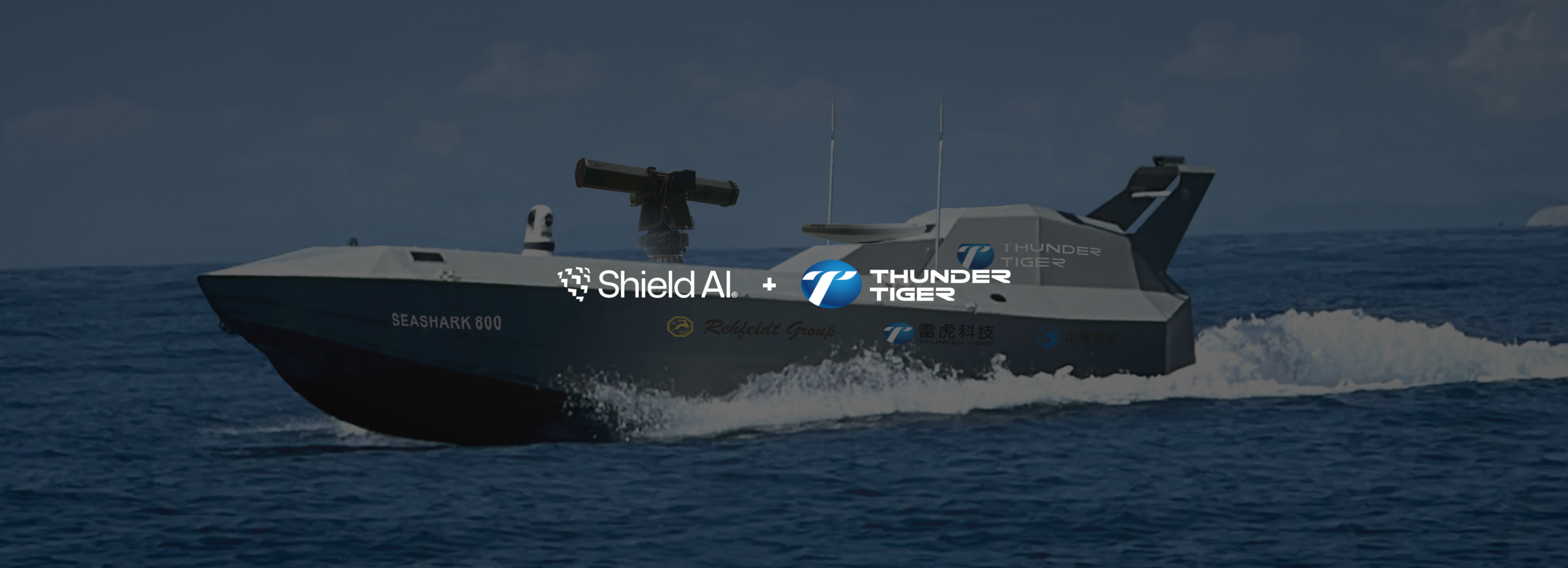
As reported by Naval News on May 16, this plan involves the gradual integration of Hivemind into Thunder Tiger's fleet of unmanned aerial vehicles and unmanned surface vessels, verifying coordinated actions of multiple vessels through simulations, hardware-in-the-loop testing, and real vessel trials. Notably, it is not the "vessels" themselves that will be exported from the U.S. to Taiwan, but rather the AI pilots that can sense, judge, and act, which will be integrated into Taiwanese-made platforms.
According to Shield AI's announcement, Thunder Tiger is a Taiwanese company that develops UAVs and USVs, possessing unmanned systems used for defense, inspection, and disaster response. The company's FPV platform is also approved under the U.S. Department of Defense's Blue UAS program, meeting non-Chinese supply chain and cybersecurity standards. This condition holds significance beyond technical specifications when considering potential crises in the Taiwan Strait.
The Role in the Taiwan Strait is More About Patrol than Attack
The term USV might immediately conjure images of attack boats loaded with explosives. However, in Taiwan's case, the initial shortfall is not in offensive capabilities but in the "numbers" needed to continuously monitor the gray zones away from the coast. If small USVs are operated at the outer edges of ports in Kinmen, Matsu, Penghu, and the western coast of Taiwan, they can fill gaps that are difficult to cover with manned vessels or coastal radar alone.
The value of Hivemind lies not in the autonomous navigation of a single vessel but in treating numerous vessels and aerial drones as a single swarm. When communication is lost, jamming occurs, or pre-planned routes become unusable, can each vessel replan without interrupting its mission? In a maritime area like the Taiwan Strait, where civilian ships, fishing boats, coast guard vessels, and warships coexist, the maturity of this capability will be a decisive factor in real-world operations.
This is Not Just a Matter for Japan
This discussion does not end with Taiwan. In March, Shield AI announced the integration of Hivemind into Mitsubishi Heavy Industries' ARMD concept, successfully conducting autonomous flight tests with two prototypes in Ota City, Gunma Prefecture, in less than 60 days. In the air, it is Japan; at sea, it is Taiwan, as the same U.S.-made autonomous software begins to enter multiple industrial bases along the first island chain.
In my view, this is both a convenient development for the U.S.-Japan alliance and a matter that requires caution. The convenience lies in the potential for unmanned systems from Japan, Taiwan, and the U.S. to share the same autonomous control philosophy in the future. The caution arises from the importance of who retains the authority for software updates, training data, and the implementation of rules of engagement, which will become more critical than the nationality of the equipment.
Undiscussed Risks the Japan Maritime Self-Defense Force Should Consider
From the perspective of the Japan Maritime Self-Defense Force's mission, the unmanning of the Taiwan Strait could increase the number of forward sensors for SLOC (Sea Lines of Communication) defense. However, as the number of USVs increases, so do the mundane issues of identification, rescue, collision avoidance, and information preservation during capture. During the Cold War, sharing acoustic signatures was key. In 2026, the ability to verify how AI made decisions among allies will become the new acoustic signature.
Even if the summer demonstration of the Seashark 800 is successful, that alone will not complete deterrence in the Taiwan Strait. Rather, the real question is not how many unmanned vessels are possessed, but whether maritime security during peacetime, engagement decisions during crises, and the technological management of the U.S., Japan, and Taiwan can be synchronized at the same pace. This difference in speed has yet to be sufficiently discussed.
Sources
- Shield AI, “Shield AI expands Hivemind maritime autonomy in Taiwan with Thunder Tiger partnership,” May 13, 2026.
- Naval News, “Shield AI expands Hivemind maritime autonomy in Taiwan with Thunder Tiger partnership,” May 16, 2026.
- Shield AI, “Shield AI and Mitsubishi Heavy Industries complete autonomous flight tests in under 60 days,” March 17, 2026.
Shield AI and Thunder Tiger are integrating Hivemind AI software into the Seashark 800 USV to enhance maritime defense in the Taiwan Strait. The first demonstration is set for summer 2026, focusing on improving surveillance capabilities. This partnership aims to enable better coordination among unmanned vessels and drones, contributing to regional security efforts involving the U.S. and Japan.
- Shield AI and Thunder Tiger announced a partnership to integrate Hivemind AI into the Seashark 800 USV.
- The first demonstration is scheduled for summer 2026.
- The focus is on enhancing maritime surveillance capabilities in the Taiwan Strait.
- The integration aims to improve coordination among multiple unmanned vessels and aerial drones.
- The technology is part of a broader defense strategy involving the U.S., Taiwan, and Japan.