
Shimikaze and HMS Spey Tested Japan-UK Maritime Cooperation in Iyo-nada on May 18
 Tanaka Takashi
Joint Japan-UK Maritime Cooperation Tested by Shimakaze and HMS Spey in Iyo-nada on May 18
In the calm waters of Iyo-nada, the camouflage-painted patrol vessel "Spey" and the Japan Maritime Self-Defense Force training ship "Shimakaze" are seen side by side. This photo was released by the Maritime Staff Office on May 19. It is not a flashy missile launch or a large-scale fleet exercise. However, such small joint training sessions indicate that recent Japan-UK defense cooperation is moving from paper agreements to actual maritime operations.
Small but Practical Training Conducted in Iyo-nada
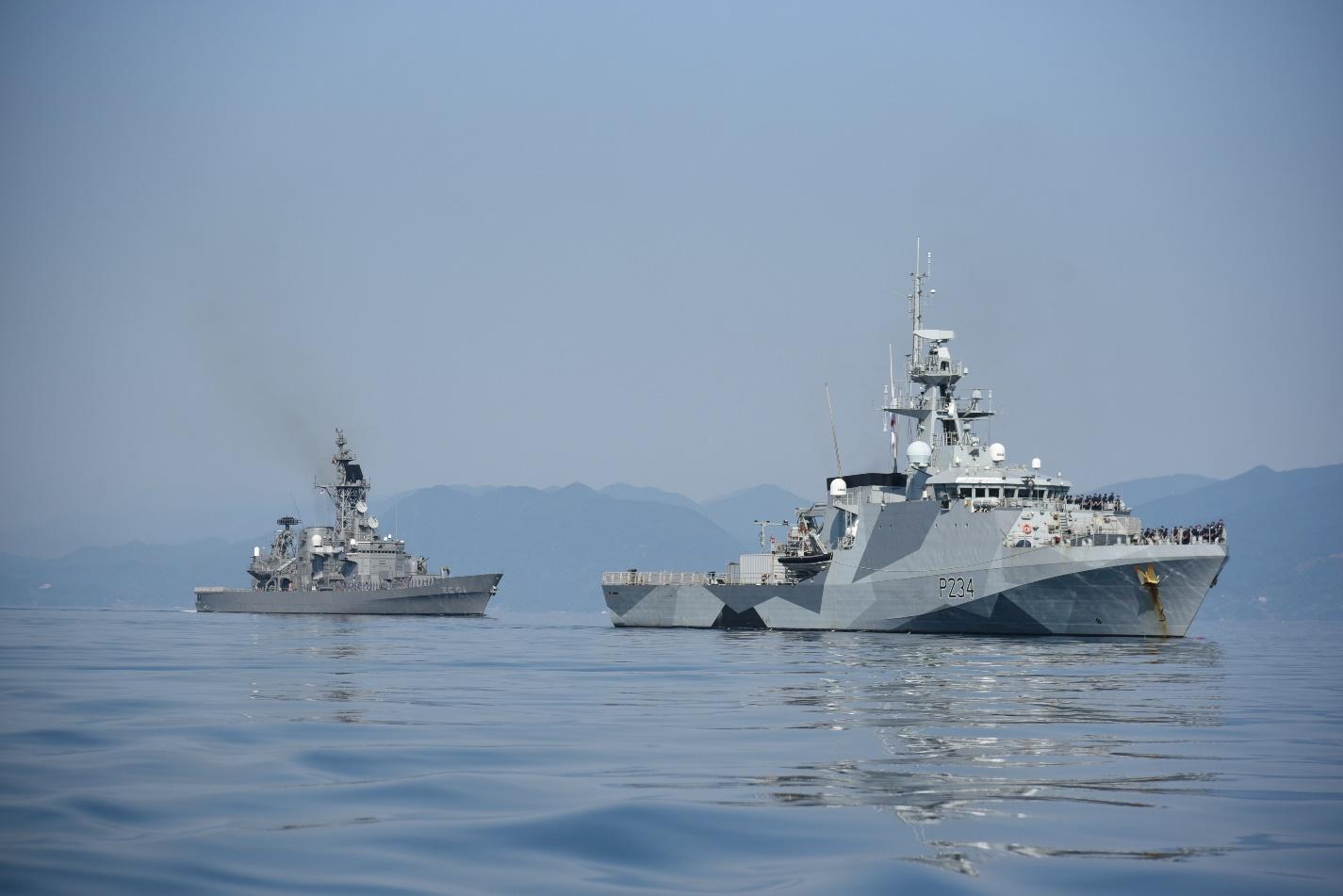
According to the Maritime Staff Office, the training was conducted on May 18, 2023, in Iyo-nada. The participating units were the JMSDF training ship "Shimakaze" and the Royal Navy patrol vessel "Spey." The training items included tactical maneuvers, communication training, and PHOTOEX, with the aim of improving the JMSDF's tactical skills and strengthening cooperation with the Royal Navy.
It is noteworthy that the training area was not in the open sea but in Iyo-nada. Iyo-nada is located in the western part of the Seto Inland Sea and is not unrelated to maritime traffic to Kure, Sasebo, the Bungo Channel, and the Kanmon area. For the JMSDF, it is a routine training area, and at the same time, it is a place to familiarize allied and friendly foreign vessels with the domestic coastal traffic environment. In my view, this is more of an exercise to maintain the ability to operate together rather than a "combat exercise."
The Value of HMS Spey Lies in Its Presence, Not Firepower
HMS Spey is a Batch 2 River-class patrol vessel, with public vessel data indicating a full load of about 2,000 tons, a length of 90.5 meters, a speed of 25 knots, a range of about 5,500 nautical miles, and armament primarily consisting of a 30mm gun. Compared to escort ships and destroyers, it is not a vessel tasked with high-intensity air and anti-submarine combat. This point should not be overestimated.
However, the significance of the UK deploying this type of patrol vessel to the Indo-Pacific lies elsewhere. In the maritime competition among great powers, it is not only aircraft carriers and destroyers that create deterrence. Vessels that can enter ports, conduct joint training, align communication procedures, and continue low-intensity missions including coastal security, surveillance, and disaster response strengthen the regional naval network. Spey is a vessel for that purpose.
The JMSDF's "Shimakaze" is also interesting. Originally commissioned in 1988 as a Hatakaze-class escort ship, it was reclassified as a training ship in 2021. It is an older missile escort ship with a length of about 150 meters and a standard displacement of about 4,600 tons, and it is no longer a front-line air defense ship. However, as a training ship, it is rather suitable for providing young officer candidates and crew members with experience in external joint training.
Japan-UK Cooperation Measured by Routine Training Rather Than Aircraft Carrier Visits
Japan-UK defense cooperation is often discussed under major headlines such as aircraft carrier strike groups, GCAP, and facilitation agreements. Of course, these are important. However, for practical navies, the more challenging aspects are the mundane details such as communication frequencies, English command, logistics, port procedures, and handling of surveillance information. The tactical maneuvers and communication training in Iyo-nada belong precisely to those mundane aspects.
While the Royal Navy has global mission objectives, it faces constraints in the number of surface combatants and maintenance capacity. The presence of River-class patrol vessels serves as a practical means to compensate for these constraints. From Japan's perspective, since the UK cannot always deploy aircraft carriers or destroyers, it is more rational to solidify the foundations of communication, identification, and joint navigation through regular training with smaller vessels.
This training does not directly name the Chinese Navy or North Korea. However, the expression "a free and open Indo-Pacific" in the maritime context indicates the need for countries protecting maritime trade routes to operate with the same maritime charts and communication procedures from peacetime. The fact that such training was conducted not only in the East China Sea, around Taiwan, and in the South China Sea, but also in waters close to the Seto Inland Sea signifies that Japan-UK cooperation is beginning to transition from expeditionary shows to part of domestic operations.
The Remaining Risk Is Not the Number of UK Vessels but the Speed of Acceptance by Japan
However, excessive expectations should be avoided. While River-class patrol vessels are useful, they cannot replace escort ships in the first island chain under missile saturation attacks. The true value of Japan-UK cooperation lies not in how many UK vessels arrive after a crisis occurs, but in how quickly Japan can accept friendly foreign vessels, share information, and manage logistics and repairs during peacetime.
The PHOTOEX in Iyo-nada is not the completed form of Japan-UK alliance cooperation. Rather, it is a preliminary but necessary step to incorporate the UK's small permanent vessels into Japan's maritime traffic environment.
A perspective that only pays attention when large vessels arrive overlooks this type of training. However, the practicalities of maritime deterrence often begin with such brief communication training. The real challenge lies not in the UK's willingness but in Japan's speed of integrating multinational vessels into routine operational environments.
Key Reference Materials
- Maritime Staff Office, May 19, 2026, "About Japan-UK Joint Training"
- Royal Navy HMS Spey / River-class Batch 2 Public Vessel Data
- JS Shimakaze / Hatakaze-class Public Vessel Data
JS Shimakaze and HMS Spey conducted a joint training exercise in Iyo-nada on May 18, 2026. The training focused on tactical movements and communication procedures to enhance operational capabilities and interoperability between the Japan Maritime Self-Defense Force and the Royal Navy. This exercise reflects the ongoing defense cooperation between Japan and the UK.
- Joint training exercise conducted on May 18, 2026, in Iyo-nada.
- Participants included JS Shimakaze and HMS Spey.
- Training focused on tactical movements and communication procedures.
- The exercise aimed to enhance operational capabilities and interoperability between Japan and the UK.
- The training area was significant for familiarizing allied vessels with local maritime conditions.