

Summary and Key Points: South Korea declared the KF-21 Boramae’s development phase complete in July 2026, and the numbers behind that announcement are the most impressive thing about the program. Korea Aerospace Industries built six prototypes and flew them on close to 1,600 sorties across 42 months of testing. According to Seoul, not one of them crashed, and not one had an accident. For a clean-sheet supersonic fighter — a category that has historically lost airframes and sometimes pilots during flight test — that is a remarkable record.
The KF-21 Fighter from South Korea Has Arrived
South Korea’s KF-21 Boramae (“Young Hawk”) is the newest South Korean supersonic fighter jet made by Korea Aerospace Industries (KAI).
By building systems like the KF-21, South Korea ensures it has an advanced warplane sourced locally to prevent disruptions to the country’s defense.
The Central Nervous System of the KF-21 Boramae
One of the systems that is indigenously produced is the Active Electronically Scanned Array (AESA) radar and the KF-21’s electronic warfare (EW) suite.
Boramae also makes advanced infrared targeting sensors domestically.
These systems are what make the KF-21 so effective in combat.
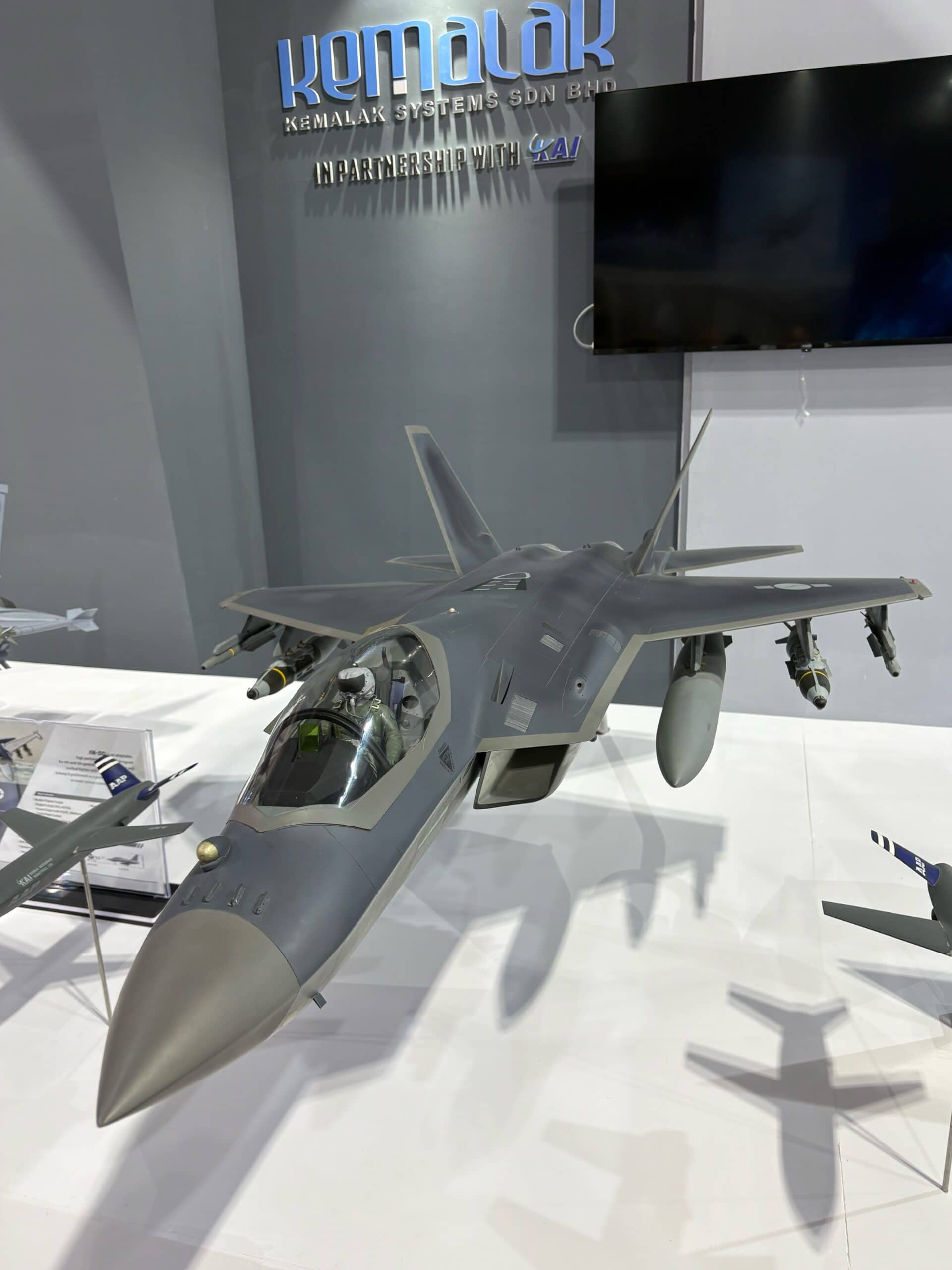
KF-21 Fighter Model. 19FortyFive Original Image.
They are among the most complex elements of the plane’s design.
By making these systems domestically produced, Seoul is ensuring that the KF-21’s central nervous system, its eyes, and its ears will remain potent elements of the plane–even if the country is attacked by its northern neighbor.
In keeping with its 4.5-generation designation, the plane has a radar-evading shape with swept-back wings.
Initial models carry weapons on external hardpoints rather than an internal weapons bay.
The Boramae can carry a large assortment of weapons.
But the lack of an internal bay reduces its stealth.
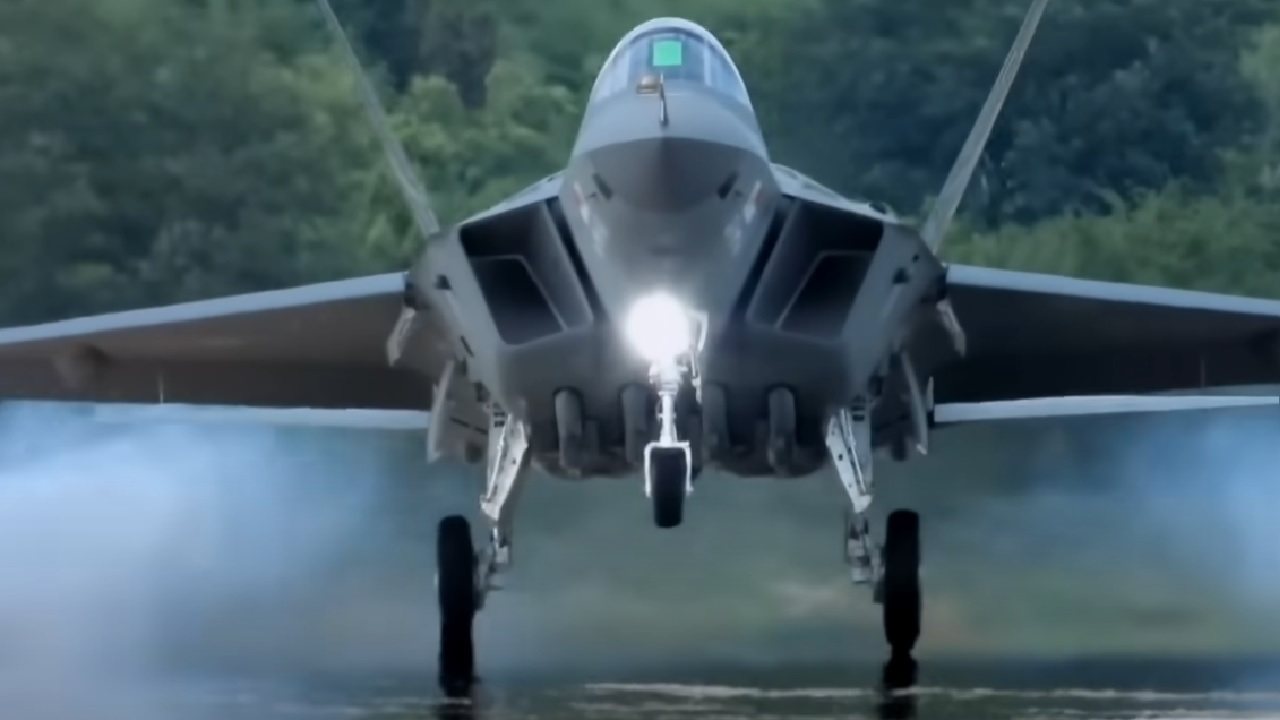
KF-21 screenshot from first flight. Image Credit: YouTube Screenshot.
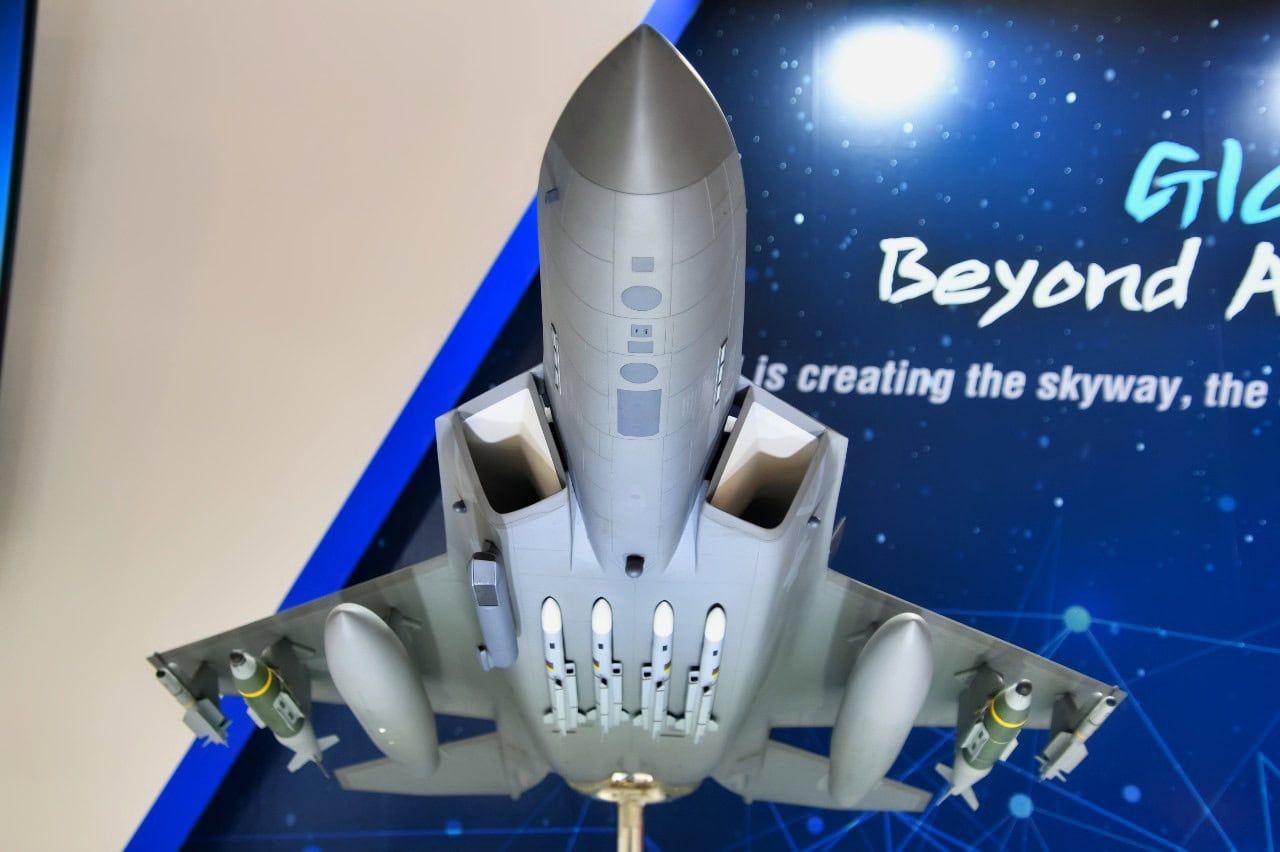
South Korea’s KF-21 Boramae is entering mass production, positioning KAI as a global defense leader. With Poland and other buyers interested, can it challenge the F-35 in export markets?
As a result, the plane is considered a 4.5-generation system. Its stealth is not as good as that of fully fifth-generation warplanes.
Still, the KF-21 is stealthier than a US Navy F/A-18 Super Hornet or a US Air Force F-16.
KF-21’s Arsenal Loadout Is Impressive
Speaking of weapons, the KF-21 will have a unique hybrid weapon loadout.
For instance, KF-21’s long-range interception mission will be made possible by the presence of the MBDA Meteor, which is one of the world’s best air-to-air missiles.
A European arms manufacturer makes it.
What’s more, the Meteor employs a solid-fueled ramjet motor, making it a highly lethal system.
And because the MBDA Meteor’s ramjet propels it beyond Mach 4, there is what’s known as a “No-Escape Zone” where a targeted aircraft cannot simply outmaneuver the missile.
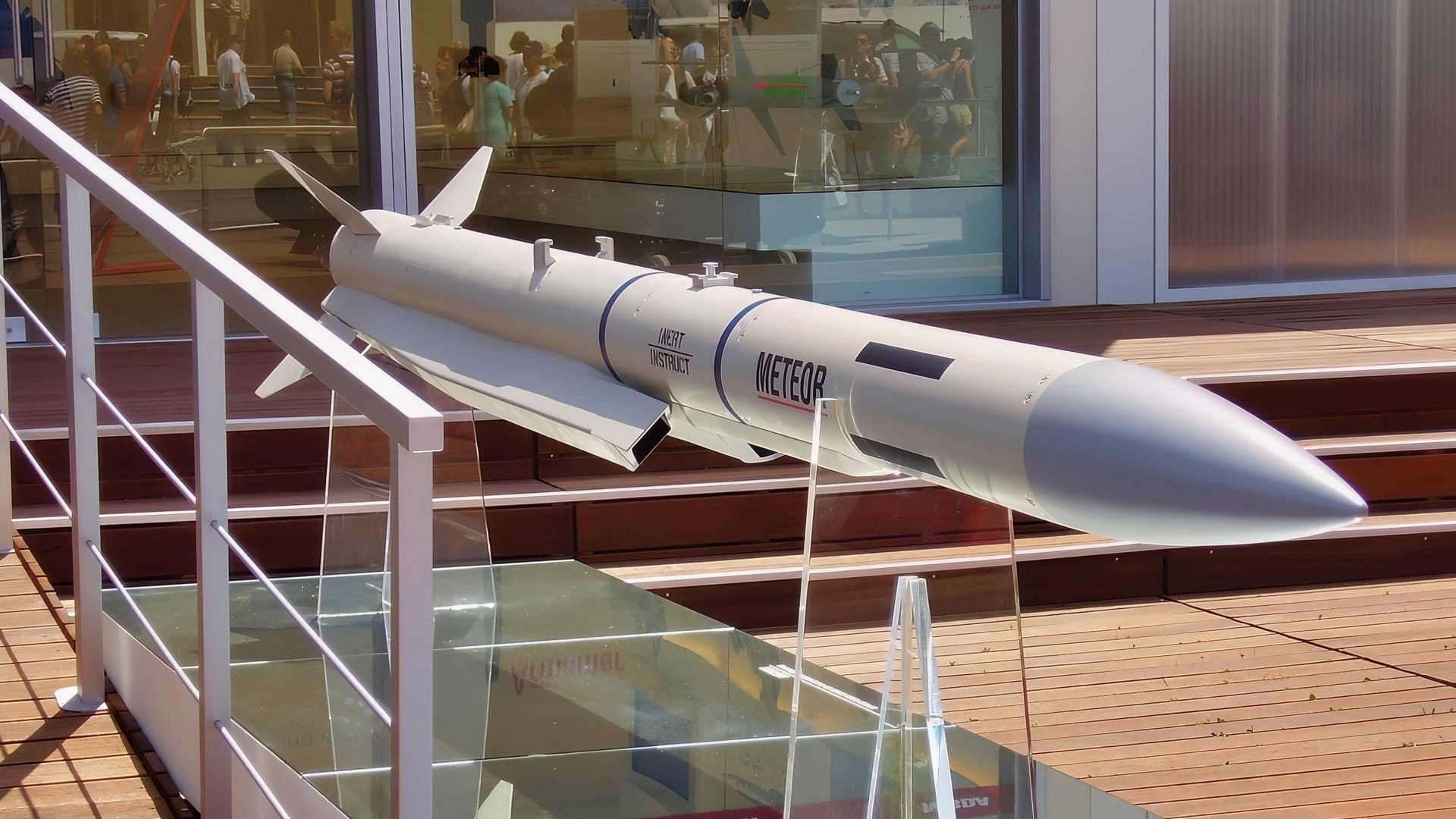
Meteor Missile. Creative Commons Photo.
That No-Escape Zone is as much as six times larger than that of other conventional missiles.
Germany’s IRIS-T (or South Korea’s AIM-2000) is used for dogfighting. The IRIS-T can track and engage targets performing extreme maneuvers.
It has thrust-vector control.
Thanks to the KF-21 pilot’s helmet-mounted display (HMD), the pilot of a KF-21 can lock on and destroy an enemy aircraft simply by looking at it.
As backups, South Korea maintains the AIM-120 AMRAAM (medium-range active radar guidance) and the AIM-9X Sidewinder, which is used for short-range heat-seeking attacks.
Nevertheless, Seoul’s commitment to indigenization is serious, and the country is working hard to eliminate any foreign supply-chain reliance for the weapons on the KF-21–that includes reliance on European systems, like the Meteor.
KAI and Hyundai Rotem are jointly developing an indigenous Meteor-like long-range air-to-air missile with a 124-mile range and Mach 4 speed.
What’s more, this home-grown KAI-Hyundai missile will employ an AESA radar seeker (Europe’s version of this missile lacks that component).
This domestically produced system will not reach maturation until 2033.
The Block II version of this plane will carry air-to-ground precision-guided munitions, like the MBDA SPEAR missile, a turbojet-powered precision-strike weapon designed to hit moving targets on land or at sea.
Block IIs will fire the German-Korean Taurus KPD 350 cruise missile while utilizing a 20mm M61A2 Vulcan rotary cannon loaded with 480 rounds for emergency strafing.
South Korea’s Need for the KF-21
KF-21s are powered by two licensed General Electric (GE) F414 jet engines.
That puts the engines in the same grouping as the engines used by the US Navy’s F/A-18 Super Hornet.
The KF-21 can achieve top speeds of up to Mach 1.97.
Seoul has added incentive to pursue this project because its F-4 and F-5 jet fleets are retiring and need replacement.
So, Block I of the new KF-21 is meant for air-to-air combat missions.
But the Block II version of the KF-21 will be made for air-to-ground strikes as well as maritime strike mission sets.
Block III of the KF-21 will have an internal weapons bay, making that variant a true fifth-generation stealth fighter.
In July of 2026, South Korea declared that the development phase of the KF-21 Boramae was over.
South Korea built six KF-21 prototypes and conducted nearly 1,600 sorties over 42 months to test the system in various scenarios.
According to South Korean government sources, the six prototypes had a spotless safety record, with no crashes or even accidents.
The Republic of Korea Air Force (ROKAF) is now taking delivery of the first tranche of mass-produced KF-21s to establish operational capability.
A contract calls for 40 Block I versions of the KF-21 to be deployed by 2028. Another 80 Block II versions will be procured, bringing the KF-21 Boramae fleet to about 120 units by 2032.
Export Woes?
Interestingly, Indonesia was slated to be the KF-21’s first export customer.
Jakarta was originally expected to contribute 20 percent of the costs as a co-development partner.
Still, it formally backed away from the program earlier this year after serious financial disputes with Seoul.
Jakarta now plans to procure a relatively small number of the KF-21s from South Korea.
Now, Seoul is marketing the KF-21 to potential buyers, like the Philippines.
Block I KF-21s will cost $83 million per plane while Block IIs will cost $112 million per plane.
That reflects the complex software integration, targeting suites, and EW capabilities required for precision-strike bombing.
South Korea’s current plan to supply Indonesia with 16 KF-21 units will cost $2 billion total.
The proposed Philippine deal of 12 to 20 KF-21s will cost around $1.5 billion.
Clearly, the South Koreans are deeply committed to indigenously producing their own warplane.
The KF-21 Boramae is the apotheosis of that push.
About the Author: Brandon J. Weichert
Brandon J. Weichert is the Senior National Security Editor at 19FortyFive.com. He also manages The Weichert Brief on Substack. Weichert also hosts “National Security Talk” on Rumble. He is the author of four bestselling national security books, the most recent of which is A Disaster of Our Own Making: How the West Lost Ukraine (Encounter Books). Follow him via Twitter/X @WeTheBrandon.