
Southern Theater Command Naval Aviation J-11B Reappears in Air Combat Training, 2026 Old Platform Still on the Frontline Indicates Production Capacity Account
 Li Minghui
Southern Theater Command Naval Aviation J-11B Reappears in Air Combat Training, 2026 Old Platform Still on the Frontline Indicates Production Capacity
On June 12, the English version of the China Military Network released a set of photos showing J-11B air combat training from a unit of the Southern Theater Command Naval Aviation. The images themselves are not explosive news: pilots first simulate the mission using models, and then take off in pairs or groups. What caught my attention is that the official media released photos of Z-20/Z-20T plateau training from the Tibet Military Region and long-distance maneuvers of the Army's Warrior armored vehicle on June 13 and 14. Viewing these three pieces of information together is more interesting than looking at an old heavy fighter jet alone.
J-11B Has Not Retired to the Second Line
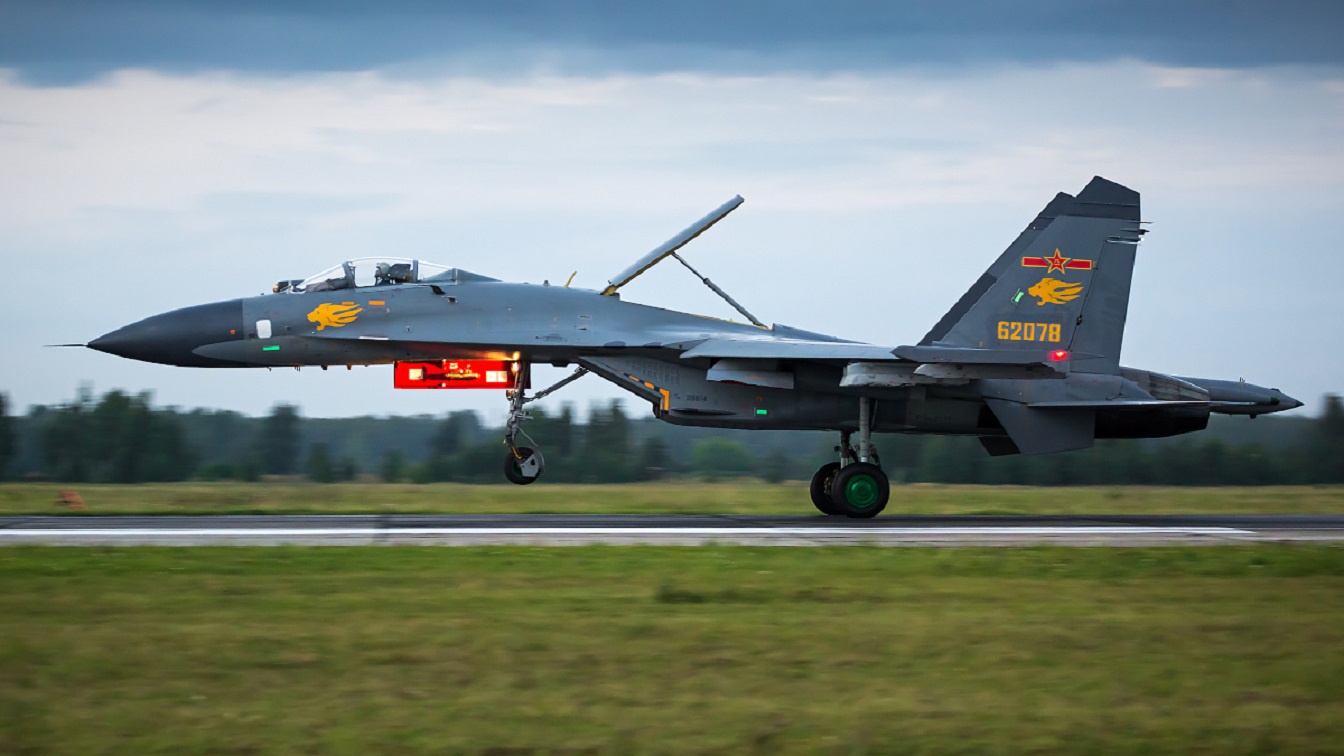
The J-11B is not a new aircraft; its lineage comes from the Su-27, but the airframe, avionics, and some power systems have been deeply localized. Public information usually categorizes it as a twin-engine heavy air superiority platform, with range and payload capacity superior to medium aircraft like the J-10, but its stealth, sensor fusion, and multi-role strike capabilities are clearly inferior to the J-16 and J-20. In simple terms, it is not the most advanced weapon of the PLA Air Force, but it is still a sufficiently long, heavy, and maturely maintained weapon.
If the Southern Theater Command Naval Aviation is still incorporating the J-11B into air combat training in 2026, it indicates at least two things. First, the daily combat readiness in the South China Sea is not solely reliant on a few new models; old platforms still undertake a large number of patrol, interception, training, and consumable flight tasks. Second, while the production capacity of the J-16, J-20, and even future carrier-based new aircraft is increasing, they will prioritize filling higher-value tasks and cannot cover all routine air situation management across all theaters.
South China Sea Needs Quantity Over Prototypes
The U.S. Department of Defense's 2025 China Military Power Report still lists the modernization of the PLA Air Force as a core trend, and CSIS has also reminded the public that China's official military expenditure figures underestimate actual defense investments. However, for the Southern Theater Command, budget growth ultimately boils down to a very simple question: how many sorties can be launched each day, and how many hours of air presence can be maintained around how many airports and islands?
- The J-11B is suitable for long-range patrol, accompanying alert, and training against, with advantages in range and mature support.
- The J-16 is more suitable for multi-role strikes, electronic suppression, and long-range precision munitions delivery, but has higher unit costs and mission loads.
- The J-20 is better suited for seizing key airspace and penetrating high-threat environments and should not be over-consumed by low-intensity interception tasks.
This is why the public appearance of old platforms does not equate to being outdated. A mature air force does not rely solely on the latest models to solve all problems. On the contrary, as it enters a high-intensity combat readiness phase, it needs to stratify the fleet according to mission: high-end models are reserved for critical nodes, while mature platforms fill daily duty and training hours.
Z-20T and Warrior Vehicles Complete Another Half of the Picture

The Z-20 and Z-20T plateau training images from June 13 should not be viewed in isolation. The Z-20 addresses the long-standing shortcomings of medium utility helicopters, while the Z-20T is more focused on assault and fire support. Plateau training means that engine power, rotor efficiency, and avionics reliability will be rigorously tested. The biggest shortcoming of the Chinese Army Aviation in the past was not the lack of helicopters, but the imbalance in the number, tonnage, and plateau adaptability of medium platforms.
The long-distance maneuver photos of the Warrior armored vehicle on June 14 highlight another keyword: theater training emphasizes cross-regional mobility. Vehicles, helicopters, and fighter jets may seem to belong to different military branches, but they all point to a common issue: the PLA is breaking down the "capable" metrics into more specific chains: can pilots simulate before taking off, can Army Aviation sustain operations in the plateau, and can ground forces arrive at assembly points on time?
The Real Shortcoming Still Lies in the Support Chain
I do not believe that a few sets of training photos can prove that the Southern Theater Command has formed a perfect system. There is too little public information to assess the scale of participation, sortie frequency, and failure rates. The continued activity of the J-11B may also indicate that the new generation of heavy aircraft has not yet reached numbers sufficient to completely replace old platforms. The appearance of the Z-20T in the plateau cannot directly lead to the conclusion of large-scale deployment either.
But the value of these photos lies precisely here: they reveal not a single product parameter, but how an army uses a combination of new and old equipment to fill the readiness ledger. The real unanswered question is whether the PLA can keep these old platforms, new helicopters, and ground mechanized forces continuously operational for two weeks if both the South China Sea and Taiwan Strait enter a high-pressure state simultaneously, rather than just completing a single impressive public display?
The Southern Theater Command Naval Aviation conducted air combat training with J-11B aircraft from June 12 to 14, 2023, in the South China Sea. Concurrently, Z-20 and Z-20T helicopters engaged in high-altitude training, while Mengshi armored vehicles performed long-distance maneuvers. This indicates a focus on operational readiness and the integration of older and newer military platforms.
- J-11B aircraft participated in air combat training exercises.
- Z-20 and Z-20T helicopters conducted high-altitude training.
- Mengshi armored vehicles were involved in long-distance maneuvers.
- The Southern Theater Command continues to utilize older aircraft alongside newer models.
- The report highlights the importance of maintaining operational readiness in the South China Sea.