
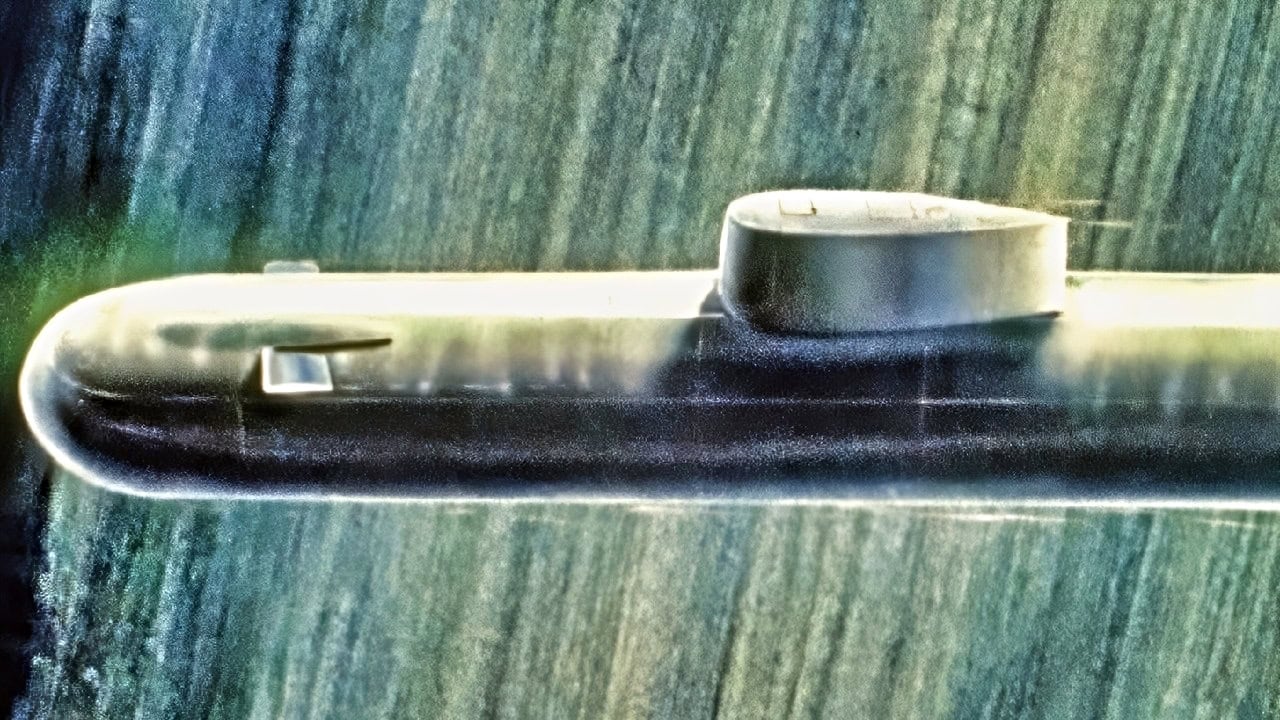
 Mike-Class K-278 Submarine
Summary and Key Points: Expert Brandon J. Weichert profiles K-278 Komsomolets, the Soviet Project 685 Plavnik submarine NATO called the Mike class: 361 feet, 8,000 tons, 30 knots, an OK-650 reactor, six 533 mm tubes for Shkval torpedoes, and a titanium hull that set the 1,020-meter combat-submarine depth record. A fire on April 7, 1989, sank it in the Norwegian Sea at 1,680 meters with two nuclear torpedoes, killing 42; Norwegian sampling found elevated cesium at the wreck in 2019.
The Soviet Navy Had a Titanium Submarine the US Navy Can’t Match
The Soviet Navy built an impressive lineup of submarines to counter those of its NATO rivals, notably the United States Navy. Soviet engineers weren’t just interested in countering the Americans, though.
They often thought of — and even built — systems they believed could outpace the Americans technologically. One such system was the K-278 Komsomolets, a nuclear-powered attack submarine with a titanium pressure hull, designed to operate at depths that would crush most other military submarines.
Mike-Class: A Submarine By Many Names Throughout Military History and Naval History
NATO knew it as the Mike-class submarine, while the USSR designated the K-278 as Project 685 Plavnik.
So the submarine had three names: two in the Soviet Union and one in NATO. “Project 685” was the Soviet design designation, while Plavnik was the Soviet project’s codename, and Komsomolets was the submarine’s individual name. NATO then assigned the new design the Mike-class designation.
Only one unit of this submarine class was ever built.
That’s because the Komsomolets sank in the Norwegian Sea after a massive onboard fire on April 7, 1989. Forty-two Soviet sailors perished, and the submarine was lost while carrying two nuclear-armed torpedoes. The submarine wreck continues to intrigue historians and oceanographers alike.
A Record-Setting Sub
Soviet engineers designed the Komsomolets to operate at unprecedented depths. The Rubin Central Design Bureau built the submarine at the famous Sevmash shipyard in Severodvinsk, and the Soviet Navy put it into operational service in 1983. Its defining feature was the aforementioned pressure hull, made from titanium alloy rather than conventional submarine steel.
Titanium gave the submarine high strength and relatively low weight that, combined with a hull capable of surviving significant underwater pressures, let it dive deeper than any NATO submarine. However, titanium had its disadvantages. It was both expensive and hard to produce. Welding large titanium structures also required specialized equipment under carefully controlled conditions.
The Crazy Ivan
But the Soviets needed a submarine that could dive deeper than American submarines.
By going deeper than any known US or NATO submarine could, the Soviets gave the Komsomolets a significant capability, especially given how often the “Crazy Ivan” maneuvers were at that point in the Cold War.
Basically, hull-mounted box sonars couldn’t hear directly behind the submarine because of the noise internal machinery creates. That means a blind spot formed (known in naval parlance as “baffles”). So, Soviet submarines would execute a sudden, hard turn (90 to 100 degrees). The sudden turn swings the sonar beam around to scan the blind spot, potentially detecting whether an enemy submarine or ship is trailing the submarine.
This maneuver, however, created a high risk of collision. Unpredictable turns at depth could lead to a collision with the enemy submarine. By having a submarine like the Komsomolets that could dive deeper, Soviet submarines could avoid these problems entirely, since American submarines could not match their depth. It was a real tactical game-changer.
The Specs
The K-278 Komsomolets measured about 361 feet long and had a submerged displacement of about 8,000 tons. The submarine could chug along at 30 knots, with an operational depth of around 800 meters (2,625 feet). But it could reach 1,020 meters (3,346 feet). To be clear, that 1,020-meter depth set the world record for a combat submarine.
The submarine was powered by one nuclear reactor, steam turbines, and a single propeller. It had six 533 mm torpedo tubes and a torpedo capacity of around 22 weapons. The Komsomolets was compatible with specialized weapons, including the rocket-powered VA-111 Shkval supercavitating torpedo. The Shkval was another unusual Soviet underwater weapon. It did not move through water like a conventional torpedo; it used rocket propulsion and a gas cavity surrounding much of the weapon to reduce drag, permitting exceptionally high underwater speeds.
And the K-278, as noted above, carried two nuclear-armed torpedoes when it sank. After the disaster, the submarine’s nuclear reactor became the focus of environmental monitoring.
Unlike the Soviet Project 705 Alfa-class submarines, which used liquid-metal-cooled nuclear reactors, the Komsomolets relied on a comparatively conventional pressurized-water reactor. Its OK-650-series nuclear propulsion system generated heat to produce steam, which drove turbines connected to a single propeller shaft. The submarine’s approximately 30-knot maximum submerged speed was impressive but not exceptional among Cold War nuclear attack submarines.
The Day of the Disaster
But on the day of the disaster, the Komsomolets was returning from an operational patrol when a fire erupted in its aft compartments. The submarine was traveling beneath the Norwegian Sea when electrical problems preceded the fire. Investigations identified an electrical malfunction and the ignition of combustible materials as possible causes.
That fire spread rapidly, affecting multiple systems.
Captain First Rank Yevgeny Vanin then ordered the submarine to surface. Meanwhile, damage to onboard systems compromised the submarine’s ability to remain afloat.
Hours after surfacing, the submarine began sinking. The crew tried to abandon ship. But the frozen Norwegian Sea was unforgiving. Many sailors entered the water without adequate thermal protection. The Soviet crew then tried to utilize an emergency escape capsule that separated from the sinking submarine. Only one occupant survived its ascent and emergence.
The submarine carried a sixty-man crew. Forty-two perished as a result of the accident. Komsomolets returned to the sea, settling on the seabed about 1,680 meters below the surface, even deeper than its extraordinary operational diving capability.
A Slowly Ticking Nuclear Time Bomb in Mike-Class Submarine for Russian Navy?
Then came the environmental concerns. The submarine is so deep that its hull might be compromised, and it carries two nuclear warheads and a nuclear reactor. Russian and Norwegian investigations examined the risk of radioactive material escaping into the surrounding marine environment. Russian expeditions inspected the wreck and took measures to reduce radiation exposure risks.
A Norwegian inspection team found elevated levels of radioactive cesium in samples collected from the submarine wreck in 2019.
The submarine remains on the Norwegian Sea Floor, where its deteriorating structure and radioactive inventory necessitate continuous monitoring.
What started as a revolutionary submarine system created by the Soviet Union quickly devolved into a slow-running, ticking potential nuclear time bomb off the coast of Norway.
About the Author: Brandon J. Weichert
Brandon J. Weichert is the Senior National Security Editor at 19FortyFive.com. He also manages The Weichert Brief on Substack. Weichert also hosts “National Security Talk” on Rumble. He is the author of four bestselling national security books, most recently A Disaster of Our Own Making: How the West Lost Ukraine (Encounter Books). Follow him via Twitter/X @WeTheBrandon.