
Su-57 Crashed in the Moscow Region in 2026 — Accident Affects Small Series
 Dmitri Volkov
Su-57 Crashed in the Moscow Region in 2026 — Accident Hits Small Series
The most unpleasant detail in the report of the Su-57 crash near Moscow is not that the pilot, according to preliminary data, managed to eject. This, on the contrary, is the only good news. The unpleasant part is that the aircraft, which Russian propaganda has presented for many years as a symbol of technological parity with the American F-22 and F-35, has once again found itself not on the front lines, not in a complex combat episode, but in a routine, almost laboratory situation of a training flight. For a mature aviation program, an accident during takeoff is a serious but statistically understandable occurrence. For a low-rate program, where each aircraft simultaneously serves as a combat unit, a test stand, and an export showcase, this is already a political-industrial symptom.
What is Known About the Crash Near Moscow
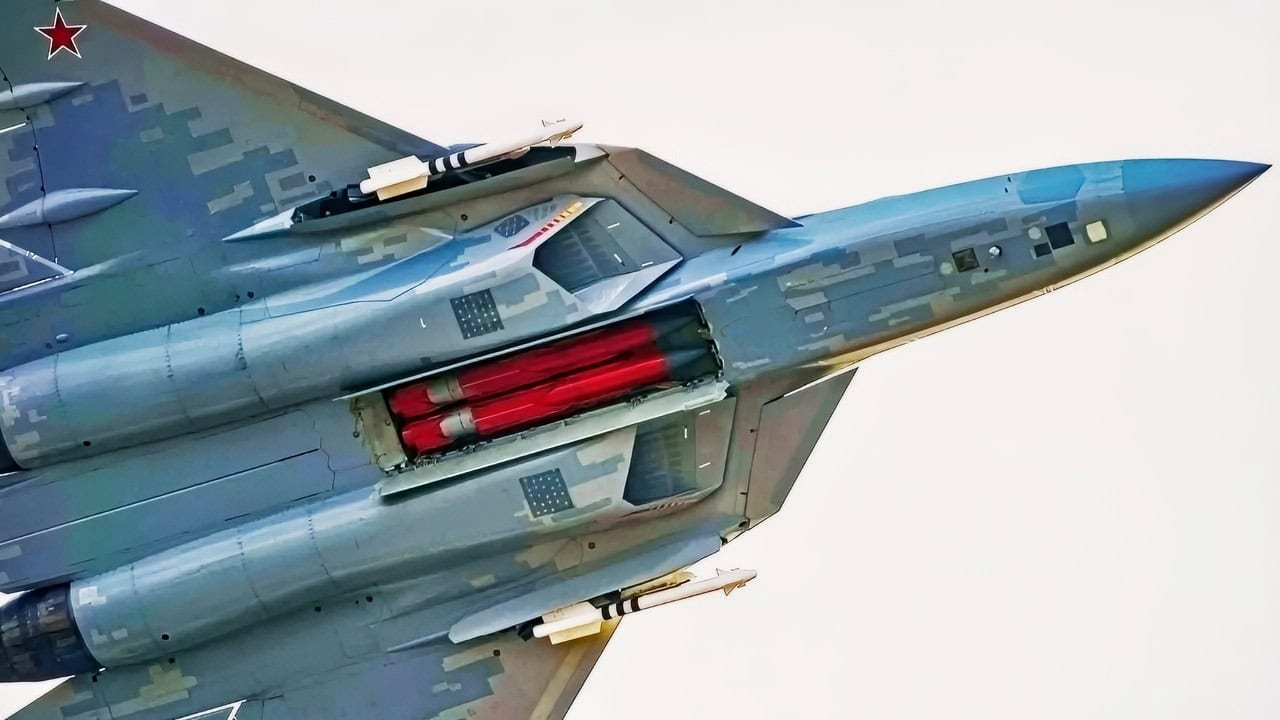
According to reports from Ukrainian and Russian media citing TASS, on July 23, 2026, a Russian Su-57 crashed in the Moscow region during a training flight. It is noted that the aircraft fell during takeoff in a remote area, with no destruction recorded on the ground, and the pilot ejected. The Kyiv Independent published a report at 12:11 GMT, and several Ukrainian publications — NV, UNN, RBC-Ukraine — almost simultaneously recounted the same story: it is indeed about the Su-57, not the more numerous Su-30SM or Su-35S. Formally, this is not yet a full technical report, and the cause of the accident cannot be deduced from journalistic formulations. But for analysis, the very fact is important: the fifth generation of the Russian Aerospace Forces continues to be a program with an extremely small fleet and a high symbolic cost for each incident.
The Su-57 was created as a multi-role fifth-generation fighter with a stealthy design, internal weapon bays, an onboard radar from the N036 family, and the capability to use air-to-air and air-to-ground missiles from internal compartments. Serial machines flew for a long time with AL-41F1 engines, while the second-stage engine remained a separate story of promises and delays. The contract for 76 aircraft by 2028 was presented by the Kremlin back in 2019 as a sharp turn from a prototype batch to a real series (The Diplomat, May 2019). However, the production of the Su-57 did not become a Soviet conveyor like the MiG-21 and did not even approach the late Soviet pace of the Su-27. It is a bespoke assembly of an expensive machine under conditions of sanctions, limited access to electronics, and constant competition for resources with simpler but immediately needed systems for the front.
Why One Accident Has Disproportionate Weight
In normal aviation statistics, the loss of one aircraft does not equal the failure of a program. Americans lost F-22s, the Chinese had problems with early series of J-20s, and the Soviet school generally considered test accidents almost an inevitable cost of speed. But the Su-57 is in a different position. Its fleet is small, the transparency of deliveries is low, and its combat role in the war against Ukraine remains cautious: Russia uses the aircraft primarily as a carrier of long-range weapons outside the dense zone of Ukrainian air defense, rather than as a fighter for air superiority. This is rational in terms of preserving a scarce asset, but it poorly aligns with the official language about the "unmatched" fighter. The Soviet formula was simpler: if the technology is good, there are many of them; if there are few, then one must explain why it still determines the outcome of the war. The second explanation always sounds weaker.
There is also a production aspect. If a country has hundreds of identical aircraft, an accident is a blow to flight safety. If it has several dozen machines, some of which are undergoing testing, crew training, and weapon refinement, an accident becomes a blow to the retraining schedule, the availability of instructors, the supply of spare parts, and customer trust. Accidents during takeoff are particularly painful: they often indicate either a powerplant failure, a control error, a training problem, or a combination of factors. Without an official investigation, this is just a framework of possible causes, but each of them is unpleasant for a program that Moscow sells as a mature product.
From Akhtubinsk to the Moscow Region
The crash near Moscow is not the first blow to the reputation of the Su-57 in recent years. In June 2024, the Main Intelligence Directorate of Ukraine reported the defeat of a Su-57 at the Akhtubinsk airfield; later, this episode was analyzed by RUSI, Al Jazeera, TWZ, and other sources. At that time, not only the damage itself was important, but also the distance: Ukrainian drones demonstrated that even deep in the rear, rare aircraft require expensive protection on the ground. Now the problem looks different: the aircraft suffers not from a Ukrainian drone, but from its own operational environment. For Russian aviation, this is worse in a propaganda sense. The enemy can be declared treacherous. The own maintenance system — no, although it is often what determines the fate of complex machines.
This reveals an old Russian institutional disease: a piece of technology is presented as proof of strategic power before a culture of mass operation is formed. In the USSR, this contradiction was mitigated by a vast industrial base, a network of design bureaus, testing centers, and repair plants. In today's Russia, it is compensated mainly by data secrecy and television confidence. But a fifth-generation aircraft is a poor object for such compensation. It requires expensive coatings, precise electronics, regular diagnostics, stable cooperation with suppliers, and a large flight time for pilots. One cannot simultaneously treat it as a museum exhibit, an export poster, and a workhorse of war.
Military-Political Effect
From an operational point of view, the crash of one Su-57 will not change the course of the war in Ukraine. Russian strikes on Ukrainian cities and infrastructure are primarily carried out by drones of the Shahed family, ballistic and cruise missiles, and Su-34 and Su-35S aircraft, rather than regular raids by Su-57s over the front line. But the strategic effect is different: Moscow loses part of the argument about the technological inevitability of its superiority. In export markets, especially in India and the Middle East, buyers look not only at range and advertised radar characteristics. They look at the pace of deliveries, accident rates, the availability of the second-stage engine, combat experience, and the manufacturer's ability to support the fleet for twenty years. In this sense, every report about the Su-57 works like financial reporting without accounting tables.
The Su-57 is not failing due to one accident. It is failing the Kremlin's habit of presenting a limited series as a full-fledged weapon system.
My cautious prediction is as follows: Russia will maintain the Su-57 program because politically it is impossible to abandon it, and technologically it is too humiliating. But by 2028, the question will not be whether 76 machines are formally built, but how many of them are actually combat-ready, with what engine, with what armament set, and with what average flight time. If the accident in the Moscow region remains a singular episode, it will be attributed to technology or piloting. If it becomes part of a series of operational problems, the Su-57 will ultimately transform from a fifth-generation fighter into an expensive proof that the Russian defense industry can create symbols faster than systems.
Sources
- The Kyiv Independent, July 23, 2026 — report on the Su-57 crash in the Moscow region.
- TASS, July 23, 2026 — initial Russian report, recounted by international and Ukrainian publications.
- The Diplomat, May 2019 — data on the contract for 76 Su-57s by 2028.
- RUSI and Al Jazeera, June 2024 — analysis of the defeat of the Su-57 at the Akhtubinsk airfield.
A Su-57 aircraft of the Russian Air Force crashed in Moscow Oblast during a training flight on July 23, 2026. The pilot ejected safely, and the crash occurred during takeoff in a remote area, with no reported damage on the ground. This incident highlights ongoing concerns regarding the operational reliability of the Su-57 program, which has faced challenges in production and deployment.
- A Su-57 aircraft crashed in Moscow Oblast during a training flight on July 23, 2026.
- The pilot successfully ejected from the aircraft before the crash.
- The incident occurred during takeoff in a remote area with no ground damage reported.
- This crash raises concerns about the operational reliability of the Su-57 program.
- The Su-57 is a fifth-generation fighter jet that has faced scrutiny regarding its production and deployment.